Who was Zaham in the bible?
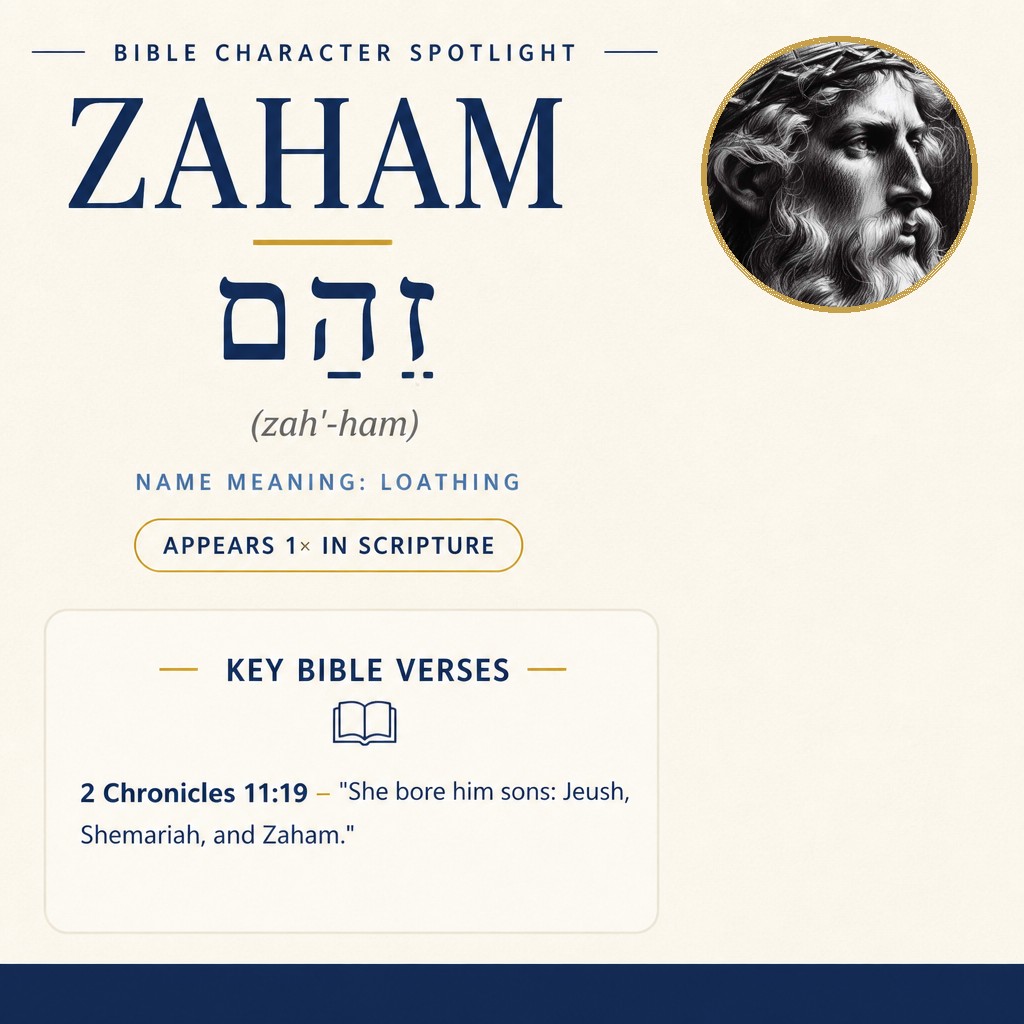
Zaham is named as one of the sons born to Rehoboam’s wife Mahalath in 2 Chronicles 11:19.

Biblical Setting
Zaham appears in the account of Rehoboam strengthening the kingdom of Judah. “So they strengthened the kingdom of Judah, and made Rehoboam… strong” (2 Chronicles 11:17).
Learn More →Name Meaning
A lexicon gloss identifies Zaham as an Israelite and connects the name to “loathing,” from a root sense “to be rancid” (Strong’s H2093).
Learn More →Zaham is named as an Israelite in the Bible, appearing in a list of sons born within the household of Rehoboam king of Judah. His name is associated (by lexicon derivation) with the idea of loathing, connected to a Hebrew root meaning “to be rancid” and, by extension, “to loathe.”
Zaham in Scripture
Zaham appears once, in a brief genealogical notice set within a narrative about the early strengthening of Rehoboam’s kingdom of Judah and the king’s family.
“So they strengthened the kingdom of Judah, and made Rehoboam the son of Solomon strong for three years; for they walked three years in the way of David and Solomon.” (2 Chronicles 11:17, WEB)
Within this setting, the text turns to Rehoboam’s marriages and children, first identifying a wife and her lineage:
“Rehoboam took a wife for himself, Mahalath the daughter of Jerimoth the son of David and of Abihail the daughter of Eliab the son of Jesse.” (2 Chronicles 11:18, WEB)
Zaham is then named among the sons Mahalath bore:
“She bore him sons: Jeush, Shemariah, and Zaham.” (2 Chronicles 11:19, WEB)
The same passage continues by noting another marriage and additional children, placing Zaham within a broader list of Rehoboam’s offspring:
“After her, he took Maacah the daughter of Absalom; and she bore him Abijah, Attai, Ziza, and Shelomith.” (2 Chronicles 11:20, WEB)
“Rehoboam loved Maacah the daughter of Absalom above all his wives and his concubines; for he took eighteen wives and sixty concubines, and became the father of twenty-eight sons and sixty daughters.” (2 Chronicles 11:21, WEB)
Finally, the chapter’s immediate narrative emphasis shifts to Rehoboam’s appointment of a particular son as chief among his brothers:
“Rehoboam appointed Abijah the son of Maacah to be chief, the prince among his brothers; for he intended to make him king.” (2 Chronicles 11:22, WEB)
Within this flow of the chapter, Zaham is presented simply as one of Rehoboam’s sons, named alongside his brothers Jeush and Shemariah as children borne by Mahalath (2 Chronicles 11:18–19). The surrounding context frames these notices as part of how Judah was strengthened and how Rehoboam’s household was established and ordered (2 Chronicles 11:17–22).
Name and Meaning
The name is written in Hebrew script as זַהַם, transliterated Zaham, and pronounced zah’-ham. By lexicon derivation, it is connected to Strong’s H2092, with an underlying component verb (זָהַם, zaham) meaning “to be rancid,” and, in an extended sense, “to loathe”; accordingly, the name is associated with the idea of “loathing.”
Observation
Zaham’s brief mention—“She bore him sons: Jeush, Shemariah, and Zaham” (2 Chronicles 11:19)—functions within 2 Chronicles 11 as part of a larger account that links Judah’s strengthening (2 Chronicles 11:17) with the naming and ordering of Rehoboam’s family (2 Chronicles 11:18–22).
Frequently Asked Questions
What does the name Zaham mean?
Zaham means “loathing.”
How many times does Zaham appear in the Bible?
Zaham appears 1 time.
Who was Zaham?
Zaham is identified as an Israelite.
Where is Zaham mentioned in the Bible?
Zaham is mentioned in 2 Chronicles 11:19.
Explore Further
If you found this page about Zaham interesting and would like to discover more about other biblical characters, explore our comprehensive Encyclopedia of Biblical Characters. For those looking to delve deeper into the Greek origins of these names and terms, our Greek Lexicon is an invaluable resource.
Sources: Name and occurrence data from Strong’s Exhaustive Concordance and STEPBible reference data (CC BY). Scripture quotations from the World English Bible (public domain).