
Who was Zalaph in the bible?
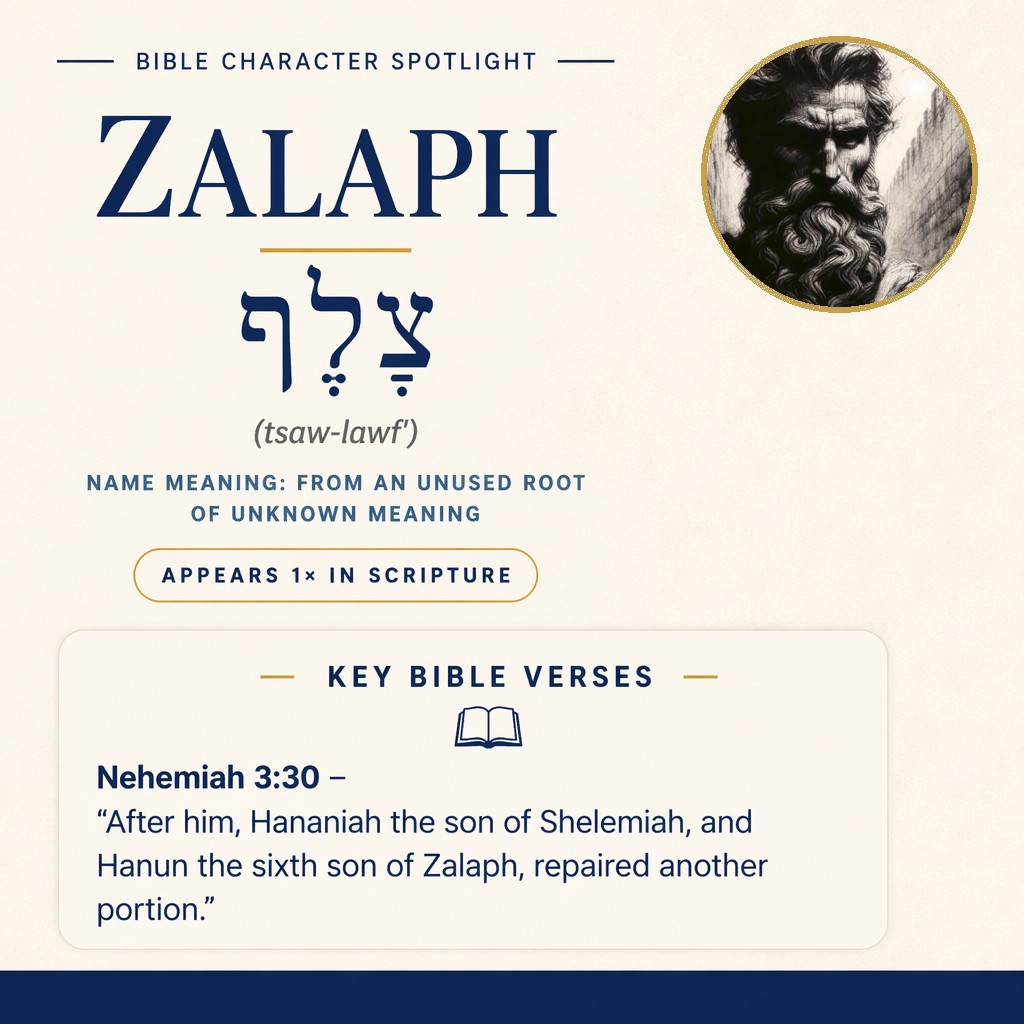
Zalaph is named in Nehemiah 3:30 as the father of Hanun, who helped repair Jerusalem’s wall.

Where Mentioned
He appears in a wall-repair list: “Hanun the sixth son of Zalaph, repaired another portion” (Nehemiah 3:30, WEB).
Learn More →Name Details
The Hebrew form is צָלָף (Tsalaph) (Strong’s H6764). Strong’s derives it “from an unused root of unknown meaning.”
Learn More →Zalaph (Hebrew צָלָף, Tsalaph) is identified in the lexicon as an Israelite, appearing in Scripture as the named father of Hanun, one of the repairers in Nehemiah’s account of rebuilding work.
Zalaph in Scripture
Zalaph is mentioned once, within a list describing sequential repair assignments. In that setting, his son is identified with a specific designation and task.
Nehemiah 3:30: “After him, Hananiah the son of Shelemiah, and Hanun the sixth son of Zalaph, repaired another portion. After him, Meshullam the son of Berechiah made repairs across from his room.”
In Nehemiah 3, the account proceeds section by section (“After him… After him…”) to describe who repaired particular areas. Zalaph himself is not described performing repairs; rather, he is used to identify Hanun: “Hanun the sixth son of Zalaph.” In the same verse, Hanun’s work is summarized briefly: he, together with “Hananiah the son of Shelemiah,” “repaired another portion.” The narrative then moves immediately to the next assignment: “After him, Meshullam the son of Berechiah made repairs across from his room.”
The surrounding context situates Zalaph’s mention among repairs made by priests, gate-keepers, and other named individuals, with work often described relative to specific locations (“across from his own house,” “the east gate,” “the gate of Hammiphkad,” “the sheep gate”).
Nehemiah 3:28: “Above the horse gate, the priests made repairs, everyone across from his own house.”
This nearby statement shows that at least some repairs were organized by proximity to the workers’ homes (“everyone across from his own house”), and it names “the horse gate” as a reference point. The list continues by naming another worker and his reference point.
Nehemiah 3:29: “After them, Zadok the son of Immer made repairs across from his own house. After him, Shemaiah the son of Shecaniah, the keeper of the east gate made repairs.”
Here the text keeps the same pattern: a named individual is introduced with lineage (“Zadok the son of Immer”), and the repair location is described (“across from his own house”). Another is introduced with both lineage and role: “Shemaiah the son of Shecaniah, the keeper of the east gate.” Immediately after this comes the only mention of Zalaph, where Hanun is identified as “the sixth son of Zalaph” and is paired with Hananiah for a repair assignment.
After Hanun’s portion is recorded, the narrative continues without pause to other trades and locations.
Nehemiah 3:31: “After him, Malchijah, one of the goldsmiths to the house of the temple servants, and of the merchants, made repairs opposite the gate of Hammiphkad, and to the ascent of the corner.”
Nehemiah 3:32: “Between the ascent of the corner and the sheep gate, the goldsmiths and the merchants made repairs.”
These lines show the same chapter-level approach: the work is recorded in sequence, with some workers identified by occupation (“one of the goldsmiths,” “the merchants”), and repair zones marked by gates and landmarks (“the gate of Hammiphkad,” “the ascent of the corner,” “the sheep gate”). Zalaph’s role in the narrative is therefore indirect: his name appears to specify which Hanun is meant, distinguishing him as “the sixth son of Zalaph” among the individuals involved in the repair list.
Name and Meaning
The name is written in Hebrew as צָלָף, transliterated Tsalaph and pronounced tsaw-lawf’. Strong’s derives it “from an unused root of unknown meaning,” and the lexicon gloss identifies Tsalaph as an Israelite.
Observation
Within Nehemiah’s record of coordinated repairs—moving “After him” from one worker to the next—Zalaph is remembered through the identification of his son: “Hanun the sixth son of Zalaph.”
Frequently Asked Questions
What does the name Zalaph mean?
Zalaph (Tsalaph) is given as the name of an Israelite.
How many times does Zalaph appear in the Bible?
Zalaph appears 1 time.
Who was Zalaph?
Zalaph is identified as an Israelite. He is mentioned as the father of Hanun in Nehemiah 3:30.
What is Zalaph connected to in Nehemiah 3:30?
Nehemiah 3:30 mentions “Hanun the sixth son of Zalaph” repairing another portion (Nehemiah 3:30).
Explore Further
If you found this page about Zalaph interesting and would like to discover more about other biblical characters, explore our comprehensive Encyclopedia of Biblical Characters. For those looking to delve deeper into the Greek origins of these names and terms, our Greek Lexicon is an invaluable resource.
Sources: Name and occurrence data from Strong’s Exhaustive Concordance and STEPBible reference data (CC BY). Scripture quotations from the World English Bible (public domain).





