Who was Zabud in the bible?
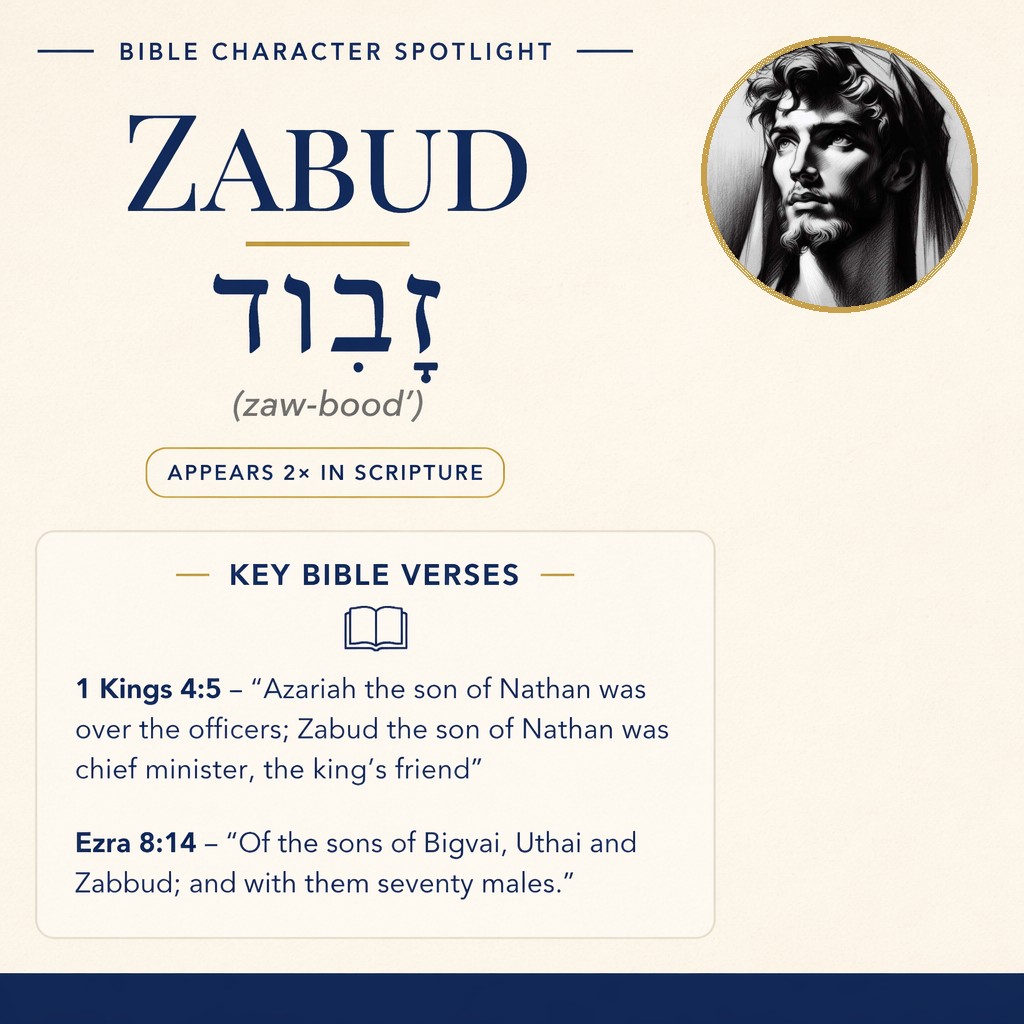
Zabud (also spelled Zabbud) is the name of two Israelites: one in Solomon’s administration (1 Kings 4:5) and one listed among the sons of Bigvai (Ezra 8:14).

Another Zabud
In Ezra’s list, “Of the sons of Bigvai, Uthai and Zabbud; and with them seventy males” (Ezra 8:14).
Learn More →Name Meaning
Strong’s gloss connects the name with the sense “given,” and relates it to a root meaning “to confer.”
Learn More →Zabud is the name of two Israelites mentioned in Scripture: one is identified as “chief minister, the king’s friend” in Solomon’s administration, and another appears in a list of returning families with Ezra. The name is explained in lexicon material as meaning “given,” derived from a Hebrew verb sense “to confer.”
Zabud in Scripture
The first bearer of the name appears in a summary of Solomon’s officials. In the immediate context, the chapter lists several named roles in the royal administration—scribes, recorder, military leadership, and priests—before naming Zabud and other household officers.
“Elihoreph and Ahijah, the sons of Shisha, scribes; Jehoshaphat the son of Ahilud, the recorder;” (1 Kings 4:3)
“Benaiah the son of Jehoiada was over the army; Zadok and Abiathar were priests;” (1 Kings 4:4)
Within this administrative list, Zabud is identified by parentage and office, and his relationship to the king is described with a specific court title.
“Azariah the son of Nathan was over the officers; Zabud the son of Nathan was chief minister, the king’s friend;” (1 Kings 4:5)
The passage continues by naming additional roles connected to royal oversight and labor organization.
“Ahishar was over the household; and Adoniram the son of Abda was over the men subject to forced labor.” (1 Kings 4:6)
It then frames the broader system of provisioning for the king and his household, setting Zabud’s mention within a larger administrative arrangement that included regional officers.
“Solomon had twelve officers over all Israel, who provided food for the king and his household. Each man had to make provision for a month in the year.” (1 Kings 4:7)
“These are their names: Ben Hur, in the hill country of Ephraim;” (1 Kings 4:8)
The second bearer appears in Ezra’s listing of those gathered for travel, presented by family groups (“sons of …”) and accompanied by counts of males. In the immediate sequence, Ezra names groups from Azgad and Adonikam before naming the group in which Zabbud (a form of Zabud) appears.
“Of the sons of Azgad, Johanan the son of Hakkatan; and with him one hundred ten males.” (Ezra 8:12)
“Of the sons of Adonikam, who were the last; and these are their names: Eliphelet, Jeuel, and Shemaiah; and with them sixty males.” (Ezra 8:13)
“Of the sons of Bigvai, Uthai and Zabbud; and with them seventy males.” (Ezra 8:14)
The narrative then describes Ezra’s gathering point and initial review of the assembled company, including priests, and his discovery about the absence of a particular group among those present.
“I gathered them together to the river that runs to Ahava; and there we encamped three days: and I looked around at the people and the priests, and found there were none of the sons of Levi.” (Ezra 8:15)
In response, Ezra reports sending for a set of named leaders and teachers, indicating organized steps taken to address what he found.
“Then sent I for Eliezer, for Ariel, for Shemaiah, for Elnathan, for Jarib, for Elnathan, for Nathan, for Zechariah, and for Meshullam, chief men; also for Joiarib and for Elnathan, who were teachers.” (Ezra 8:16)
“I sent them out to Iddo the chief at the place Casiphia; and I told them what they should tell Iddo, and his brothers the temple servants, at the place Casiphia, that they should bring to us ministers for the house of our God.” (Ezra 8:17)
Two People Named Zabud
Zabud son of Nathan (1 Kings). This Zabud is explicitly named with parentage and appointment: “Zabud the son of Nathan was chief minister, the king’s friend” (1 Kings 4:5). His mention occurs amid a structured list of Solomon’s officials (1 Kings 4:3–8), placing him among key figures in the king’s administration.
Zabbud of the sons of Bigvai (Ezra). In Ezra’s list, the name appears as “Zabbud,” presented alongside Uthai as leaders or representatives within a family grouping: “Of the sons of Bigvai, Uthai and Zabbud; and with them seventy males” (Ezra 8:14). This mention belongs to a travel-gathering narrative (Ezra 8:12–17) that includes counting groups, encamping by a river at Ahava, and Ezra’s action to seek “ministers for the house of our God” (Ezra 8:17).
Name and Meaning
The name appears in Hebrew as זָבוּד (transliterated Zabuwd, pronounced zaw-bood’) and also as זַבּוּד (transliterated Zabbuwd, pronounced zab-bood’), the latter described in lexicon material as a form of the former. The lexicon derivation explains Zabud as meaning “given,” tracing it to a root connected with the verb זָבַד (zabad) in the sense “to confer.”
Observation
Across the two occurrences, the name is attached to identifiable roles within larger organized efforts: one Zabud is listed among Solomon’s high officials (1 Kings 4:3–7), and the other is counted among family groups gathered with Ezra, in a context focused on securing “ministers for the house of our God” (Ezra 8:12–17).
Frequently Asked Questions
What does the name Zabud mean?
Zabud means “given.”
How many times does Zabud appear in the Bible?
Zabud/Zabbud appears 2 times total across the two entries.
Who was Zabud?
In 1 Kings 4:5, Zabud is called “the son of Nathan,” and he was “chief minister, the king’s friend.”
Was there more than one person named Zabud?
Yes. One Zabud is “the son of Nathan” in 1 Kings 4:5, and another is listed as Zabbud among “the sons of Bigvai” in Ezra 8:14.
Explore Further
If you found this page about Zabud interesting and would like to discover more about other biblical characters, explore our comprehensive Encyclopedia of Biblical Characters. For those looking to delve deeper into the Greek origins of these names and terms, our Greek Lexicon is an invaluable resource.
Sources: Name and occurrence data from Strong’s Exhaustive Concordance and STEPBible reference data (CC BY). Scripture quotations from the World English Bible (public domain).