Who was Tahrea in the bible?
Tahrea is named as one of Micah’s sons in a genealogy recorded in 1 Chronicles 9:41.

Scripture Mention
“The sons of Micah: Pithon, Melech, Tahrea, and Ahaz.” (1 Chronicles 9:41) Tahrea is listed among Micah’s sons.
Learn More →Family Context
The genealogy states, “Merib Baal became the father of Micah.” (1 Chronicles 9:40) Tahrea is then named among Micah’s sons (1 Chronicles 9:41).
Learn More →Tahrea (Tachrea) is named as an Israelite in a genealogical list, appearing as one of the sons of Micah. The name is presented in Hebrew as תַּחְרֵעַ and is connected in its derivation to H8390, with a related component name Ta’area’ (Taarea), described as an Israelite.
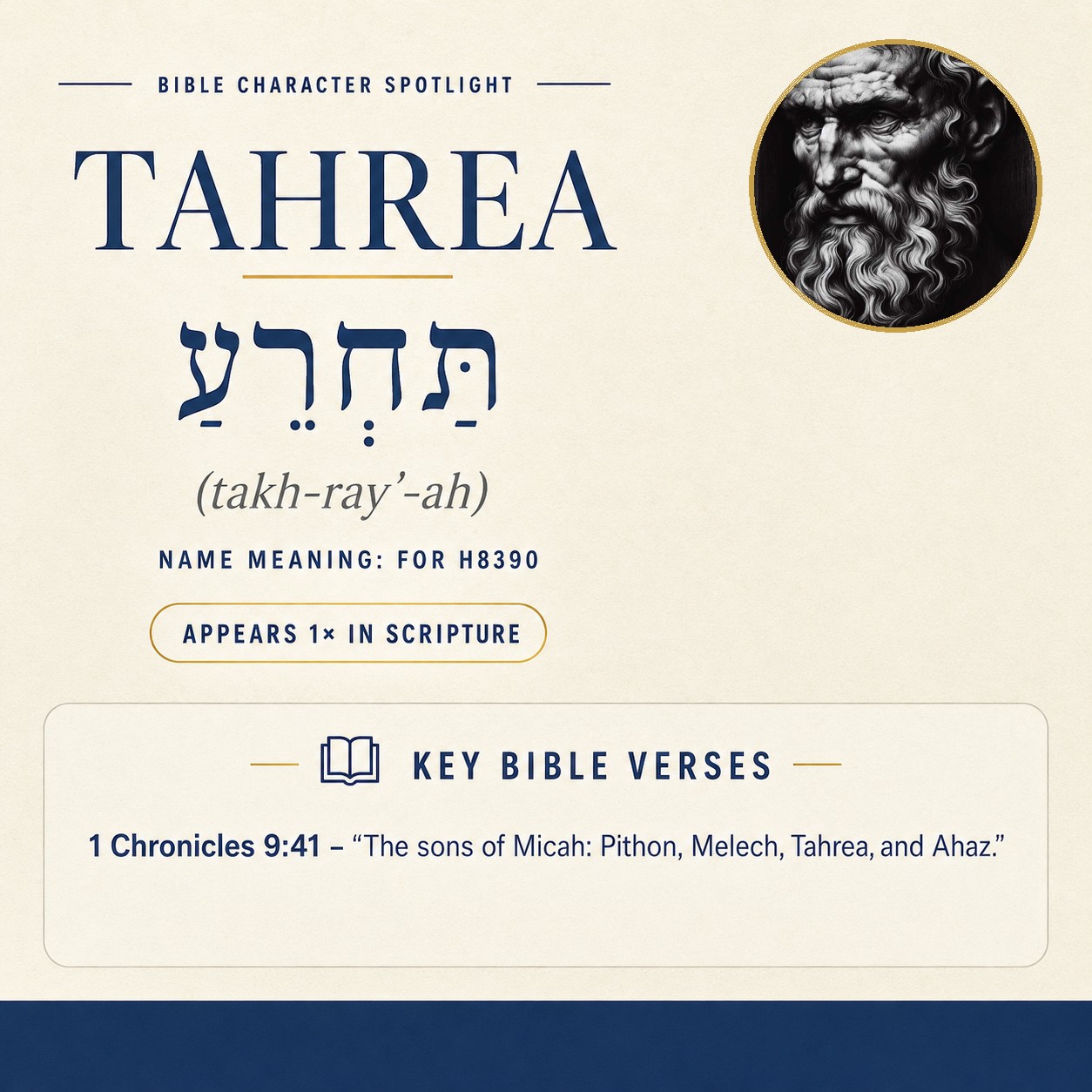
Tahrea in Scripture
Tahrea appears once, in a sequence of family lines recorded in 1 Chronicles 9. The surrounding verses trace a genealogy beginning with Ner and proceeding through Kish, Saul, Jonathan, and then into the line in which Tahrea is mentioned.
“Ner became the father of Kish. Kish became the father of Saul. Saul became the father of Jonathan, Malchishua, Abinadab, and Eshbaal.” (1 Chronicles 9:39, WEB)
This establishes the larger family setting in which the subsequent names appear. The line then narrows from Jonathan to his son, and then to Micah.
“The son of Jonathan was Merib Baal. Merib Baal became the father of Micah.” (1 Chronicles 9:40, WEB)
Tahrea is then introduced in the next generation, as one of Micah’s sons. The verse does not provide actions or additional description for Tahrea; it identifies him by placement within this family list.
“The sons of Micah: Pithon, Melech, Tahrea, and Ahaz.” (1 Chronicles 9:41, WEB)
After naming Tahrea and his brothers, the genealogy continues through one of those brothers, Ahaz, and proceeds through successive descendants. This continuation gives context for how Tahrea’s name functions within the chapter: it is part of a generational record that moves forward through particular branches of the family.
“Ahaz became the father of Jarah. Jarah became the father of Alemeth, Azmaveth, and Zimri. Zimri became the father of Moza.” (1 Chronicles 9:42, WEB)
“Moza became the father of Binea; and Rephaiah his son, Eleasah his son, and Azel his son.” (1 Chronicles 9:43, WEB)
“Azel had six sons, whose names are these: Azrikam, Bocheru, Ishmael, Sheariah, Obadiah, and Hanan. These were the sons of Azel.” (1 Chronicles 9:44, WEB)
Within this narrated flow of descent, Tahrea is not followed as the line continues; instead, he is named among Micah’s sons while the record proceeds through Ahaz. Tahrea’s scriptural identification, therefore, is as a son within Micah’s household and as a figure situated in the genealogy that runs from Ner to Saul and beyond.
Name and Meaning
The name appears in Hebrew as תַּחְרֵעַ, transliterated Tachrea’ and pronounced takh-ray’-ah. Its derivation is connected to H8390, and it is associated with a related component name Ta’area’ (תַּאֲרֵעַ), Taarea, identified as an Israelite in the lexicon gloss.
Observation
Tahrea is remembered in Scripture through his placement in a carefully ordered genealogy: “The sons of Micah: Pithon, Melech, Tahrea, and Ahaz” (1 Chronicles 9:41, WEB), a brief mention that locates him within a wider family line traced across multiple generations (1 Chronicles 9:39–44).
Frequently Asked Questions
Who was Tahrea?
Tahrea (Tachrea) is identified as an Israelite. In 1 Chronicles 9:41, Tahrea is listed as one of the sons of Micah.
What does the name Tahrea mean?
The name Tahrea (Tachrea) is given as meaning “for”.
How many times does Tahrea appear in the Bible?
Tahrea appears 1 time.
Where is Tahrea mentioned?
Tahrea is mentioned in 1 Chronicles 9:41, in a list of Micah’s sons: “Pithon, Melech, Tahrea, and Ahaz.”
Explore Further
If you found this page about Tahrea interesting and would like to discover more about other biblical characters, explore our comprehensive Encyclopedia of Biblical Characters. For those looking to delve deeper into the Greek origins of these names and terms, our Greek Lexicon is an invaluable resource.
Sources: Name and occurrence data from Strong’s Exhaustive Concordance and STEPBible reference data (CC BY). Scripture quotations from the World English Bible (public domain).