Who was Shema in the bible?
Shema is a name shared by several individuals in Chronicles and Nehemiah, and also by a place listed among Judah’s towns in Joshua 15:26.
Other Mentions
A Shema appears in a lineage: “Bela the son of Azaz, the son of Shema, the son of Joel” (1 Chronicles 5:8). Another Shema is named among leaders: “Beriah, and Shema, who were heads of fathers’ households… who put to flight the inhabitants of Gath” (1 Chronicles 8:13).
Learn More →Public Assembly
During Ezra’s reading, “beside him stood Mattithiah, Shema, Anaiah, Uriah, Hilkiah, and Maaseiah” (Nehemiah 8:4). In Joshua’s town list, “Amam, Shema, Moladah,” names Shema as a place (Joshua 15:26).
Learn More →Shema is the name of both a place and several individuals in the Bible. In the passages given, Shema appears as a town listed among Judah’s locations and as the name of multiple Israelites mentioned in genealogies and in a public assembly.
Shema in Scripture
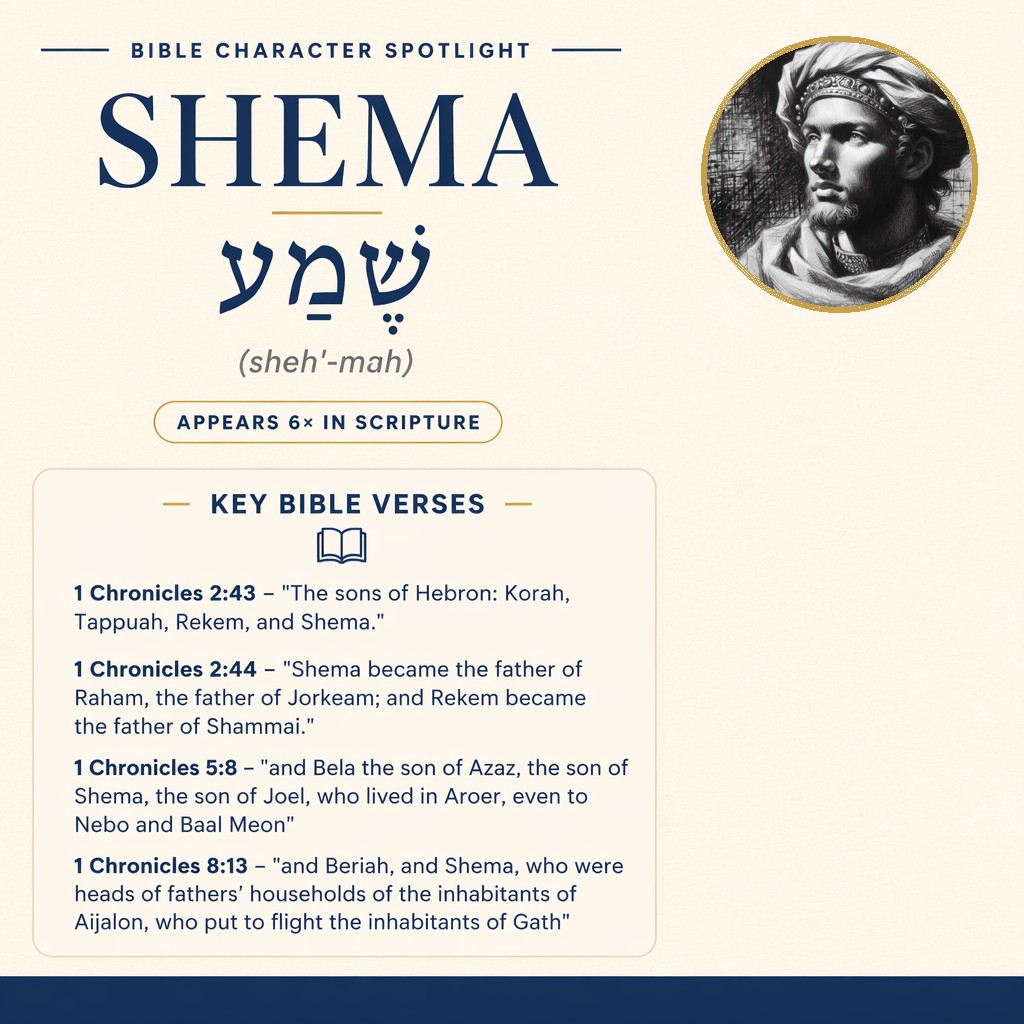
“Amam, Shema, Moladah,” (Joshua 15:26)
In Joshua’s listing of places, Shema is named among other towns: “Ziph, Telem, Bealoth,” (Joshua 15:24); “Hazor Hadattah, Kerioth Hezron (also called Hazor),” (Joshua 15:25); “Amam, Shema, Moladah,” (Joshua 15:26); “Hazar Gaddah, Heshmon, Beth Pelet,” (Joshua 15:27); “Hazar Shual, Beersheba, Biziothiah,” (Joshua 15:28); and “Baalah, Iim, Ezem,” (Joshua 15:29). In this context, Shema functions as one named location in a regional list.
In 1 Chronicles, Shema also appears as the name of several Israelites in genealogical and historical notices. Within the extended genealogy of 1 Chronicles 2, Shema is included among “The sons of Hebron.”
“The sons of Hebron: Korah, Tappuah, Rekem, and Shema.” (1 Chronicles 2:43)
The next verse continues with Shema’s line:
“Shema became the father of Raham, the father of Jorkeam; and Rekem became the father of Shammai.” (1 Chronicles 2:44)
In the flow of 1 Chronicles 2, these statements sit within a longer presentation of Israel’s family lines: “These are the sons of Israel: Reuben, Simeon, Levi, Judah, Issachar, Zebulun,” (1 Chronicles 2:1) continuing through the tribes (1 Chronicles 2:2), and then developing Judah’s descendants and related families through many generations. Within that setting, Shema is presented straightforwardly as one of Hebron’s sons and as the father of Raham, who is then said to be the father of Jorkeam.
A different Shema appears in a genealogical line in 1 Chronicles 5:
“and Bela the son of Azaz, the son of Shema, the son of Joel, who lived in Aroer, even to Nebo and Baal Meon;” (1 Chronicles 5:8)
Here Shema is placed between Joel and Azaz in Bela’s ancestry. The verse also links this family line to a place of residence, saying of Bela that he “lived in Aroer, even to Nebo and Baal Meon.”
Another Shema is named in 1 Chronicles 8 among heads of fathers’ households, in a notice connected with Aijalon and Gath:
“and Beriah, and Shema, who were heads of fathers’ households of the inhabitants of Aijalon, who put to flight the inhabitants of Gath;” (1 Chronicles 8:13)
In this passage, Shema is associated with leadership (“heads of fathers’ households”) among the inhabitants of Aijalon, and the verse attributes to those inhabitants an action against Gath: they “put to flight the inhabitants of Gath.”
Finally, Shema appears in Nehemiah 8 in a scene where Ezra reads publicly, and a group stands with him:
“Ezra the scribe stood on a pulpit of wood, which they had made for the purpose; and beside him stood Mattithiah, Shema, Anaiah, Uriah, Hilkiah, and Maaseiah, on his right hand; and on his left hand, Pedaiah, Mishael, Malchijah, Hashum, Hashbaddanah, Zechariah,” (Nehemiah 8:4)
In this setting, Shema is one of the named individuals standing beside “Ezra the scribe” on the constructed “pulpit of wood,” positioned on Ezra’s right hand along with several others.
Multiple Bearers
The verses present Shema as more than one bearer of the same name, and also as a place-name.
1) Shema the town. Shema is listed as a location: “Amam, Shema, Moladah,” (Joshua 15:26), within a larger list of towns (Joshua 15:24–29).
2) Shema son of Hebron. In Judah’s genealogical material, Shema is identified as one of Hebron’s sons: “The sons of Hebron: Korah, Tappuah, Rekem, and Shema.” (1 Chronicles 2:43). This Shema is then said to have descendants: “Shema became the father of Raham, the father of Jorkeam” (1 Chronicles 2:44).
3) Shema in Bela’s ancestry. A Shema is named as the father of Azaz and the son of Joel in the ancestry of Bela: “Bela the son of Azaz, the son of Shema, the son of Joel” (1 Chronicles 5:8). The same verse notes Bela’s dwelling area: “who lived in Aroer, even to Nebo and Baal Meon” (1 Chronicles 5:8).
4) Shema a head of fathers’ households in Aijalon. Another Shema is paired with Beriah and described in a leadership role: “Beriah, and Shema, who were heads of fathers’ households of the inhabitants of Aijalon” (1 Chronicles 8:13). The verse continues that these inhabitants “put to flight the inhabitants of Gath” (1 Chronicles 8:13).
5) Shema beside Ezra. In Nehemiah’s account of Ezra’s public reading, Shema is among those standing beside Ezra: “beside him stood Mattithiah, Shema, Anaiah, Uriah, Hilkiah, and Maaseiah, on his right hand” (Nehemiah 8:4).
Name and Meaning
In Hebrew, the name is written שֶׁמַע / שְׁמָע and transliterated Shema’ (pronounced sheh’-mah and shem-aw’ in the provided glosses). The derivation given connects it to a term associated with something heard—described in the lexicon paraphrase as “something heard, i.e. a sound, rumor.” The same name is also used as a place-name in Palestine, and (in the provided identity gloss) is borne by multiple Israelites.
Observation
Across the passages, “Shema” functions as a shared name applied to different referents: a town listed among other towns (Joshua 15:26) and several individuals who appear in genealogical lines (1 Chronicles 2:43–44; 1 Chronicles 5:8), in a leadership notice (1 Chronicles 8:13), and in a public assembly beside Ezra (Nehemiah 8:4).
Frequently Asked Questions
What does the name Shema mean?
Shema is used as the name of a place in Palestine and as the name of four Israelites.
How many times does Shema appear in the Bible?
Shema appears 6 times total in the Bible across these entries.
Who was Shema?
Shema is the name of several Israelites, including a son of Hebron (1 Chronicles 2:43) who became the father of Raham (1 Chronicles 2:44), and a man standing beside Ezra when he read the Law (Nehemiah 8:4).
Was there more than one person named Shema?
Yes. Shema is given as the name of four Israelites, and it is also the name of a place in Palestine.
Explore Further
If you found this page about Shema interesting and would like to discover more about other biblical characters, explore our comprehensive Encyclopedia of Biblical Characters. For those looking to delve deeper into the Greek origins of these names and terms, our Greek Lexicon is an invaluable resource.
Sources: Name and occurrence data from Strong’s Exhaustive Concordance and STEPBible reference data (CC BY). Scripture quotations from the World English Bible (public domain).