Who was Ram in the bible?
Ram is a biblical name found in genealogies in 1 Chronicles 2 and Ruth 4, and in Job 32 as the family name of Elihu.

Family Lines
“Ram became the father of Amminadab” (1 Chronicles 2:10; Ruth 4:19). In another line, “The sons of Jerahmeel… were Ram the firstborn” (1 Chronicles 2:25), and “The sons of Ram… were Maaz, Jamin, and Eker” (1 Chronicles 2:27).
Learn More →Name and Use
A lexicon gloss identifies Ram as the name of an Arabian and of an Israelite, and derives it from a root meaning “high.” In Job, Elihu is introduced as “of the family of Ram” (Job 32:2).
Learn More →Ram (a name meaning “high,” from a Hebrew root connected with being high or rising) is presented in Scripture in genealogical notices: one Ram appears among the descendants of Hezron, and another Ram is named as the firstborn son of Jerahmeel; Job also mentions a “family of Ram.” The lexicon gloss summarizes the name as borne by an Arabian and by an Israelite.
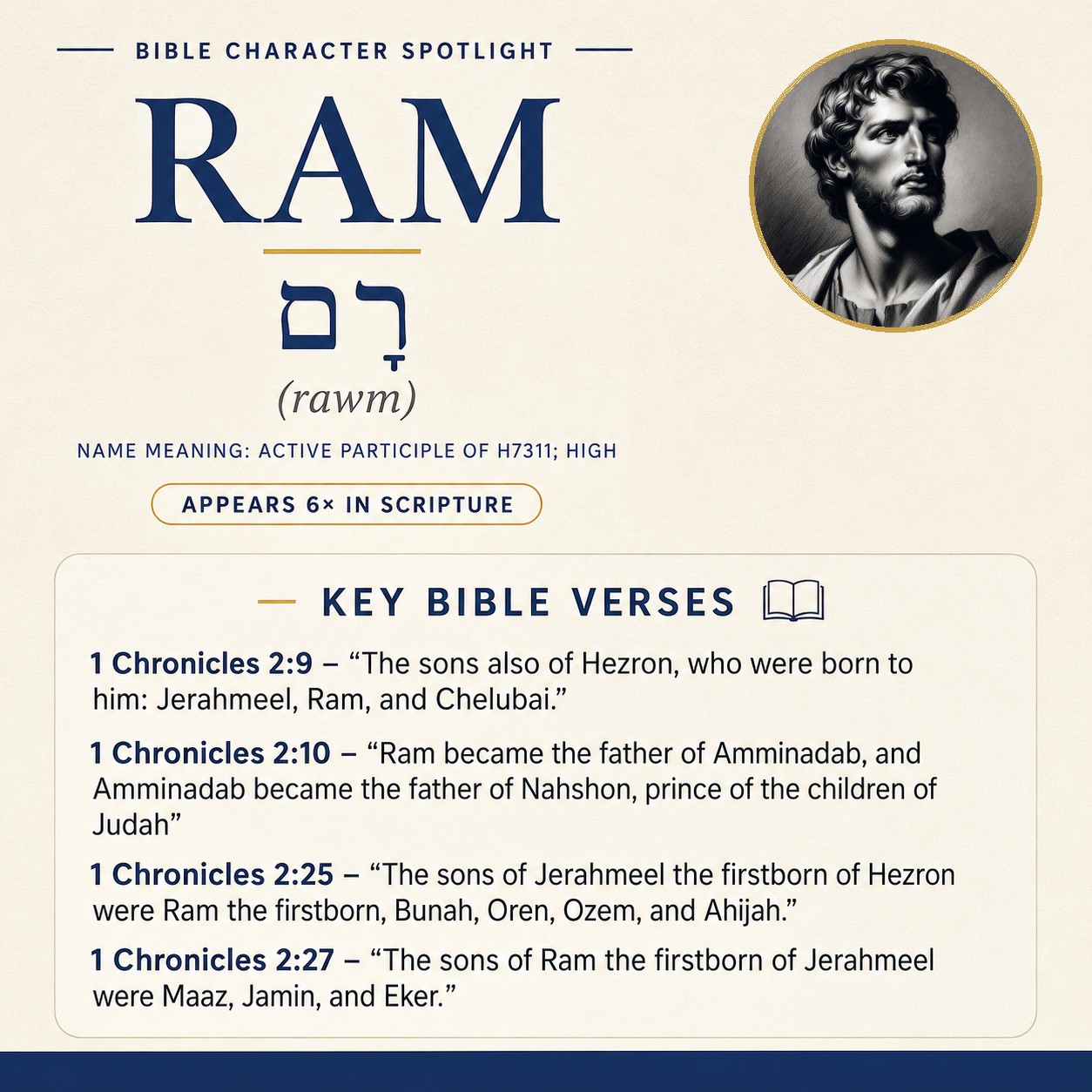
Ram in Scripture
Ram appears within a broad set of genealogies in 1 Chronicles 2 that trace lines within Israel, focusing especially on Judah and related families. The chapter opens by listing “the sons of Israel” (1 Chronicles 2:1–2), then turns to “the sons of Judah” (1 Chronicles 2:3) and continues through Judah’s descendants, including Perez and then Hezron (1 Chronicles 2:4–5). Within this setting, Ram is first named as one of Hezron’s sons.
“The sons also of Hezron, who were born to him: Jerahmeel, Ram, and Chelubai.” (1 Chronicles 2:9)
The genealogy then continues by placing Ram as an ancestor in a line that proceeds through Amminadab and Nahshon, identified by his role among Judah.
“Ram became the father of Amminadab, and Amminadab became the father of Nahshon, prince of the children of Judah;” (1 Chronicles 2:10)
Immediately after this, the chapter carries the same genealogical line forward (1 Chronicles 2:11–17), but Ram’s direct mention is limited to his placement as Hezron’s son and as Amminadab’s father.
Later in the same chapter, the narrative shifts to the descendants of Jerahmeel, who is introduced as “the firstborn of Hezron” (1 Chronicles 2:25). In that list, a Ram is named again—this time explicitly as Jerahmeel’s firstborn—alongside Jerahmeel’s other sons.
“The sons of Jerahmeel the firstborn of Hezron were Ram the firstborn, Bunah, Oren, Ozem, and Ahijah.” (1 Chronicles 2:25)
The genealogy then continues by giving the sons of this Ram, keeping the focus on lineage rather than events.
“The sons of Ram the firstborn of Jerahmeel were Maaz, Jamin, and Eker.” (1 Chronicles 2:27)
Within 1 Chronicles 2 as a whole, these references place Ram within Judah’s extended genealogical framework: the chapter begins with Israel’s sons (1 Chronicles 2:1–2), narrows to Judah (1 Chronicles 2:3), proceeds to Perez and Hezron (1 Chronicles 2:4–5), names Hezron’s sons including Ram (1 Chronicles 2:9), and then expands into multiple family branches, including the branch of Jerahmeel where another Ram is singled out as “the firstborn” and is further traced through his sons (1 Chronicles 2:25, 27).
Ram is also named in a separate genealogical notice in Ruth, where he stands between Hezron and Amminadab.
“and Hezron became the father of Ram, and Ram became the father of Amminadab,” (Ruth 4:19)
In Job, Ram appears not as an individual acting in the narrative, but as a family designation used to locate Elihu within a larger clan structure. Elihu’s anger is described, and his lineage is given as part of his identification.
“Then the wrath of Elihu the son of Barachel, the Buzite, of the family of Ram, was kindled against Job. His wrath was kindled because he justified himself rather than God.” (Job 32:2)
Multiple bearers
The name Ram is applied to more than one figure in the genealogies. First, one Ram is named among “the sons also of Hezron” (1 Chronicles 2:9) and is placed in the line “Ram became the father of Amminadab” (1 Chronicles 2:10), matching Ruth’s statement: “Hezron became the father of Ram, and Ram became the father of Amminadab” (Ruth 4:19).
Second, another Ram is identified specifically as “Ram the firstborn” among “the sons of Jerahmeel the firstborn of Hezron” (1 Chronicles 2:25). This Ram is further distinguished by having named sons: “Maaz, Jamin, and Eker” (1 Chronicles 2:27). The text does not explicitly equate this Ram with Hezron’s son of the same name; it simply presents a Ram as Jerahmeel’s firstborn within Jerahmeel’s list.
Third, Job identifies Elihu as being “of the family of Ram” (Job 32:2). This reference uses Ram as a family or clan marker, without giving a genealogy connecting that Ram to the genealogies in Ruth or Chronicles.
Name and Meaning
The name is written in Hebrew script as רָם, transliterated Ram and pronounced “rawm.” According to the lexicon’s derivation, it is connected to a Hebrew term meaning “high,” described as an active participle related to a root (ruwm, רוּם) that conveys the sense “to be high” actively, “to rise or raise.”
Observation
Across the passages, Ram functions mainly as a marker of lineage: in Chronicles and Ruth he links named generations (“Hezron became the father of Ram, and Ram became the father of Amminadab,” Ruth 4:19), and in Job his name identifies a broader kin group (“of the family of Ram,” Job 32:2).
Frequently Asked Questions
What does the name Ram mean?
The name Ram means “high.”
How many times does Ram appear in the Bible?
Ram appears 6 times.
Who was Ram in the Bible?
Ram is the name of an Arabian and of an Israelite. In genealogies, Ram is listed as a son of Hezron (Ruth 4:19; 1 Chronicles 2:9) and as the father of Amminadab (Ruth 4:19; 1 Chronicles 2:10).
What does Job 32:2 say about Ram?
Job 32:2 mentions Elihu as being “of the family of Ram” (Job 32:2).
Explore Further
If you found this page about Ram interesting and would like to discover more about other biblical characters, explore our comprehensive Encyclopedia of Biblical Characters. For those looking to delve deeper into the Greek origins of these names and terms, our Greek Lexicon is an invaluable resource.
Sources: Name and occurrence data from Strong’s Exhaustive Concordance and STEPBible reference data (CC BY). Scripture quotations from the World English Bible (public domain).