
Who was Massa in the bible?
Massa is named among the sons of Ishmael in Genesis 25:14 and 1 Chronicles 1:30.

Where Mentioned
Massa is recorded in genealogical contexts: “Now this is the history of the generations of Ishmael” (Genesis 25:12–14) and “These are their generations” (1 Chronicles 1:29–31).
Learn More →Name and Sense
A Hebrew lexicon entry connects Massa’s name-form with a term meaning “burden,” used in Scripture for “tribute,” a “burden,” or an “utterance.”
Learn More →Massa is a personal name borne in Scripture by a son of Ishmael, listed among Ishmael’s sons. In Hebrew usage the same written form is also a common word associated with the idea of a “burden,” a term used in several contexts in the cited passages.
Massa in Scripture
Massa appears in genealogical lists that identify him as one of Ishmael’s sons.
“The sons of Abraham: Isaac and Ishmael.” (1 Chronicles 1:28, WEB)
“These are their generations: the firstborn of Ishmael, Nebaioth; then Kedar, Adbeel, Mibsam,” (1 Chronicles 1:29, WEB)
“Mishma, Dumah, Massa, Hadad, Tema,” (1 Chronicles 1:30, WEB)
“Jetur, Naphish, and Kedemah. These are the sons of Ishmael.” (1 Chronicles 1:31, WEB)
A parallel list in Genesis places Massa in the same sequence of names within “the history of the generations of Ishmael.”
“Now this is the history of the generations of Ishmael, Abraham’s son, whom Hagar the Egyptian, Sarah’s servant, bore to Abraham.” (Genesis 25:12, WEB)
“These are the names of the sons of Ishmael, by their names, according to the order of their birth: the firstborn of Ishmael, Nebaioth, then Kedar, Adbeel, Mibsam,” (Genesis 25:13, WEB)
“Mishma, Dumah, Massa,” (Genesis 25:14, WEB)
“Hadad, Tema, Jetur, Naphish, and Kedemah.” (Genesis 25:15, WEB)
“These are the sons of Ishmael, and these are their names, by their villages, and by their encampments: twelve princes, according to their nations.” (Genesis 25:16, WEB)
In these passages, Massa is not given individual actions or sayings; he is presented as part of the named set of Ishmael’s sons.
Multiple Uses of “Massa”
The same Hebrew form is also used as a common term connected with the idea of a “burden,” and the provided verses show that usage in varied settings. For example, it can describe an emotional or practical load borne by a leader:
“How can I myself alone bear your problems, your burdens, and your strife?” (Deuteronomy 1:12, WEB)
It can describe the prospect of being a hindrance:
“David said to him, ‘If you pass on with me, then you will be a burden to me;’” (2 Samuel 15:33, WEB)
“Why then should your servant be a burden to my lord the king?” (2 Samuel 19:35, WEB)
It can refer to a physical load:
“Naaman said, ‘If not, then, please let two mules’ burden of earth be given to your servant; for your servant will from now on offer neither burnt offering nor sacrifice to other gods, but to Yahweh.’” (2 Kings 5:17, WEB)
“So Hazael went to meet him, and took a present with him, even of every good thing of Damascus, forty camels’ burden, and came and stood before him, and said, ‘Your son Benhadad king of Syria has sent me to you, saying, “Will I recover from this sickness?” ’” (2 Kings 8:9, WEB)
It can also refer to something “laid” as a spoken or imposed burden:
“Then Jehu said to Bidkar his captain, ‘Pick him up, and throw him in the plot of the field of Naboth the Jezreelite; for remember how, when you and I rode together after Ahab his father, Yahweh laid this burden on him:’” (2 Kings 9:25, WEB)
And it can be used in contexts of tribute or imposed loads:
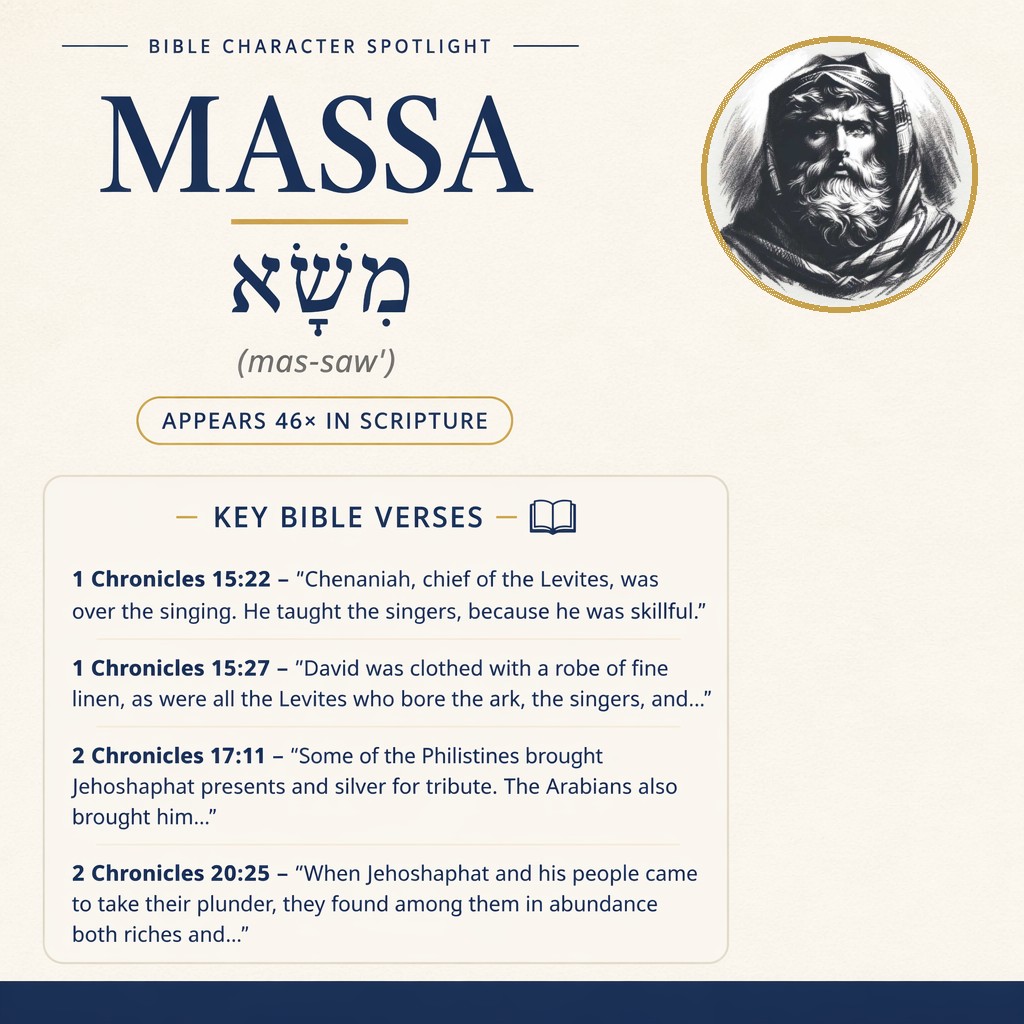
“Some of the Philistines brought Jehoshaphat presents and silver for tribute. The Arabians also brought him flocks, seven thousand seven hundred rams, and seven thousand seven hundred male goats.” (2 Chronicles 17:11, WEB)
“Now concerning his sons, the greatness of the burdens laid on him, and the rebuilding of God’s house, behold, they are written in the commentary of the book of the kings. Amaziah his son reigned in his place.” (2 Chronicles 24:27, WEB)
One passage uses the term in connection with sacred service, contrasting past bearing with a new instruction:
“He said to the Levites who taught all Israel, who were holy to Yahweh, ‘Put the holy ark in the house which Solomon the son of David king of Israel built. It will no longer be a burden on your shoulders. Now serve Yahweh your God, and his people Israel.’” (2 Chronicles 35:3, WEB)
Finally, in the narrative describing the bringing up of the ark, the same Hebrew form appears in a statement about musical leadership:
“Chenaniah, chief of the Levites, was over the singing. He taught the singers, because he was skillful.” (1 Chronicles 15:22, WEB)
“David was clothed with a robe of fine linen, as were all the Levites who bore the ark, the singers, and Chenaniah the choir master with the singers; and David had an ephod of linen on him.” (1 Chronicles 15:27, WEB)
In that chapter’s wider account, David prepared a place for the ark and assembled Israel at Jerusalem, instructing that “No one ought to carry God’s ark but the Levites” (1 Chronicles 15:2, WEB). Levite leaders are listed (1 Chronicles 15:4–10), they are told, “Sanctify yourselves… that you may bring the ark of Yahweh” (1 Chronicles 15:12, WEB), and the ark is borne “on their shoulders with its poles” (1 Chronicles 15:15, WEB). David also arranged for singers and instruments so that they would be “sounding aloud and lifting up their voices with joy” (1 Chronicles 15:16, WEB), and the ark was brought up “with shouting, with sound of the cornet, with trumpets, and with cymbals” (1 Chronicles 15:28, WEB). This chapter does not present a person named Massa; it shows the broader range of the Hebrew term’s usage in the verses supplied.
Name and Meaning
The name is written מַשָּׂא, transliterated Massa’ (also given as massa’), and pronounced mas-saw’. According to the provided lexicon information, it is derived from a Hebrew root meaning “to lift,” and the related sense is that of a “burden,” with extensions that can include tribute or a carried load, and also an utterance (often in the sense of a weighty pronouncement).
Observation
In the genealogies, Massa is simply named among “the sons of Ishmael” (1 Chronicles 1:31, WEB); in the other passages, the same Hebrew form appears as a word for burdens that are borne, laid on someone, or removed—“It will no longer be a burden on your shoulders” (2 Chronicles 35:3, WEB).
Frequently Asked Questions
What does the name Massa mean?
Massa means “a burden,” and can refer to tribute or porterage; it can also be used figuratively for an utterance (chiefly a doom), singing, or desire.
How many times does Massa appear in the Bible?
Massa appears 46 times total across the two Hebrew entries listed.
Who was Massa?
Massa is named as a son of Ishmael (Genesis 25:14; 1 Chronicles 1:30).
Was there more than one meaning for Massa in the Bible?
Yes. One Hebrew entry uses massa’ with senses like “burden” or “tribute,” while another uses Massa’ as the personal name of a son of Ishmael.
Explore Further
If you found this page about Massa interesting and would like to discover more about other biblical characters, explore our comprehensive Encyclopedia of Biblical Characters. For those looking to delve deeper into the Greek origins of these names and terms, our Greek Lexicon is an invaluable resource.
Sources: Name and occurrence data from Strong’s Exhaustive Concordance and STEPBible reference data (CC BY). Scripture quotations from the World English Bible (public domain).




