
Who was Maharai in the bible?
Maharai was an Israelite called “the Netophathite,” named in 2 Samuel 23:28 and 1 Chronicles 11:30; 27:13.
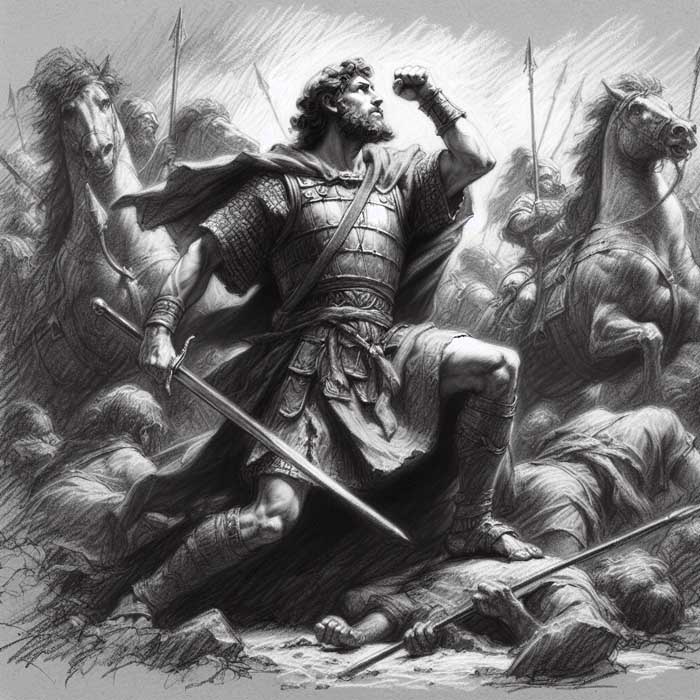
Military Role
“The tenth captain for the tenth month was Maharai the Netophathite, of the Zerahites. In his division were twenty-four thousand.” (1 Chronicles 27:13)
Learn More →Name Meaning
The name Maharai (Maharay) is explained in a lexicon as meaning “hasty.” He is identified there as an Israelite.
Learn More →Maharai (Hebrew Maharay) is presented as an Israelite identified as “the Netophathite,” and his name is derived from a Hebrew root associated with being “hasty.” In Scripture he appears in lists that place him among notable warriors and among captains overseeing a large military division.
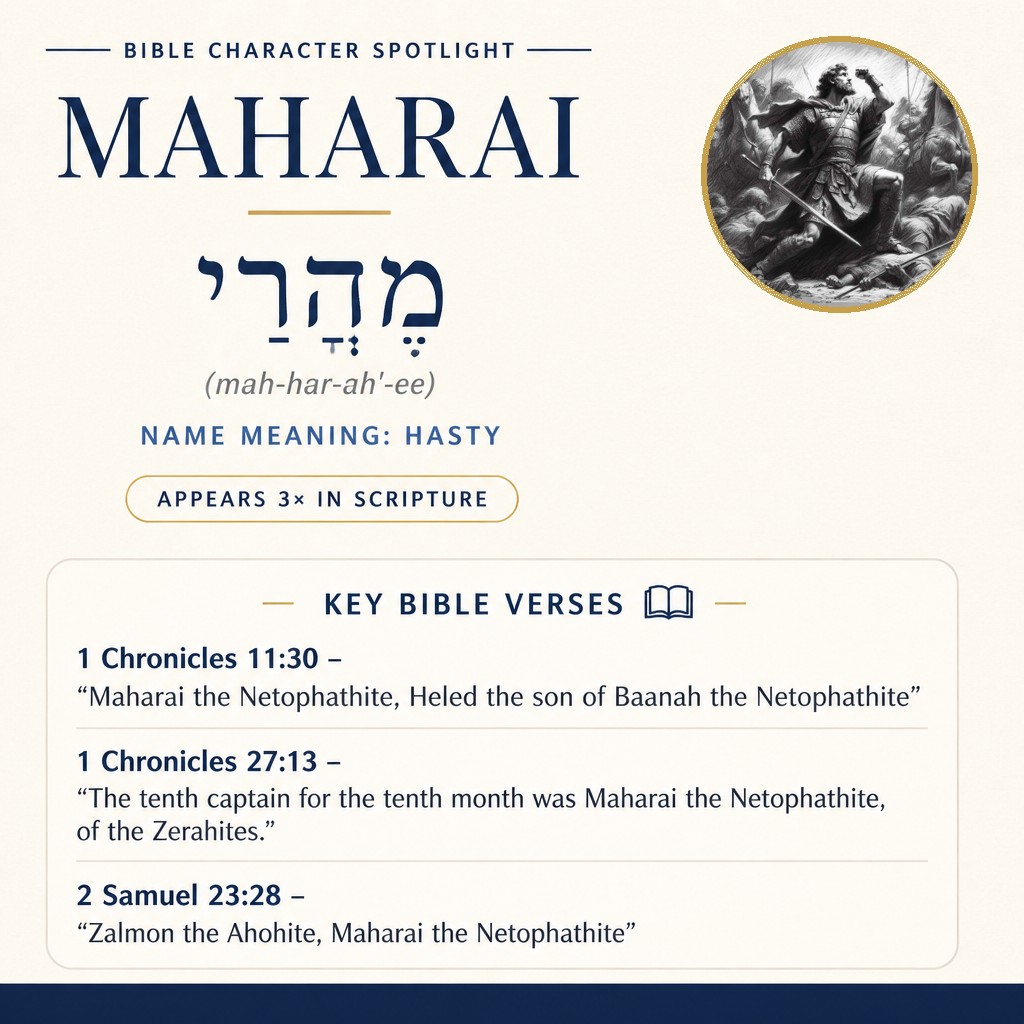
Maharai in Scripture
Maharai is named in a roster of warriors in 2 Samuel 23, where he appears in sequence among other men identified by place or clan. The immediate context situates him within a list that includes figures such as Zalmon and others associated with Netophah and Benjamin.
“Zalmon the Ahohite, Maharai the Netophathite,” (2 Samuel 23:28, WEB)
The surrounding lines keep the same list-like style and help locate Maharai among his contemporaries. Immediately before, the list reads:
“Helez the Paltite, Ira the son of Ikkesh the Tekoite,” (2 Samuel 23:26, WEB)
“Abiezer the Anathothite, Mebunnai the Hushathite,” (2 Samuel 23:27, WEB)
Immediately after Maharai is named, the list continues with another Netophathite family connection:
“Heleb the son of Baanah the Netophathite, Ittai the son of Ribai of Gibeah of the children of Benjamin,” (2 Samuel 23:29, WEB)
Maharai appears again in the parallel-type listing found in 1 Chronicles 11, where he is likewise identified as “the Netophathite.” In this passage he is placed between men identified as Hushathite and Ahohite on one side, and others linked to Benjamin and Pirathon on the other.
“Maharai the Netophathite, Heled the son of Baanah the Netophathite,” (1 Chronicles 11:30, WEB)
The immediate context in 1 Chronicles 11 is again a list of named warriors, emphasizing identification by lineage and locality. The verses around Maharai read:
“Ira the son of Ikkesh the Tekoite, Abiezer the Anathothite,” (1 Chronicles 11:28, WEB)
“Sibbecai the Hushathite, Ilai the Ahohite,” (1 Chronicles 11:29, WEB)
“Ithai the son of Ribai of Gibeah of the children of Benjamin, Benaiah the Pirathonite,” (1 Chronicles 11:31, WEB)
“Hurai of the brooks of Gaash, Abiel the Arbathite,” (1 Chronicles 11:32, WEB)
“Azmaveth the Baharumite, Eliahba the Shaalbonite,” (1 Chronicles 11:33, WEB)
In this setting, Maharai’s repeated descriptor—“the Netophathite”—functions as his primary identifier, the same way others are designated “the Tekoite,” “the Anathothite,” or connected to “Gibeah of the children of Benjamin.” Maharai’s placement beside “Heled the son of Baanah the Netophathite” highlights that more than one warrior in these lists is associated with Netophah.
A third reference to Maharai appears in 1 Chronicles 27, within a structured list of captains assigned to specific months, each with a division enumerated at the same strength. Maharai is presented as the captain associated with the tenth month, and the verse explicitly links him to “the Zerahites” and gives the size of his division.
“The tenth captain for the tenth month was Maharai the Netophathite, of the Zerahites. In his division were twenty-four thousand.” (1 Chronicles 27:13, WEB)
The surrounding context makes clear that Maharai is one in a series of monthly captains, each commanding “twenty-four thousand.” The chapter’s immediate pattern can be seen in the adjacent entries:
“The eighth captain for the eighth month was Sibbecai the Hushathite, of the Zerahites. In his division were twenty-four thousand.” (1 Chronicles 27:11, WEB)
“The ninth captain for the ninth month was Abiezer the Anathothite, of the Benjamites. In his division were twenty-four thousand.” (1 Chronicles 27:12, WEB)
“The eleventh captain for the eleventh month was Benaiah the Pirathonite, of the children of Ephraim. In his division were twenty-four thousand.” (1 Chronicles 27:14, WEB)
“The twelfth captain for the twelfth month was Heldai the Netophathite, of Othniel. In his division were twenty-four thousand.” (1 Chronicles 27:15, WEB)
Within this administrative-military framework, Maharai’s identification holds two linked descriptors: he is “the Netophathite,” and he is “of the Zerahites.” The text also attributes to him a command role (“captain”) and assigns him a defined unit size (“twenty-four thousand”). The proximity of another “Netophathite” captain (“Heldai the Netophathite”) further shows that this locality descriptor is shared by multiple individuals in the chapter’s list.
Name and Meaning
The name is written in Hebrew as מַהֲרַי, transliterated Maharay and pronounced “mah-har-ah’-ee.” Its derivation is explained as coming from a Hebrew root meaning “hasty,” connected with a component word mahar (מָהַר), described as properly “to be liquid or flow easily.”
Observation
Across the passages, Maharai is consistently identified by place (“the Netophathite”) and is also portrayed in a position of organized leadership, since “The tenth captain for the tenth month was Maharai the Netophathite… In his division were twenty-four thousand” (1 Chronicles 27:13, WEB).
Frequently Asked Questions
What does the name Maharai mean?
Maharai means “hasty.”
How many times does Maharai appear in the Bible?
Maharai appears 3 times.
Who was Maharai?
Maharai is described as an Israelite and is called “Maharai the Netophathite” (1 Chronicles 11:30; 2 Samuel 23:28).
What role is Maharai said to have had?
He is named as “the tenth captain for the tenth month” in 1 Chronicles 27:13.
Explore Further
If you found this page about Maharai interesting and would like to discover more about other biblical characters, explore our comprehensive Encyclopedia of Biblical Characters. For those looking to delve deeper into the Greek origins of these names and terms, our Greek Lexicon is an invaluable resource.
Sources: Name and occurrence data from Strong’s Exhaustive Concordance and STEPBible reference data (CC BY). Scripture quotations from the World English Bible (public domain).





