
Exploring the Meaning of Klasis in Greek
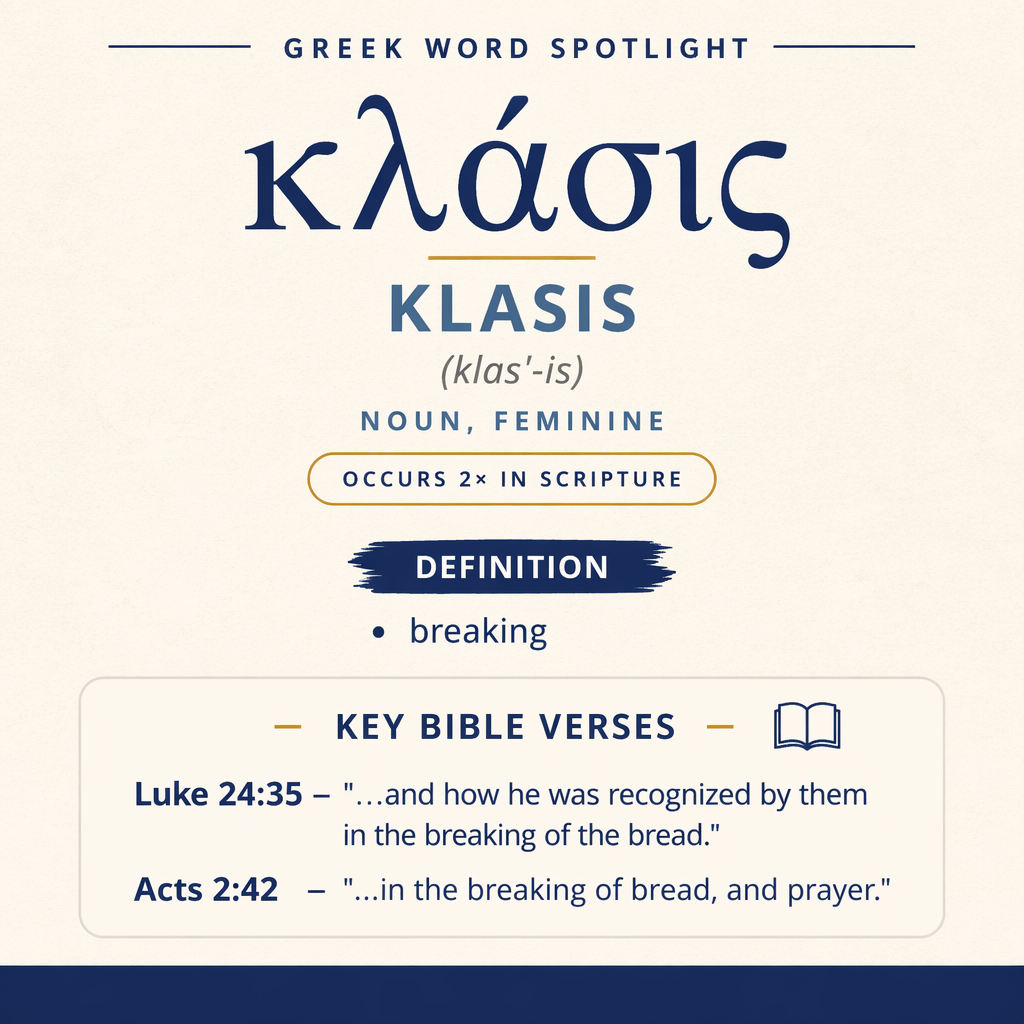
κλάσις means “breaking” and appears in Luke 24:35 and Acts 2:42 in connection with the breaking of bread.
Scripture Occurrences
κλάσις occurs 2 times in Scripture. It appears in Luke 24:35 and Acts 2:42.
Learn More →Breaking of Bread
In Luke 24:35, Jesus was recognized in the breaking of the bread. In Acts 2:42, believers continued steadfastly in the breaking of bread.
Learn More →κλάσις speaks of “breaking” and appears in two New Testament scenes, both set around “the breaking of the bread.” In each, the noun points to an identifiable action within a larger pattern of communal life and recognition.
Root and Related Words
κλάσις is derived from the verb klao (κλάω), “to break” (Strong’s G2806). The noun form names the action as a thing—an event or act that can be referred to, remembered, or practiced.

Occurrences
Luke 24:35: “They related the things that happened along the way, and how he was recognized by them in the breaking of the bread.”
Here κλάσις is tied to recognition: the speakers recount not only “the things that happened along the way” but also “how he was recognized by them in the breaking of the bread.” The noun functions as a marker of the moment within their story when recognition occurred. The verse frames the breaking as a distinct, describable act (“the breaking of the bread”), giving it enough clarity and weight that it can serve as the setting for a pivotal realization. κλάσις, therefore, contributes a concrete point in the narrative: recognition is associated with a particular action involving bread, not merely with conversation on the road.
The phrasing “in the breaking of the bread” presents the act as a context in which something else happens—recognition. That construction does not require κλάσις to carry the whole meaning of the moment; rather, it supplies the identifiable action around which the testimony is organized. Within this report, κλάσις is not an abstract idea but an event remembered and recounted, an action that can be named succinctly as part of what “they related.”
Acts 2:42: “They continued steadfastly in the apostles’ teaching and fellowship, in the breaking of bread, and prayer.”
In this summary of communal practice, κλάσις appears in a list of sustained activities: “the apostles’ teaching and fellowship,” “the breaking of bread,” and “prayer.” The verb phrase “continued steadfastly” portrays persistence and regularity; within that portrayal, κλάσις is one of the recurring acts that characterize the community’s shared life. The noun again points to a recognizable practice, something that can stand alongside teaching, fellowship, and prayer as a stable feature rather than a one-time incident.
The wording “in the breaking of bread” places κλάσις within the rhythm of the group’s commitments. It is framed not as a private act but as part of a communal pattern, coordinated with other shared devotions. By naming “the breaking of bread” with a noun, the verse treats it as a practice with a certain definable shape—an activity the community can “continue steadfastly” in, rather than a vague idea of eating together.
Sense and Usage
The core sense of κλάσις is the act of breaking. In both occurrences, the breaking is specified as involving bread, and in both it is expressed as a definite action (“the breaking of the bread,” “the breaking of bread”). The noun therefore does not merely describe an incidental physical motion; it provides a compact label for an action that is significant enough to be referenced as a known event (Luke) or a continuing practice (Acts). This highlights a common function of action-nouns: they allow a writer to speak of an act as something that can be placed in relation to other realities—recognition happens “in” it, and a community persists “in” it.
Across these two passages, κλάσις shows how an act of breaking can be treated as a recognizable unit of meaning. In Luke 24:35, κλάσις is embedded within a testimony (“They related… how he was recognized…”). The breaking is not narrated at length here; instead, it is named as the identifying moment that the witnesses can point to when explaining how recognition occurred. The noun’s usefulness in this verse lies in its ability to refer to a specific action without retelling every detail: the audience is given a concise handle—“the breaking of the bread”—by which to understand when recognition took place.
In Acts 2:42, κλάσις has a different temporal feel. Rather than anchoring a single remembered moment, it helps depict an ongoing way of life. “They continued steadfastly” casts the listed activities as habitual. Within that framework, κλάσις functions as a repeated action, one that can be practiced over time like teaching, fellowship, and prayer. The noun thus accommodates both a punctiliar reference (a moment that can be recalled) and a durative reference (a practice that can be maintained), without changing its essential sense as an act of breaking.
The two phrases also show how κλάσις can be specified by its object. The word itself names the act; the accompanying “of (the) bread” identifies what is being broken. This pairing makes the action concrete and readily imaginable, yet it also allows the text to treat the act as more than mere mechanics: in Luke, it becomes the setting of recognition; in Acts, it becomes part of a steadfast communal pattern. The action remains the same kind of act—breaking—while the surrounding context shows different kinds of significance attached to it.
Because κλάσις is used with bread in both occurrences, the imagery is tactile and ordinary: something held, broken, and shared. Yet the narrative and communal frames keep the noun from being reduced to a purely physical description. In Luke, the breaking is closely linked to knowing; in Acts, it is closely linked to belonging and perseverance. In both, the noun helps the reader see that the action is distinct enough to be named and remembered, and stable enough to be practiced as part of a shared life.
Imagery
Both passages picture the same simple motion: bread being broken. Luke 24:35 associates that moment with being “recognized,” giving the act a sharp narrative focus, as though the breaking itself becomes the remembered point at which perception changed. Acts 2:42 places the same act among the community’s steady commitments, so the image shifts from a single decisive moment to a repeated practice that accompanies teaching, fellowship, and prayer.
Sources: Lexical data from Strong’s Exhaustive Concordance and the Translators Brief Lexicon of Extended Strongs for Greek (STEPBible, CC BY). Occurrence data from the Translators Amalgamated Greek New Testament (STEPBible, CC BY). Scripture quotations from the World English Bible (public domain).





