
Exploring the Meaning of Klaio in Greek
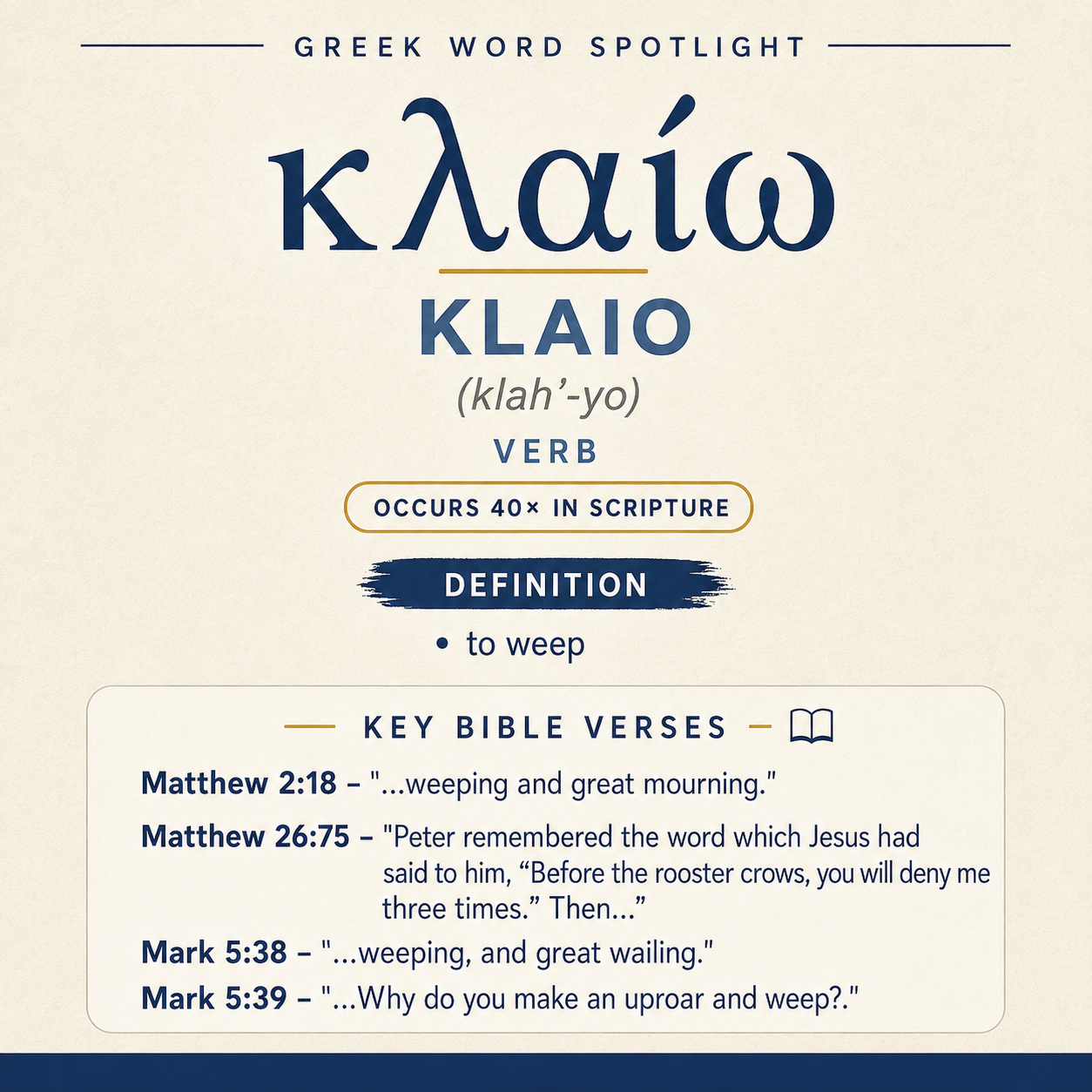
κλαίω means “to weep” and appears 40 times in Scripture, including Matthew, Mark, and Luke.
Gospel Scenes
It appears in scenes of lament and mourning (Matthew 2:18; Mark 5:38–39). It is used of Peter after denying Jesus (Matthew 26:75; Mark 14:72).
Learn More →Teaching Context
In Luke, κλαίω occurs in Jesus’ blessings and woes addressing those who weep now (Luke 6:21, 6:25).
Learn More →κλαίω expresses the act of weeping. In the passages below it appears in scenes of bereavement, public lament, repentance, and Jesus’ instruction about grief and joy.
Occurrences
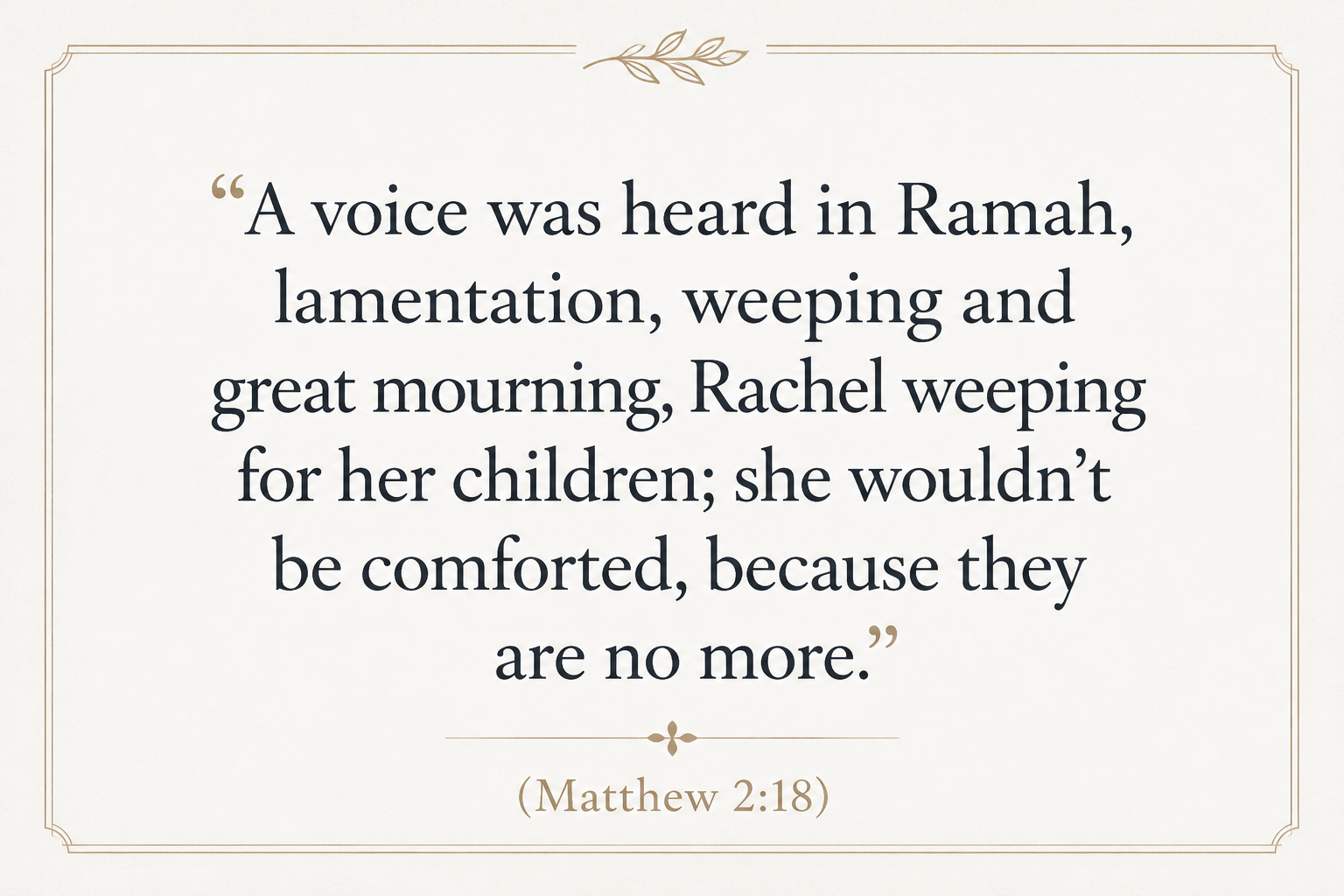
“A voice was heard in Ramah, lamentation, weeping and great mourning, Rachel weeping for her children; she wouldn’t be comforted, because they are no more.” (Matthew 2:18)
Here κλαίω stands within a cluster of grief words (“lamentation,” “weeping,” “great mourning”), depicting weeping as the audible, visible outflow of loss. The repeated reference to “Rachel weeping” makes the action emblematic: her weeping is not momentary but tied to an irreversible absence—“because they are no more”—and to inconsolability (“she wouldn’t be comforted”).
Peter remembered the word which Jesus had said to him, “Before the rooster crows, you will deny me three times.” Then he went out and wept bitterly. (Matthew 26:75)
κλαίω marks Peter’s personal response after recollection (“Peter remembered the word”). The narration places weeping after a deliberate movement—“he went out”—so the act occurs away from the immediate scene of denial. The adverb “bitterly” frames the weeping as intense and piercing, fitting the moral and emotional collapse implied by remembering Jesus’ prediction.
He came to the synagogue ruler’s house, and he saw an uproar, weeping, and great wailing. (Mark 5:38)
In this house of crisis, κλαίω is part of a communal soundscape. The “uproar” is not abstract; it consists of “weeping, and great wailing,” signaling that multiple mourners are already performing the customary responses to death. Weeping here functions as public proof that the household understands the situation as catastrophic.
When he had entered in, he said to them, “Why do you make an uproar and weep? The child is not dead, but is asleep.” (Mark 5:39)
κλαίω becomes the target of Jesus’ question and correction. The mourners’ weeping is linked to their assumption (“The child is… dead”), while Jesus re-describes the state of the child as “asleep.” The act of weeping is treated as a reaction to a diagnosis; Jesus challenges the appropriateness of that reaction by challenging the diagnosis itself.
The rooster crowed the second time. Peter remembered the word, how that Jesus said to him, “Before the rooster crows twice, you will deny me three times.” When he thought about that, he wept. (Mark 14:72)
This parallel account again ties κλαίω to remembrance and reflection: “Peter remembered… When he thought about that, he wept.” The weeping is presented as the natural consequence of letting the weight of the prediction and its fulfillment register. Unlike Matthew’s “wept bitterly,” Mark states the act plainly, emphasizing the sequence: sound of the rooster, memory of Jesus’ words, inward consideration, then tears.
She went and told those who had been with him, as they mourned and wept. (Mark 16:10)
κλαίω depicts the condition of the group when Mary reports to them. They are not merely sad; they are actively engaged in mourning expressed through weeping. The participial setting (“as they mourned and wept”) paints a room or gathering shaped by grief, which forms the emotional background against which the message is delivered.
Blessed are you who hunger now, for you will be filled. Blessed are you who weep now, for you will laugh. (Luke 6:21)
Here κλαίω describes a present experience (“now”) paired with a promised reversal (“you will laugh”). Weeping is treated as a marker of current hardship or sorrow within the “blessed” condition, not as an end in itself. The future laughter does not erase the present tears in the wording; instead, the saying places weeping within a time-structured expectation of change.
Woe to you, you who are full now, for you will be hungry. Woe to you who laugh now, for you will mourn and weep. (Luke 6:25)
κλαίω appears again in a reversal statement, but now as the future outcome for those who “laugh now.” The movement is from present satisfaction and laughter to future deprivation and grief (“you will mourn and weep”). Weeping is paired with mourning, portraying a deepened condition rather than a passing tear, and it functions as part of the warning: what seems secure can turn into lament.
When the Lord saw her, he had compassion on her, and said to her, “Don’t cry.” (Luke 7:13)
κλαίω is here addressed directly as an imperative to stop: “Don’t cry.” The command arises from compassion (“he had compassion on her”), indicating that weeping is recognized as a legitimate expression of pain. At the same time, the instruction implies an approaching change in the situation that makes continued weeping unnecessary or premature within the narrative moment.
They are like children who sit in the marketplace, and call to one another, saying, ‘We piped to you, and you didn’t dance. We mourned, and you didn’t weep.’ (Luke 7:32)
κλαίω is used in a miniature social script: one group expects the other to respond to “We mourned” with “weep.” Weeping is treated as the fitting counterpart to a mournful performance, like dancing is to piping. The complaint (“you didn’t…”) highlights refusal or inability to match the expected emotional response; κλαίω thus marks the socially intelligible sign of participating in sorrow.
Standing behind at his feet weeping, she began to wet his feet with her tears, and she wiped them with the hair of her head, kissed his feet, and anointed them with the ointment. (Luke 7:38)
In this scene κλαίω is portrayed with physical immediacy. The woman’s weeping is not only inward; it produces “tears” abundant enough to “wet his feet,” and it leads into a sequence of actions—wiping, kissing, anointing. Weeping is the posture and atmosphere of her approach (“standing behind at his feet weeping”), shaping the entire encounter as one marked by intense emotion expressed through tears.
All were weeping and mourning her, but he said, “Don’t weep. She isn’t dead, but sleeping.” (Luke 8:52)
κλαίω again describes communal grief (“All were weeping and mourning her”), and again Jesus counters it with “Don’t weep,” grounding the command in a re-description of the girl’s condition: “She isn’t dead, but sleeping.” The juxtaposition underscores how weeping, in these narratives, is often a rational response to perceived death; when death is denied, the weeping is challenged as misdirected.

Sense and Usage
Across these passages κλαίω consistently denotes weeping as an enacted response, not merely a feeling. The word appears both in individual crises (Peter after denial; a woman at Jesus’ feet) and in collective scenes where grief is shared and audible (the synagogue ruler’s house; “All were weeping and mourning her”; the group in Mark 16:10). In the communal settings, weeping is paired with other terms of lament—“great wailing,” “mourning”—which frames κλαίω as part of a recognized repertoire of grief behavior. In Luke 7:32 it even functions as an expected social signal: the appropriate counterpart to a performed “mourning.”
Several occurrences place κλαίω under direct speech. Jesus’ “Don’t cry” (Luke 7:13) and “Don’t weep” (Luke 8:52), alongside “Why do you… weep?” (Mark 5:39), do not treat weeping as inexplicable; they treat it as grounded in what people believe has happened. In both resurrection-adjacent scenes, the weeping is connected to an assumption of death, and Jesus’ response reframes the situation as “sleep,” thereby confronting the reason for tears. The word thus serves narrative contrast: visible grief stands next to a declaration that the reality is other than mourners think.
In the sayings of Luke 6, κλαίω is placed on a timeline. “Weep now” belongs to the present, while laughter belongs to the future; conversely, present laughter can lead to a future characterized by mourning and weeping. In this way κλαίω becomes a marker of present distress or future reversal rather than a mere description of temperament. The word can signify the immediate, bodily expression of sorrow (“wet his feet with her tears”) and also function as a sign within larger moral and eschatological patterns of reversal (“for you will laugh”; “for you will mourn and weep”).
Imagery
These texts repeatedly anchor κλαίω in the sights and sounds of grief: an “uproar,” “great wailing,” tears that wet and then are wiped away. Even when it appears in speech and proverb, weeping remains concrete—a demanded response (“you didn’t weep”), a forbidden response (“Don’t weep”), or a predicted response (“you will… weep”). The word therefore carries an image of sorrow made visible, whether in a crowd’s lament or in a single person’s tears falling at someone’s feet.
Sources: Lexical data from Strong’s Exhaustive Concordance and the Translators Brief Lexicon of Extended Strongs for Greek (STEPBible, CC BY). Occurrence data from the Translators Amalgamated Greek New Testament (STEPBible, CC BY). Scripture quotations from the World English Bible (public domain).





