Exploring the Meaning of Kindunos in Greek
κίνδυνος (Kindunos) means “danger” and occurs 9 times in Scripture, including Romans 8:35 and 2 Corinthians 11:26.
Scripture Occurrences
This word occurs 9 times in Scripture. It appears in Romans 8:35 and 2 Corinthians 11:26.
Learn More →Example Usage
In 2 Corinthians 11:26 it is used repeatedly for “perils.” Romans 8:35 lists hardships in a series that includes it.
Learn More →κίνδυνος means “danger,” appearing in two quoted passages where it names concrete threats and the felt exposure that comes with them. In these contexts it functions as a label for peril within lists of hardships, helping to portray danger as one pressure among many.

Occurrences
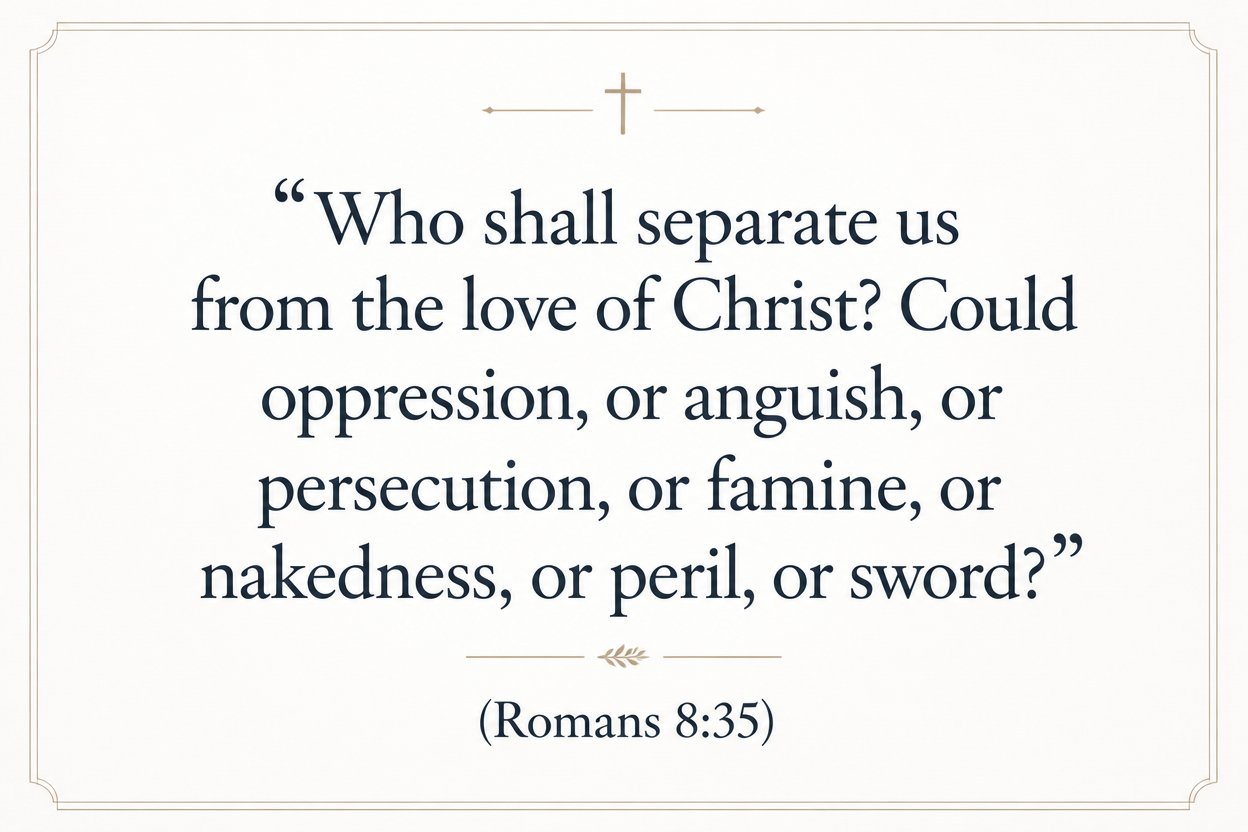
“Who shall separate us from the love of Christ? Could oppression, or anguish, or persecution, or famine, or nakedness, or peril, or sword?” (Romans 8:35)
Here κίνδυνος (“peril”) stands in a chain of nouns that pile up potential forces thought capable of breaking a bond: “oppression… anguish… persecution… famine… nakedness… peril… sword.” The question is framed around separation—“Who shall separate us from the love of Christ?”—and danger is presented as one candidate among others. Within the list, κίνδυνος is not isolated as a single dramatic event; it is grouped with experiences that range from social pressure (“persecution”) to material lack (“famine,” “nakedness”) and direct violence (“sword”). The effect is to treat danger as a real, named threat that belongs to the same category of life-altering pressures as hunger and attack. By placing “peril” between “nakedness” and “sword,” the verse positions danger amid vulnerability and violence, so that danger feels both general (an exposed condition) and immediate (near lethal harm), without defining its source in this sentence.
“I have been in travels often, perils of rivers, perils of robbers, perils from my countrymen, perils from the Gentiles, perils in the city, perils in the wilderness, perils in the sea, perils among false brothers;” (2 Corinthians 11:26)
In this verse κίνδυνος (“perils”) becomes the repeated heading for a catalog of dangers encountered “in travels often.” The recurrence—“perils… perils… perils…”—creates a rhythmic inventory in which danger is not one moment but a continuing feature of movement and ministry. Each phrase specifies a sphere or source: “of rivers,” “of robbers,” “from my countrymen,” “from the Gentiles,” “in the city,” “in the wilderness,” “in the sea,” “among false brothers.” κίνδυνος thus functions like a frame that can be filled with different circumstances: natural hazards (“rivers,” “sea”), criminal threats (“robbers”), social hostility (“from my countrymen,” “from the Gentiles”), geographic settings (“in the city,” “in the wilderness”), and relational risk (“among false brothers”). The list also widens the reader’s imagination of danger: it can come from environment, people, places, and even from those close enough to be called “brothers” yet false. The repeated term keeps these varied threats under one single idea—danger—while the modifiers keep that idea concrete and situational.

Sense and Usage
Across these passages, κίνδυνος names danger in a way that is both comprehensive and adaptable. In Romans 8:35 it appears once, as a member of a broader set of hardships that might be imagined to “separate” someone from “the love of Christ.” The term contributes to the pressure of the list: it adds the category of hazardous exposure, the kind of threat that makes the future uncertain and the body at risk. Because Romans places κίνδυνος alongside deprivation (“famine,” “nakedness”) and violence (“sword”), danger is pictured as part of a spectrum from need to harm—one of several realities that can bear down on a person.
In 2 Corinthians 11:26, κίνδυνος is the organizing word for an extended sequence. The sense of danger is not abstract; it is danger encountered in identifiable contexts, and the verse shows how elastic the term is when paired with descriptors. Danger can be tied to a feature of travel (“rivers”), to the intent of others (“robbers”), to identity-based opposition (“from my countrymen… from the Gentiles”), to contrasting environments (“in the city… in the wilderness”), and even to betrayal or deception within close associations (“among false brothers”). The single word κίνδυνος is able to hold together dangers that differ in cause and setting, suggesting that what unites them is not their source but their shared character as threatening situations.
Read together, the two uses display two complementary ways the word operates. Romans uses “peril” to intensify a rhetorical question about what could break a relationship; danger is one of the pressures that might be expected to do so. Second Corinthians uses “perils” to map danger onto a traveler’s landscape; it is experienced repeatedly and in varied forms. In both, κίνδυνος is not portrayed as a theoretical possibility. It belongs to lived conditions—pressures that can be listed, located, and remembered. The word therefore carries a practical force: it marks those circumstances in which safety is compromised and outcomes are uncertain, whether the threat is generalized (Romans) or itemized (Corinthians).
Imagery
The imagery associated with κίνδυνος in these texts is the imagery of exposure. Romans 8:35 places “peril” in the middle of a stark sequence—need, vulnerability, danger, violence—so that danger is felt as part of a tightening circle around a person’s life. Second Corinthians 11:26 spreads danger across a wide map: rivers, roads stalked by robbers, hostile groups, city streets, wilderness paths, open sea, and treacherous companionship. Together these scenes give “danger” a terrain and a texture: not one dramatic snapshot, but a persistent risk that can arise in any place and from many kinds of encounters.
Sources: Lexical data from Strong’s Exhaustive Concordance and the Translators Brief Lexicon of Extended Strongs for Greek (STEPBible, CC BY). Occurrence data from the Translators Amalgamated Greek New Testament (STEPBible, CC BY). Scripture quotations from the World English Bible (public domain).