
Exploring the Meaning of Kitharodos in Greek
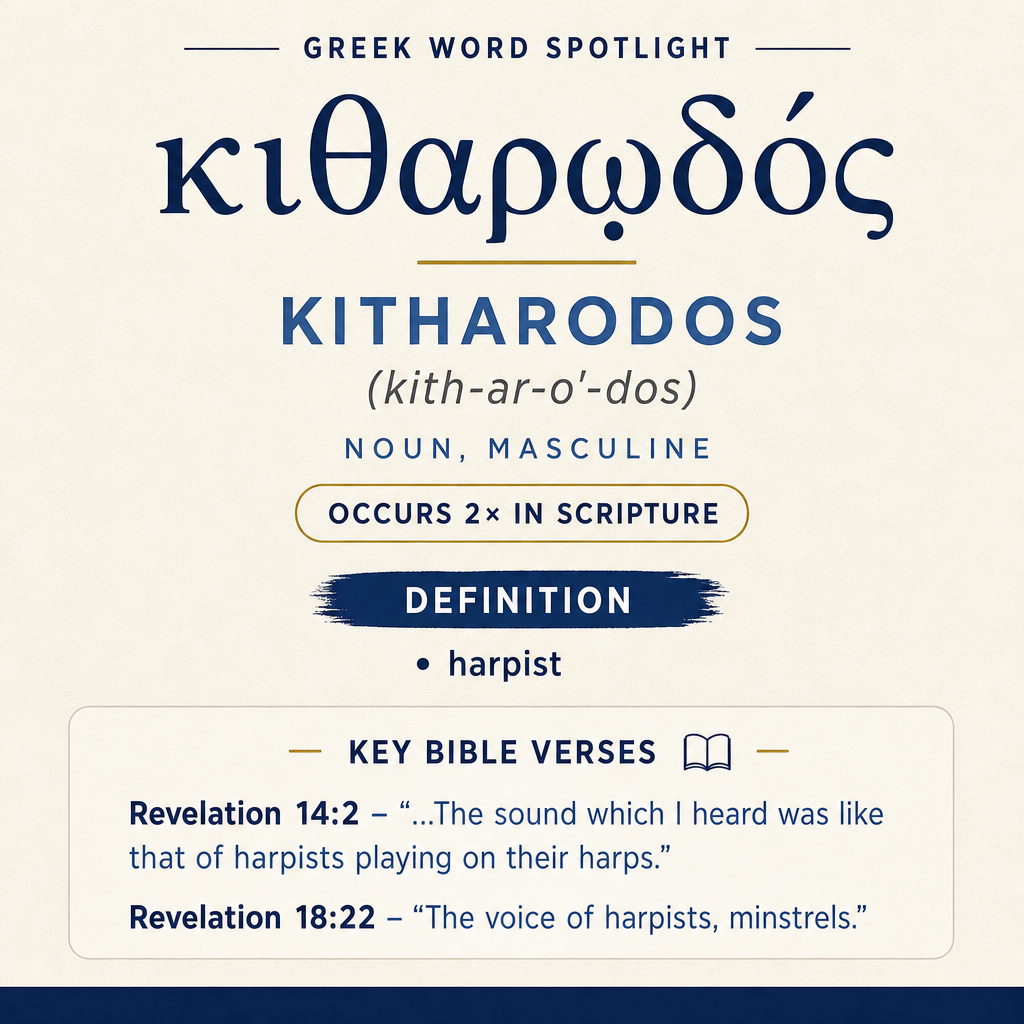
κιθαρῳδός means “harpist” and appears twice in Scripture, in Revelation 14:2 and Revelation 18:22.
Biblical Occurrences
The word occurs 2 times in Scripture. It is found in Revelation 14:2 and Revelation 18:22.
Learn More →Revelation Context
In Revelation 14:2, it appears within a description of a sound heard from heaven. In Revelation 18:22, it is part of a list of musicians whose voices will be heard no more.
Learn More →κιθαρῳδός means “harpist.” It appears in Revelation in two contrasting scenes: heavenly sound in worship and the silencing of music in judgment.
Root and Related Words
κιθαρῳδός is presented with derivation from kithara (κιθάρα), “harp,” and oide (ᾠδή), “song.” These related terms keep the word anchored to music that is both instrumental (harp) and associated with sung performance (song), fitting a designation for a performer identified by the instrument and its musical output.

Occurrences
“I heard a sound from heaven, like the sound of many waters, and like the sound of a great thunder. The sound which I heard was like that of harpists playing on their harps.” (Revelation 14:2)
Here κιθαρῳδός helps shape how the “sound from heaven” is heard and imagined. The verse layers comparisons: it is “like the sound of many waters” and “like the sound of a great thunder,” and then it becomes “like that of harpists playing on their harps.” In that sequence, “harpists” contributes a more detailed, concrete musical analogy within an otherwise immense soundscape. Waters and thunder convey overwhelming volume and force; harpists add texture—music that is performed, patterned, and played. The plural “harpists” and the phrase “playing on their harps” make the sound communal and coordinated rather than solitary or accidental. The word therefore functions to locate the heavenly sound within the recognizable category of performed music: an audible event that can be described not only by loudness but by artistry.
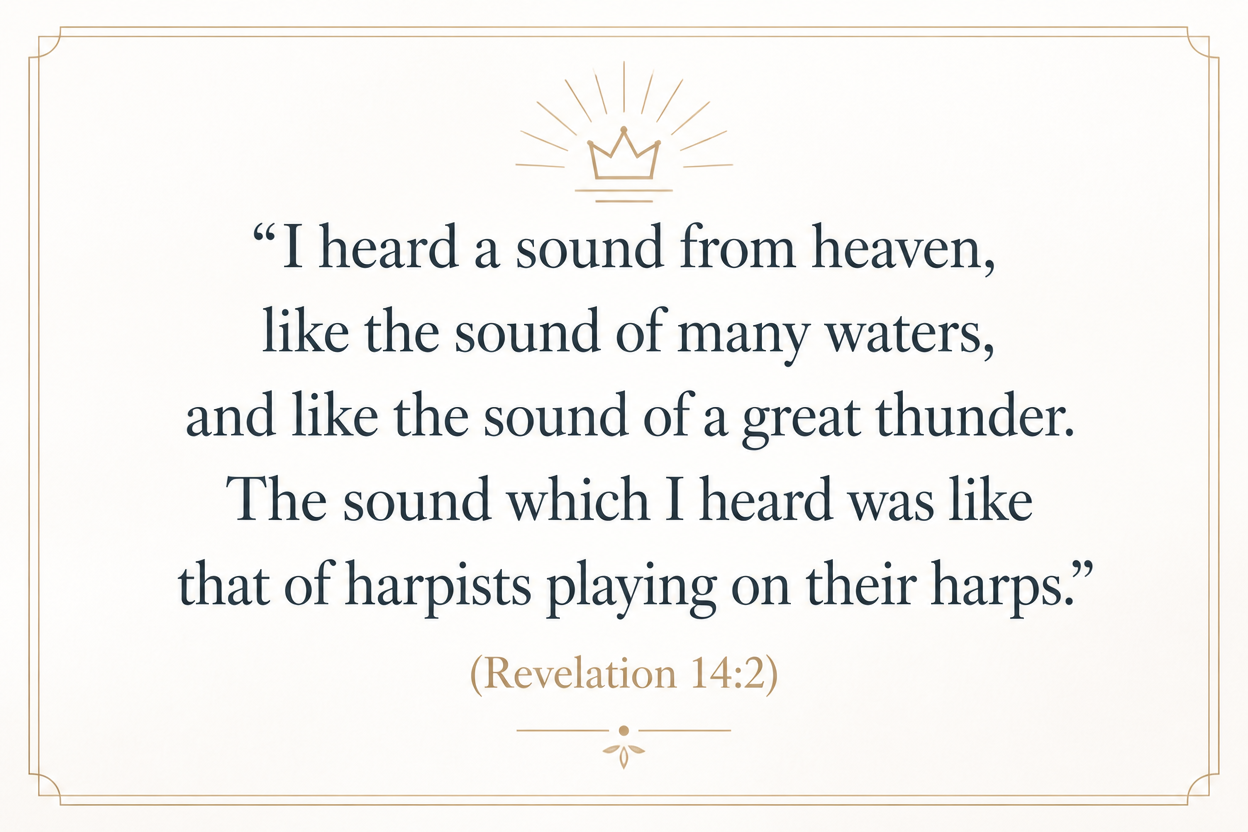
The immediate context of the line also matters: the speaker says, “I heard,” emphasizing perception and the attempt to render what is heard through comparisons. κιθαρῳδός participates in this auditory description as the most explicitly musical element in the verse. It suggests that what is heard is not merely noise but a kind of played sound, with harpists as the agents producing it.
“The voice of harpists, minstrels, flute players, and trumpeters will be heard no more at all in you. No craftsman, of whatever craft, will be found any more at all in you. The sound of a mill will be heard no more at all in you.” (Revelation 18:22)
In Revelation 18:22 κιθαρῳδός appears in a list of sound-makers: “harpists, minstrels, flute players, and trumpeters.” The word stands at the head of the musical catalogue, contributing to a comprehensive picture of music disappearing. The verse is structured with repeated negation—“will be heard no more at all in you” and again “will be heard no more at all in you”—so “harpists” are included as part of what is removed from the place addressed as “you.” Their “voice” (in the phrasing “The voice of harpists”) represents audible presence and cultural life: performers whose music once filled public space.
The verse then moves from music to work: “No craftsman… will be found any more at all in you,” and from work to ordinary sound: “The sound of a mill will be heard no more at all in you.” In that progression, κιθαρῳδός belongs to the first category, the category of artistry and celebration—music made by performers—before the text turns to trades and daily labor. The inclusion of harpists in the series makes the silence total: the end is not limited to commerce or industry but reaches into entertainment and festivity. By naming the performer rather than only the instrument, the line pictures absence not only of harps as objects but of those who play them as living contributors to a city’s sound.
Sense and Usage
Across these two occurrences, κιθαρῳδός is consistently used for a musician defined by harp performance. The contexts are both dominated by sound, and the word functions to specify a recognizable type of music-making within larger auditory imagery. In Revelation 14:2, the harpists are a positive point of comparison: the heavenly sound is likened to the playing of harpists, setting the experience in the realm of music rather than mere natural phenomena. The comparison does not reduce the sound’s magnitude—waters and thunder remain in view—but it adds a distinctively musical frame, suggesting that what is heard carries intentionality and performance.
In Revelation 18:22, the word is part of a roster of performers and instruments, and the emphasis falls on their disappearance: the “voice of harpists” will not be heard. In this setting, a harpist represents more than an individual musician; the harpist stands for an audible culture—music as a public, shared experience—now removed. The phrasing treats the harpist’s output as “voice,” a term that naturally fits performers whose work is meant to be heard and that can include the presence of music as a hallmark of life in a place.
Taken together, the two passages show κιθαρῳδός operating at two ends of Revelation’s sound imagery: on one side, an overwhelming heavenly sound described with musical likeness; on the other, the total cessation of music within a judged city. The word’s contribution is therefore not merely to name a musician but to help the reader hear the scene—either by adding musical color to a heavenly auditory experience or by sharpening the sense of silence through the removal of familiar performers.
Imagery
Revelation’s use of κιθαρῳδός carries vivid auditory imagery. “Harpists playing on their harps” (Revelation 14:2) evokes a layered sound that can be imagined as structured and performed, even while it is compared to waters and thunder. Conversely, “The voice of harpists… will be heard no more at all in you” (Revelation 18:22) evokes an emptied soundscape, where artistry, celebration, and ordinary human activity are all muted. In both, the harpist is a marker of what fills the air—either heavenly music heard from above or the absence of music within a place brought to silence.
Sources: Lexical data from Strong’s Exhaustive Concordance and the Translators Brief Lexicon of Extended Strongs for Greek (STEPBible, CC BY). Occurrence data from the Translators Amalgamated Greek New Testament (STEPBible, CC BY). Scripture quotations from the World English Bible (public domain).





