Exploring the Meaning of Keleuo in Greek
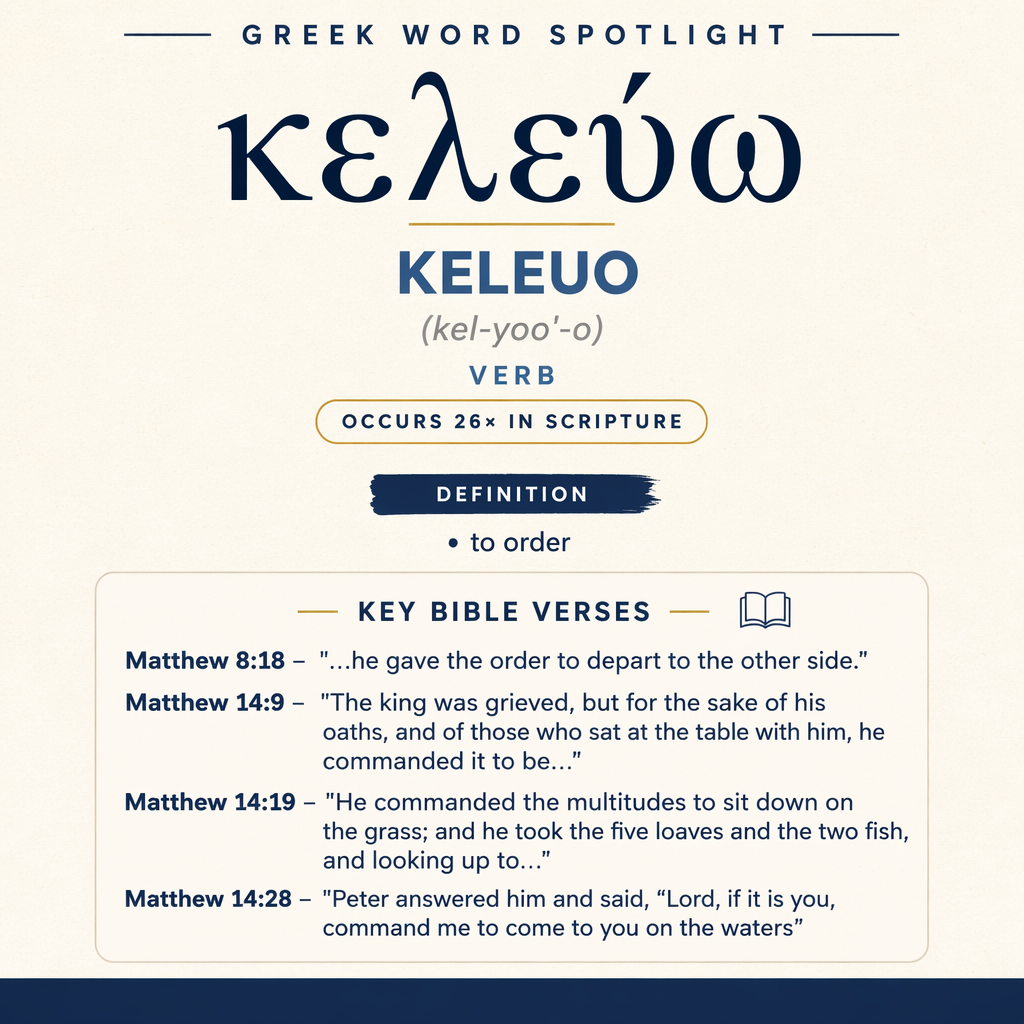
κελεύω means “to order” and occurs 26 times in Scripture, including Matthew 8:18; 14:9,19,28; 18:25; 27:58,64 and Luke 18:40.
Core Meaning
κελεύω means “to order.” In the listed passages, it describes giving a command or directive.
Learn More →Gospel Commands
In Matthew, it is used for commands by Jesus and by authorities like the king and Pilate (e.g., Matthew 14:9; 27:58). It also appears in Luke 18:40 when Jesus commands someone be brought to him.
Learn More →Scene Examples
It is used for ordering travel (Matthew 8:18) and instructing crowds (Matthew 14:19). It also appears in requests for commands, such as “command me to come” (Matthew 14:28).
Learn More →κελεύω expresses an act of ordering: a speaker issues a directive that sets another person (or a situation) into motion. In the passages below, it appears in settings ranging from Jesus directing movements and actions, to rulers and councils issuing binding commands in judicial or administrative contexts.
Occurrences
Matthew 8:18 — “Now when Jesus saw great multitudes around him, he gave the order to depart to the other side.”
Here κελεύω marks a decisive instruction that changes the group’s immediate course. The order arises from Jesus’ perception of “great multitudes,” and it results in departure “to the other side,” presenting the command as a concrete decision about movement and destination.

Matthew 14:9 — “The king was grieved, but for the sake of his oaths, and of those who sat at the table with him, he commanded it to be given,”
In this scene the ordering is set within royal authority and social pressure. Although “grieved,” the king issues a command shaped by “his oaths” and the presence of “those who sat at the table with him,” portraying κελεύω as an authoritative act that proceeds even against personal reluctance when public commitments are at stake.
Matthew 14:19 — “He commanded the multitudes to sit down on the grass; and he took the five loaves and the two fish, and looking up to heaven, he blessed, broke and gave the loaves to the disciples, and the disciples gave to the multitudes.”
κελεύω here organizes the crowd for what follows. The command (“to sit down on the grass”) is practical and preparatory; it arranges the “multitudes” into a posture suitable for distribution as Jesus blesses and breaks the food and the disciples pass it on. The ordering functions as a structured step within a larger sequence of actions.
Matthew 14:28 — “Peter answered him and said, “Lord, if it is you, command me to come to you on the waters.””
In Peter’s request, κελεύω is treated as the enabling directive that authorizes a risky movement. The wording frames the command as contingent (“if it is you”) and personal (“command me”), with a specific goal (“to come to you”) and an extraordinary setting (“on the waters”). The verb thus carries the force of a spoken order that would govern Peter’s immediate action.
Matthew 18:25 — “But because he couldn’t pay, his lord commanded him to be sold, with his wife, his children, and all that he had, and payment to be made.”
Here κελεύω conveys a punitive or coercive order within a debt situation. The command is tied to inability (“because he couldn’t pay”) and expands to encompass family and property (“his wife, his children, and all that he had”), with the stated aim “and payment to be made.” The ordering is not merely advisory; it activates consequences affecting multiple people.
Matthew 27:58 — “This man went to Pilate, and asked for Jesus’ body. Then Pilate commanded the body to be given up.”
In this exchange κελεύω indicates an official authorization responding to a request. The act of ordering comes from Pilate and concerns the release of “the body,” so the command functions as a formal decision that permits transfer from custody to the petitioner.
Matthew 27:64 — “Command therefore that the tomb be made secure until the third day, lest perhaps his disciples come at night and steal him away, and tell the people, ‘He is risen from the dead;’ and the last deception will be worse than the first.”
κελεύω here is an appeal for preventative security measures. The desired order is specific (“that the tomb be made secure until the third day”) and justified by an anticipated scenario: disciples might “come at night and steal him away” and announce a message to “the people.” The command is portrayed as a protective directive meant to control outcomes and public perception.
Luke 18:40 — “Standing still, Jesus commanded him to be brought to him. When he had come near, he asked him,”
In Luke’s account, κελεύω moves the encounter from a crowd setting into direct access. Jesus “standing still” issues an order that someone be “brought to him,” and the command results in proximity (“When he had come near”). The verb underlines Jesus’ authority to summon and arrange an interaction before speaking further.
Acts 4:15 — “But when they had commanded them to go aside out of the council, they conferred among themselves,”
Within a council setting, κελεύω signals procedural control. The command removes certain persons (“them”) from the deliberation space (“to go aside out of the council”), enabling the council to “confer among themselves.” The ordering sets boundaries on who may be present during decision-making.
Acts 5:34 — “But one stood up in the council, a Pharisee named Gamaliel, a teacher of the law, honored by all the people, and commanded to put the apostles out for a little while.”
Here κελεύω again functions as a procedural instruction, this time associated with Gamaliel’s intervention. The command “to put the apostles out for a little while” creates a temporary exclusion that frames the council’s process. The short duration (“for a little while”) highlights that the order governs the immediate conduct of the hearing.
Acts 8:38 — “He commanded the chariot to stand still, and they both went down into the water, both Philip and the eunuch, and he baptized him.”
In this travel scene, κελεύω is a practical order directed to a vehicle’s movement: “the chariot” is commanded “to stand still.” The effect is immediate and physical, enabling subsequent actions—both men “went down into the water,” and baptism follows. The ordering marks the transition from travel to a stationary moment of action.
Acts 12:19 — “When Herod had sought for him, and didn’t find him, he examined the guards, then commanded that they should be put to death. He went down from Judea to Caesarea, and stayed there.”
κελεύω here conveys a ruler’s severe command following an investigation. Herod’s actions proceed from search (“sought for him”) to examination (“he examined the guards”) to a final order of execution (“commanded that they should be put to death”). The command is portrayed as the decisive outcome of failed retrieval and inquiry.

Sense and Usage
Across these occurrences, κελεύω consistently presents ordering as an exercise of recognized authority that brings about an immediate, concrete result. The directive may govern movement (departing to the other side; bringing someone near; stopping a chariot), posture and arrangement (the multitudes sitting on the grass), or access and procedure (sending people out of the council; putting the apostles out briefly). In each case the command is not merely a suggestion; it sets conditions that others follow, and it reshapes the situation in view of what is about to happen.
The verb also operates in settings where the stakes vary widely. Some commands are logistical and preparatory, facilitating a sequence of actions already underway (crowd arrangement before distribution of food; stilling the chariot before entering the water). Others are legal or administrative and carry institutional weight: a king commands something to be given despite grief; a lord orders the sale of a debtor’s household for payment; Pilate’s command releases a body; a council’s commands control deliberations; Herod’s command enacts capital punishment. Even when the text foregrounds emotion or persuasion—grief at a banquet, caution about a “last deception,” or a council’s need to confer—the ordering remains the pivotal act that converts motive into enforceable action.
Several passages highlight the purpose or rationale attached to commands. Matthew 27:64 connects the order to a projected chain of events (“lest perhaps his disciples come at night… and tell the people…”), showing how an order can be framed as prevention. Matthew 18:25 ties the command to a stated goal (“and payment to be made”), showing an order aimed at resolving an obligation by force. Luke 18:40 shows the command as the means to establish a setting for questioning (“When he had come near, he asked him”), making the order the gateway into dialogue. Matthew 14:28 portrays an order as the necessary authorization for a person to act in a perilous context, placing the initiative in the commander’s word.
Imagery
The scenes collectively give κελεύω a vivid, situational texture: a shoreline departure amid “great multitudes,” people seated on grass awaiting food, a lone figure being brought close to Jesus, doors of a council chamber closing behind those sent out, a chariot halted on a road, and a tomb secured against intrusion. In each, the act of ordering is pictured as a spoken decision that rearranges space, movement, and access—sometimes for care and coordination, sometimes for control and judgment.
Sources: Lexical data from Strong’s Exhaustive Concordance and the Translators Brief Lexicon of Extended Strongs for Greek (STEPBible, CC BY). Occurrence data from the Translators Amalgamated Greek New Testament (STEPBible, CC BY). Scripture quotations from the World English Bible (public domain).