
Exploring the Meaning of Keleuma in Greek
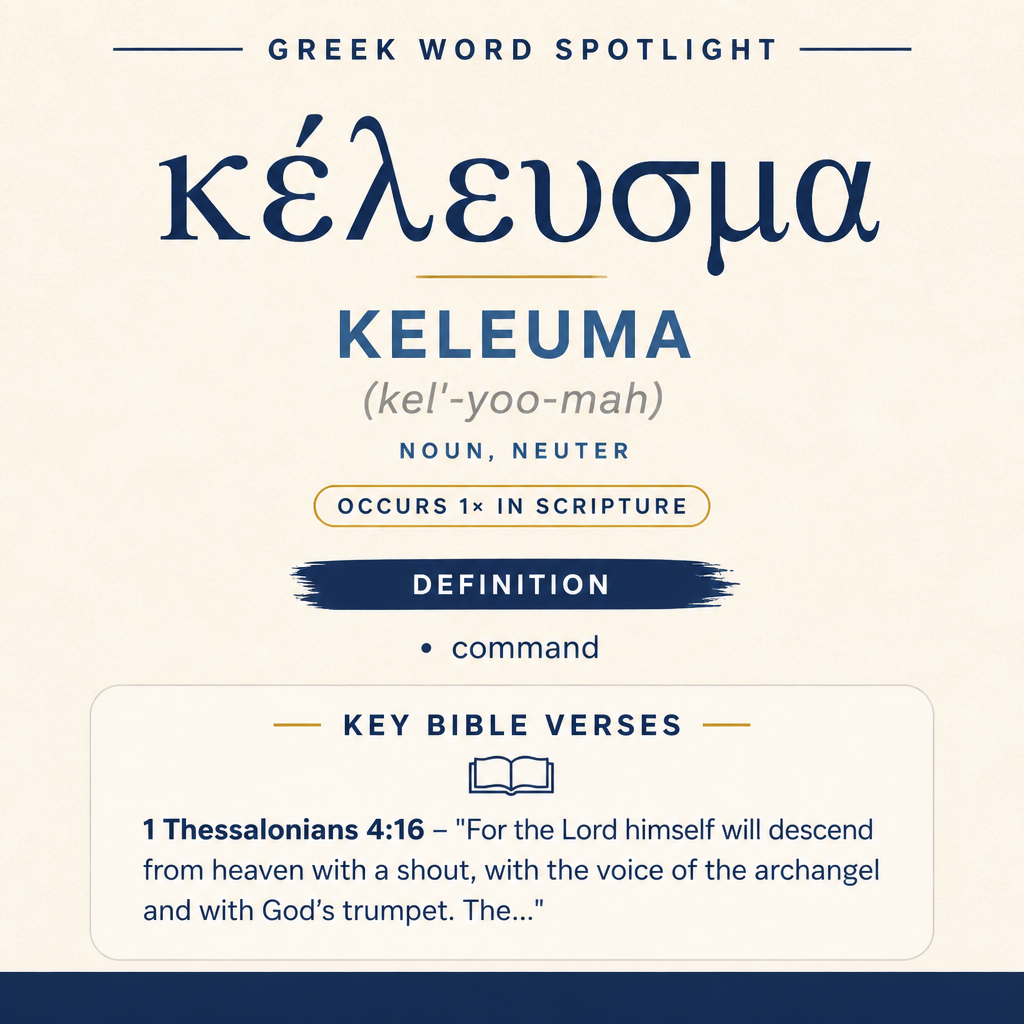
κέλευσμα means “command” and appears once in Scripture, in 1 Thessalonians 4:16.
Scripture Occurrence
This Greek word occurs 1 time in Scripture. Its single reference is 1 Thessalonians 4:16.
Learn More →Verse Context
In 1 Thessalonians 4:16, the Lord descends from heaven “with a shout,” alongside the voice of the archangel and God’s trumpet.
Learn More →κέλευσμα means “command” and appears once in the New Testament, in Paul’s description of the Lord’s descent from heaven in 1 Thessalonians 4:16. In that verse it belongs to a cluster of audible signals that accompany the event.
Root and Related Words
κέλευσμα (Keleuma) derives from the verb keleuo (κελεύω), “to order” (Strong’s G2753). The relationship is visible in how the noun names the issued order itself—an utterance characterized by its authoritative, directive force.

Occurrences
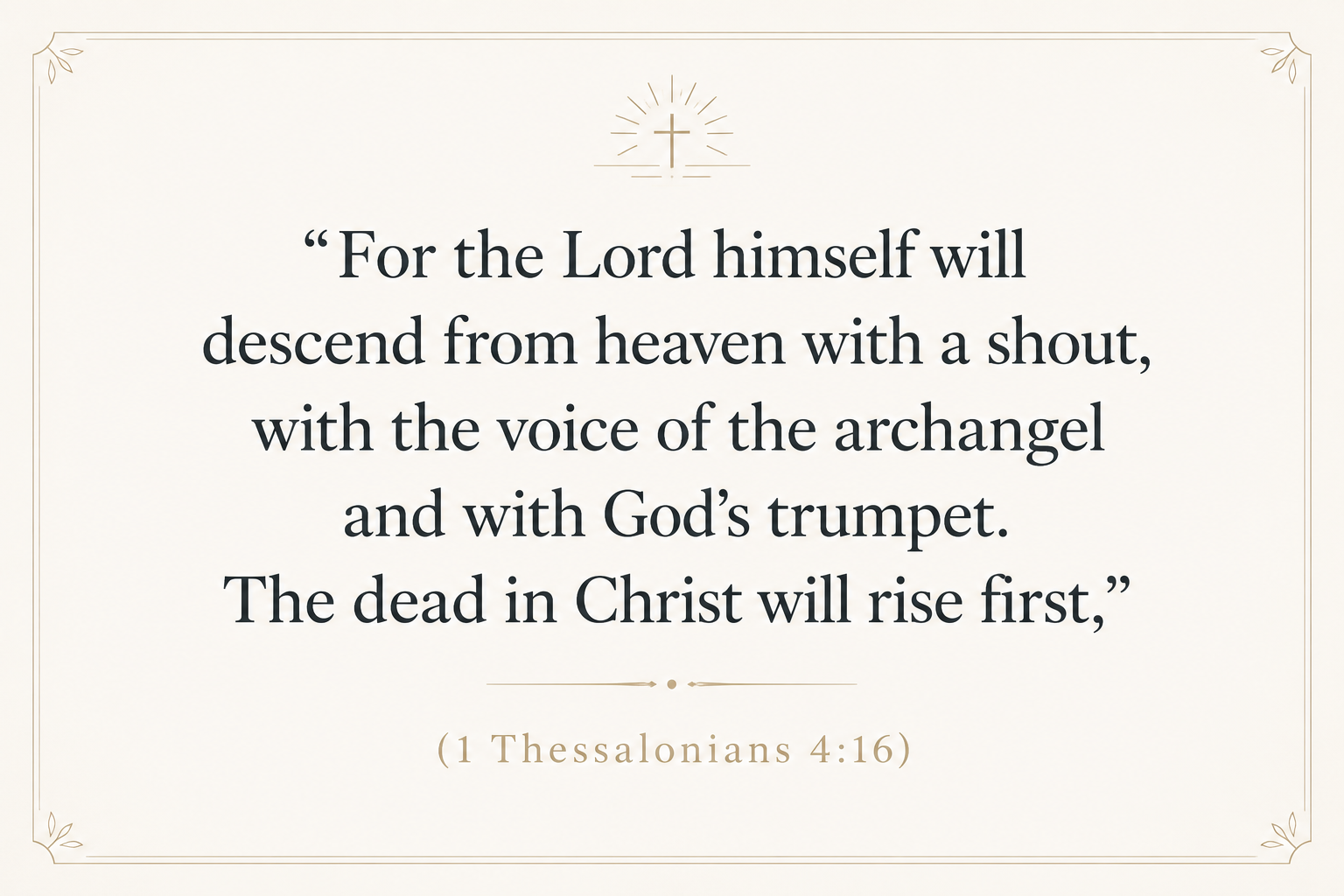
“For the Lord himself will descend from heaven with a shout, with the voice of the archangel and with God’s trumpet. The dead in Christ will rise first,” (1 Thessalonians 4:16)
In 1 Thessalonians 4:16, κέλευσμα stands within a threefold description of sound: “with a shout,” “with the voice of the archangel,” and “with God’s trumpet.” Within that sequence, the word contributes the idea of an issued order as part of the descent “from heaven.” The verse presents the descent as public and audible rather than silent or hidden; κέλευσμα is one of the sounds that marks the moment as an enacted directive rather than a mere announcement.
The verse also connects these sounds to an effect in the created order: “The dead in Christ will rise first.” In that immediate context, κέλευσμα functions as one element in the audible setting that frames the action that follows. The command is not described in content—no words are quoted—but it is described in company: it is paired with “the voice of the archangel” and “God’s trumpet,” giving the scene the character of coordinated proclamation and summons. The noun therefore helps portray the descent as an event that comes with authority and direction, an act that brings about the stated outcome.
Sense and Usage
The definition “command” fits the way κέλευσμα operates here: it is an authoritative signal associated with the Lord’s own descent. A command differs from a mere sound in that it implies an ordering force—something that directs, summons, or brings about obedience—yet the verse leaves the command’s wording implicit and instead emphasizes its setting and accompaniment. The surrounding phrases supply the texture: the command belongs to a moment marked by “the voice of the archangel” and “God’s trumpet,” combining personal voice and instrumental blast, and locating the action in a heavenly-to-earth movement (“will descend from heaven”).
Because κέλευσμα appears alongside other auditory markers, it is best read as part of a coordinated sequence of signals rather than as an isolated cry. Paul’s phrasing arranges these sounds as parallel items introduced by “with,” which places κέλευσμα in the same descriptive layer as the archangel’s voice and the trumpet. This parallelism assigns it a functional role: it is one component of how the descent is manifested and how the ensuing action is set in motion. The clause that follows—“The dead in Christ will rise first”—shows that the scene is not merely about noise; it is about a decisive, ordered event in which an authoritative directive accompanies the Lord’s coming and is associated with resurrection.
Within this single attestation, κέλευσμα carries a distinctly event-shaping force. It does not merely color the atmosphere; it belongs to the mechanism of the moment as Paul narrates it. The emphasis on command, voice, and trumpet together also underscores that the descent is portrayed as unmistakable: not only is there a command, there is also a named heavenly herald (“the archangel”) and a divine instrument (“God’s trumpet”). In that setting, κέλευσμα serves to anchor the scene in the category of authoritative summons—an ordering sound that fits the Lord’s initiative (“the Lord himself will descend”) and the immediate consequence (“will rise first”).
Imagery
The imagery attached to κέλευσμα in 1 Thessalonians 4:16 is the imagery of audible authority arriving from heaven. A “command” is heard in the same moment as an archangelic voice and a trumpet belonging to God, and the verse places these sounds at the juncture between descent and rising. The word therefore participates in a picture of coordinated heavenly proclamation whose purpose is not description alone but decisive action within the scene.
Sources: Lexical data from Strong’s Exhaustive Concordance and the Translators Brief Lexicon of Extended Strongs for Greek (STEPBible, CC BY). Occurrence data from the Translators Amalgamated Greek New Testament (STEPBible, CC BY). Scripture quotations from the World English Bible (public domain).





