Who was Jeduthun in the bible?
Jeduthun was an Israelite mentioned in Chronicles and Nehemiah, connected with temple music and thanksgiving to Yahweh and named in several genealogical lines.

Worship Service
“With them Heman and Jeduthun with trumpets and cymbals” and “instruments for the songs of God” (1 Chronicles 16:42). “Asaph, Jeduthun, and Heman” are named for “song in Yahweh’s house” (1 Chronicles 25:6).
Learn More →Family Mentions
Genealogies include “Galal, the son of Jeduthun” (1 Chronicles 9:16) and “Abda… the son of Galal, the son of Jeduthun” (Nehemiah 11:17). His descendants are listed as “the sons of Jeduthun” (1 Chronicles 25:3).
Learn More →Jeduthun (an Israelite name used in Chronicles and Nehemiah) is presented as a figure associated with appointed service of thanks and music, and also appears as an ancestor in genealogies. The name is described in a lexicon gloss as laudatory, derived from a Hebrew root connected with “yadah.”
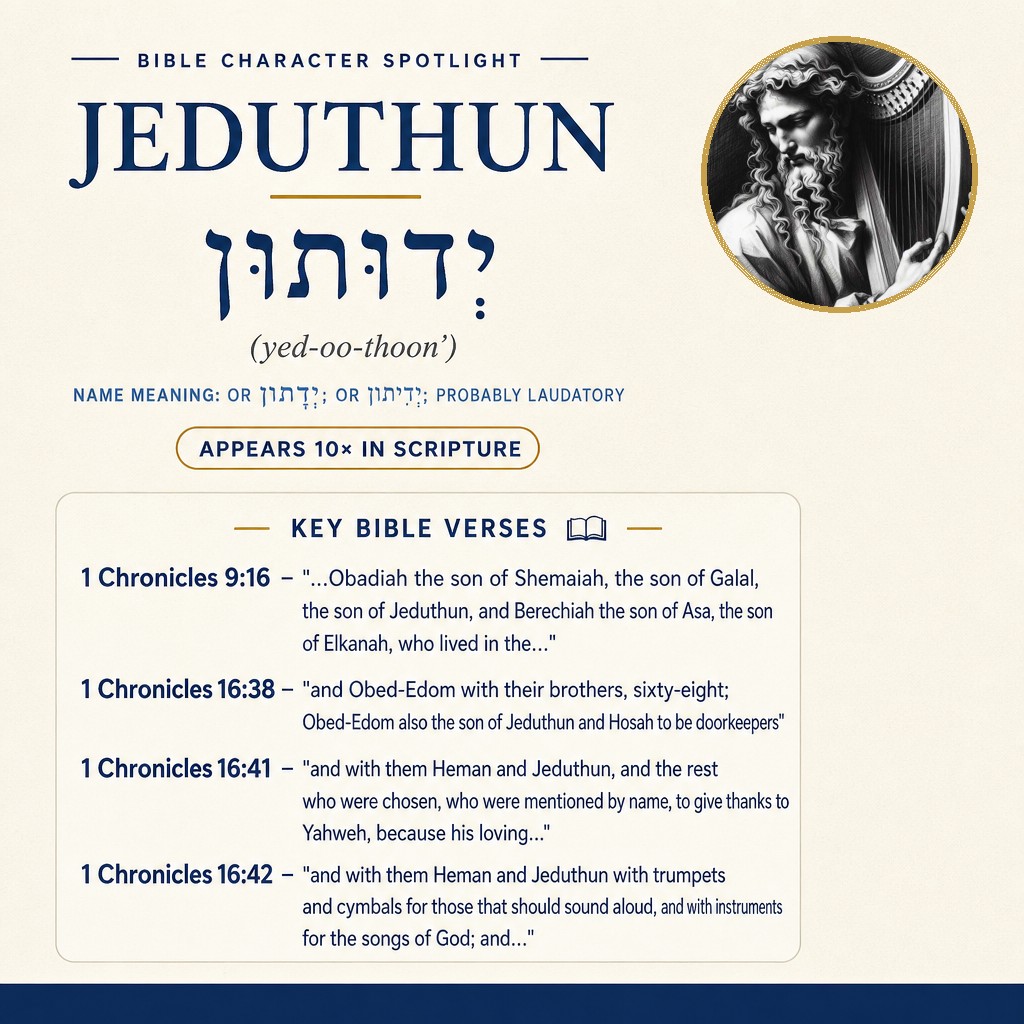
Jeduthun in Scripture
Jeduthun first appears in genealogical notices. In a list connected with Jerusalem inhabitants, he is named as an ancestor of Obadiah:
“and Obadiah the son of Shemaiah, the son of Galal, the son of Jeduthun” (1 Chronicles 9:16).
A parallel genealogical line in Nehemiah likewise traces Abda back to Jeduthun:
“and Abda the son of Shammua, the son of Galal, the son of Jeduthun.” (Nehemiah 11:17)
In Nehemiah’s same verse, thanksgiving and prayer are in view through others named in the list:
“Mattaniah… who was the chief to begin the thanksgiving in prayer” (Nehemiah 11:17).
Jeduthun is then named within a larger narrative of ordered worship surrounding the ark. The chapter begins with the ark being set in place and offerings being made:
“They brought in God’s ark, and set it in the middle of the tent that David had pitched for it; and they offered burnt offerings and peace offerings before God.” (1 Chronicles 16:1)
After the offerings, blessing and provision are described:
“When David had finished offering the burnt offering and the peace offerings, he blessed the people in Yahweh’s name.” (1 Chronicles 16:2)
and
“He gave to everyone of Israel… a loaf of bread, a portion of meat, and a cake of raisins.” (1 Chronicles 16:3)
Within this setting, Levites are appointed to minister with a focus on remembrance, thanks, and praise:
“He appointed some of the Levites to minister before Yahweh’s ark, and to commemorate, to thank, and to praise Yahweh, the God of Israel:” (1 Chronicles 16:4)
The musical character of this ministry is illustrated by named personnel and instruments:
“Asaph the chief… with stringed instruments and with harps; and Asaph with cymbals, sounding aloud;” (1 Chronicles 16:5)
and
“with Benaiah and Jahaziel the priests with trumpets continually, before the ark of the covenant of God.” (1 Chronicles 16:6)
The chapter includes a lengthy, spoken or sung call to give thanks and proclaim Yahweh’s works, beginning with:
“Oh give thanks to Yahweh. Call on his name. Make what he has done known among the peoples.” (1 Chronicles 16:8)
and repeating the theme later:
“Oh give thanks to Yahweh, for he is good, for his loving kindness endures forever.” (1 Chronicles 16:34)
The chapter closes that section with congregational assent:
“Blessed be Yahweh, the God of Israel, from everlasting even to everlasting. All the people said, “Amen,” and praised Yahweh.” (1 Chronicles 16:36)
In the practical arrangements that follow, Jeduthun is named in the assignments. One part of the narrative describes ongoing service before the ark and then names doorkeepers, including a man identified as Jeduthun’s son:
“So he left Asaph and his brothers there before the ark of Yahweh’s covenant, to minister before the ark continually, as every day’s work required;” (1 Chronicles 16:37)
and
“and Obed-Edom with their brothers, sixty-eight; Obed-Edom also the son of Jeduthun and Hosah to be doorkeepers;” (1 Chronicles 16:38).
Another assignment names Jeduthun directly alongside Heman in a role defined by giving thanks:
“and with them Heman and Jeduthun, and the rest who were chosen, who were mentioned by name, to give thanks to Yahweh, because his loving kindness endures forever;” (1 Chronicles 16:41)
and again with instruments and a gate-related duty for his sons:
“and with them Heman and Jeduthun with trumpets and cymbals for those that should sound aloud, and with instruments for the songs of God; and the sons of Jeduthun to be at the gate.” (1 Chronicles 16:42)
Additional lists expand on the sons of Jeduthun and their musical service. In an organized roster, six sons are named and their father’s activity is described in striking terms:
“Of Jeduthun, the sons of Jeduthun: Gedaliah, Zeri, Jeshaiah, Shimei, Hashabiah, and Mattithiah, six, under the hands of their father Jeduthun, who prophesied in giving thanks and praising Yahweh with the harp.” (1 Chronicles 25:3)
This same organizational context aligns Jeduthun with Asaph and Heman under royal order and places them in the song-service of Yahweh’s house:
“All these were under the hands of their father for song in Yahweh’s house, with cymbals, stringed instruments, and harps, for the service of God’s house: Asaph, Jeduthun, and Heman being under the order of the king.” (1 Chronicles 25:6)
Later, Jeduthun is named among Levite singers standing in fine linen with instruments:
“also the Levites who were the singers, all of them, even Asaph, Heman, Jeduthun, and their sons and their brothers, arrayed in fine linen, with cymbals and stringed instruments and harps, stood at the east end of the altar” (2 Chronicles 5:12).
A separate list names two “sons of Jeduthun”:
“and of the sons of Jeduthun, Shemaiah and Uzziel.” (2 Chronicles 29:14)
Another passage places “Jeduthun” alongside David, Asaph, and Heman, and adds a distinctive title to him:
“The singers the sons of Asaph were in their place, according to the commandment of David, Asaph, Heman, and Jeduthun the king’s seer; and the gatekeepers were at every gate.” (2 Chronicles 35:15)
Multiple bearers
The name Jeduthun appears both as a personal name within genealogies and as the name of a leading figure associated with singers, instruments, and thanksgiving. Genealogically, Jeduthun is the ancestor named in:
“Galal, the son of Jeduthun” (1 Chronicles 9:16)
and again in a similar chain:
“Galal, the son of Jeduthun” (Nehemiah 11:17).
In narratives and rosters of worship service, Jeduthun is named alongside Heman and Asaph (1 Chronicles 16:41–42; 1 Chronicles 25:6; 2 Chronicles 5:12), and his “sons” are repeatedly associated with gate duty and music (1 Chronicles 16:42; 1 Chronicles 25:3; 2 Chronicles 29:14).
Name and Meaning
Jeduthun is written in Hebrew as יְדוּתוּן (transliterated Yeduwthuwn; pronounced “yed-oo-thoon’”). A lexicon description characterizes it as probably derived from H3034 and “laudatory,” with a component in the root yadah (יָדָה), glossed as “physically, to throw (a stone, an arrow).”
Observation
Across the passages where he is named directly, Jeduthun is repeatedly linked with publicly ordered thanksgiving—“to give thanks to Yahweh” (1 Chronicles 16:41)—and with musical instruments used “for the songs of God” (1 Chronicles 16:42).
Frequently Asked Questions
What does the name Jeduthun mean?
Jeduthun is described as a laudatory name.
How many times does Jeduthun appear in the Bible?
Jeduthun appears 10 times.
Who was Jeduthun?
Jeduthun is identified as an Israelite. He is mentioned among Levites who were singers alongside Asaph and Heman (2 Chronicles 5:12).
What role is Jeduthun shown having in worship music?
Jeduthun is shown serving in song and giving thanks, named with Heman among those chosen “to give thanks to Yahweh” (1 Chronicles 16:41).
Explore Further
If you found this page about Jeduthun interesting and would like to discover more about other biblical characters, explore our comprehensive Encyclopedia of Biblical Characters. For those looking to delve deeper into the Greek origins of these names and terms, our Greek Lexicon is an invaluable resource.
Sources: Name and occurrence data from Strong’s Exhaustive Concordance and STEPBible reference data (CC BY). Scripture quotations from the World English Bible (public domain).