
Who was Hiel in the bible?
Hiel was a Bethelite mentioned in 1 Kings 16:34 for building Jericho during Ahab’s days.

Cost and Word
He “laid its foundation with the loss of Abiram his firstborn, and set up its gates with the loss of his youngest son Segub… according to Yahweh’s word” (1 Kings 16:34).
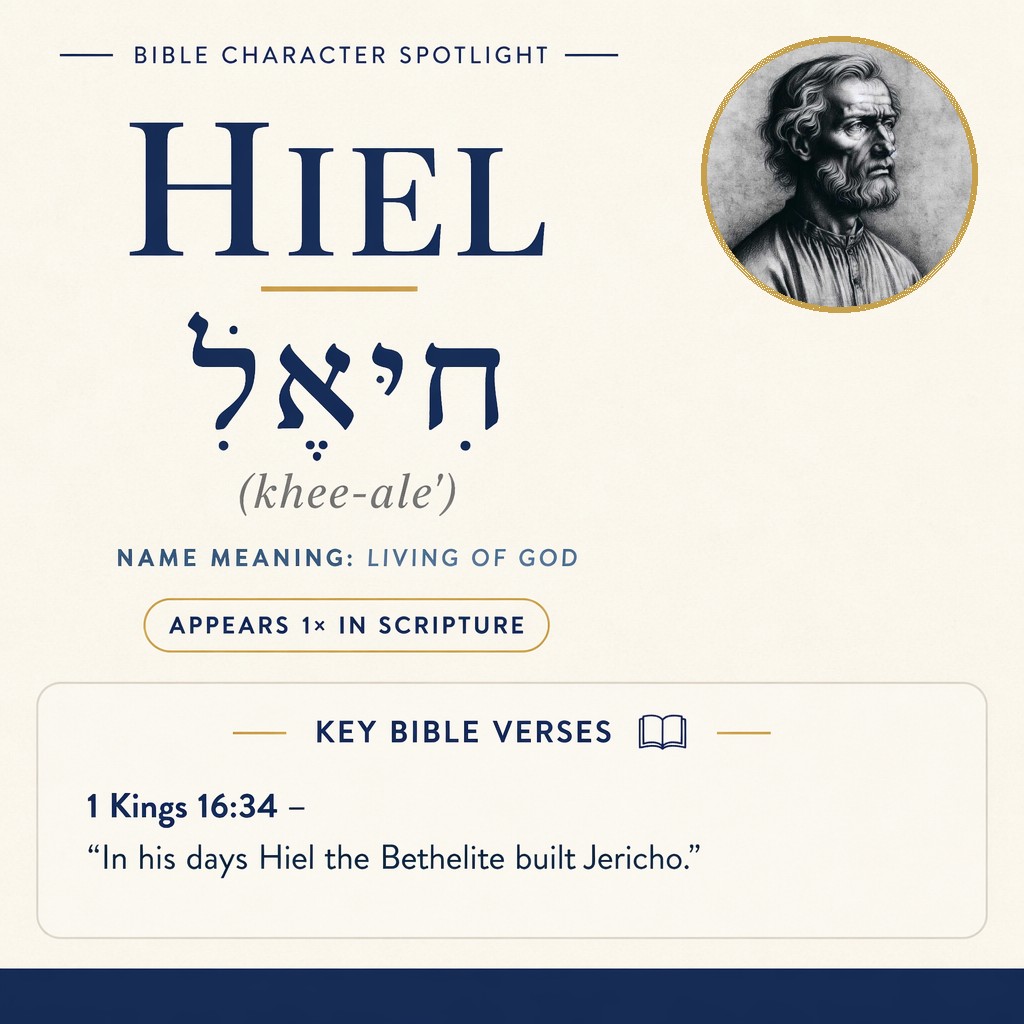
Learn More →Hiel was an Israelite identified as “the Bethelite,” remembered in Scripture for rebuilding Jericho. His Hebrew name (Chiy’el) is derived from elements meaning “alive” and “God,” yielding a sense like “living of God.”
Hiel in Scripture
Hiel appears in a brief narrative set within a description of actions that provoked Yahweh during the days of Ahab. The chapter context first describes religious building and worship associated with Baal and Asherah:
“He raised up an altar for Baal in the house of Baal, which he had built in Samaria.” (1 Kings 16:32)
“Ahab made the Asherah; and Ahab did more yet to provoke Yahweh, the God of Israel, to anger than all the kings of Israel who were before him.” (1 Kings 16:33)
Within that setting, Hiel is introduced and a specific act is attributed to him: he “built Jericho.” The verse links this rebuilding to the death of two of his sons, naming them and tying their losses to the stages of construction—laying the foundation and setting up the gates. The text also states that these events occurred “according to Yahweh’s word,” specifically a word “which he spoke by Joshua the son of Nun.”
“In his days Hiel the Bethelite built Jericho. He laid its foundation with the loss of Abiram his firstborn, and set up its gates with the loss of his youngest son Segub, according to Yahweh’s word, which he spoke by Joshua the son of Nun.” (1 Kings 16:34)
This single verse provides the fullest portrait of Hiel. He is described by origin or association as “the Bethelite.” His rebuilding of Jericho is narrated as a process with two highlighted milestones: the foundation and the gates. At the foundation, the text states he did so “with the loss of Abiram his firstborn,” and at the gates he did so “with the loss of his youngest son Segub.” The names of these sons—Abiram and Segub—are given only in connection with their deaths (“loss”) as Jericho was rebuilt.
The narrative’s final clause makes a theological claim about the meaning of what occurred: it happened “according to Yahweh’s word.” The verse specifies that the word had been spoken “by Joshua the son of Nun,” and it presents Hiel’s experience as the point at which that word was realized in connection with Jericho’s rebuilding.
Name and Meaning
Hiel’s name is written in Hebrew as חִיאֵל and transliterated Chiy’el (pronounced khee-ale’). Strong’s derivation explains it as formed from components meaning “alive” (chay, חַי) and “God” (’el, אֵל, “strength,” used as a term for God), giving the sense “living of God.”
Observation
The only biblical notice of Hiel links his building project—“Hiel the Bethelite built Jericho”—with personal loss “according to Yahweh’s word,” explicitly connecting the deaths of Abiram and Segub to the rebuilding’s foundation and gates (1 Kings 16:34).
Frequently Asked Questions
What does the name Hiel mean?
Hiel means “living of God.”
How many times does Hiel appear in the Bible?
Hiel appears 1 time.
Who was Hiel?
Hiel (Chiel) is identified as an Israelite, and in 1 Kings 16:34 he is called “Hiel the Bethelite.”
What is Hiel known for doing?
In 1 Kings 16:34, Hiel the Bethelite built Jericho, laying its foundation with the loss of Abiram his firstborn and setting up its gates with the loss of his youngest son.
Explore Further
If you found this page about Hiel interesting and would like to discover more about other biblical characters, explore our comprehensive Encyclopedia of Biblical Characters. For those looking to delve deeper into the Greek origins of these names and terms, our Greek Lexicon is an invaluable resource.
Sources: Name and occurrence data from Strong’s Exhaustive Concordance and STEPBible reference data (CC BY). Scripture quotations from the World English Bible (public domain).





