Who was Guni in the bible?
Guni is a name borne by two Israelites, appearing in genealogies in Genesis 46:24, Numbers 26:48, 1 Chronicles 5:15, and 1 Chronicles 7:13.

Naphtali Line
Guni appears in Naphtali’s genealogy: “The sons of Naphtali: Jahziel, Guni, Jezer, Shallum, and the sons of Bilhah” (1 Chronicles 7:13). His name is also used for a clan: “of Guni, the family of the Gunites” (Numbers 26:48).
Learn More →Chronicles Reference
A different Guni is named in a genealogy as an ancestor of Ahi: “Ahi the son of Abdiel, the son of Guni, chief of their fathers’ houses” (1 Chronicles 5:15). The name is commonly explained as meaning “protected.”
Learn More →Guni is the name of two Israelites in the Bible. In one line of Scripture, Guni appears among the sons of Naphtali; in another, Guni appears in a different genealogy as an ancestor of a family leader named Ahi.
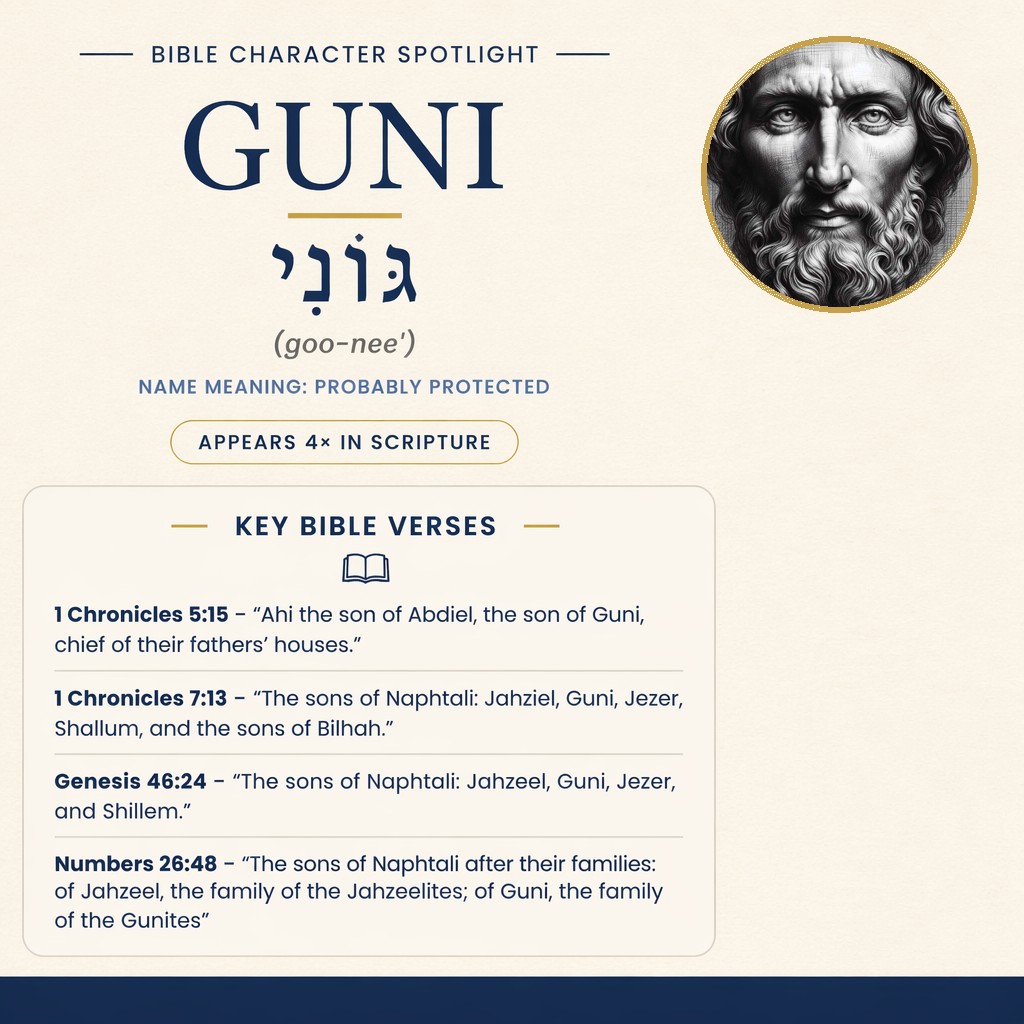
Guni in Scripture
The earliest mentions of Guni in the provided passages occur in lists describing the sons of Naphtali. In Genesis, Guni is listed among Naphtali’s sons in a context that also names Bilhah in the surrounding verses.
“The sons of Naphtali: Jahzeel, Guni, Jezer, and Shillem.” (Genesis 46:24)
Later, in Numbers, the same family line is framed in terms of tribal families “after their families,” where Guni becomes the eponym for a named clan within Naphtali.
“The sons of Naphtali after their families: of Jahzeel, the family of the Jahzeelites; of Guni, the family of the Gunites;” (Numbers 26:48)
The surrounding lines continue listing Naphtali’s other families and conclude with a summary statement about Naphtali’s families and those counted from them.
“of Jezer, the family of the Jezerites; of Shillem, the family of the Shillemites.” (Numbers 26:49)
“These are the families of Naphtali according to their families; and those who were counted of them were forty-five thousand four hundred.” (Numbers 26:50)
In Chronicles, Guni again appears among Naphtali’s sons, closely matching the Genesis list (with some spelling differences in other names) and situated among other tribal genealogies.
“The sons of Naphtali: Jahziel, Guni, Jezer, Shallum, and the sons of Bilhah.” (1 Chronicles 7:13)
In a separate genealogical context, Guni is named as the grandfather of Ahi through Abdiel. Here Guni is not placed in Naphtali’s line in the verse itself; rather, the verse identifies Guni as an ancestor within a line that ends with a leader described as “chief of their fathers’ houses.”
“Ahi the son of Abdiel, the son of Guni, chief of their fathers’ houses.” (1 Chronicles 5:15)
The immediate setting around this statement in 1 Chronicles 5 describes related households, lineage notices, and where “they lived,” giving a brief picture of the group’s location and military characterization in the wider passage. First, the text notes “brothers of their fathers’ houses” by name.
“Their brothers of their fathers’ houses: Michael, Meshullam, Sheba, Jorai, Jacan, Zia, and Eber, seven.” (1 Chronicles 5:13)
It then provides another line of ancestry for “sons of Abihail,” and soon after identifies Ahi’s descent from Guni.
“These were the sons of Abihail, the son of Huri, the son of Jaroah, the son of Gilead, the son of Michael, the son of Jeshishai, the son of Jahdo, the son of Buz;” (1 Chronicles 5:14)
“Ahi the son of Abdiel, the son of Guni, chief of their fathers’ houses.” (1 Chronicles 5:15)
The passage then states where “they lived,” followed by notes about genealogical registration and the military character of the tribes named in the broader context.
“They lived in Gilead in Bashan, and in its towns, and in all the pasture lands of Sharon, as far as their borders.” (1 Chronicles 5:16)
“All these were listed by genealogies in the days of Jotham king of Judah, and in the days of Jeroboam king of Israel.” (1 Chronicles 5:17)
“The sons of Reuben, the Gadites, and the half-tribe of Manasseh, of valiant men, men able to bear buckler and sword, and to shoot with bow, and skillful in war, were forty-four thousand seven hundred sixty, that were able to go out to war.” (1 Chronicles 5:18)
Multiple Bearers
The lexicon gloss describes “Guni” as the name of two Israelites, and the provided verses reflect two distinct uses of the name.
1) Guni in the line of Naphtali. In both Genesis and 1 Chronicles, Guni is named as one of “The sons of Naphtali,” and in Numbers this same Guni is connected to a clan designation within Naphtali: “of Guni, the family of the Gunites” (Numbers 26:48).
2) Guni in a separate genealogy. In 1 Chronicles 5, Guni appears as an ancestor in the line “Ahi the son of Abdiel, the son of Guni” (1 Chronicles 5:15). In that context, Ahi is described as “chief of their fathers’ houses” (1 Chronicles 5:15), and the surrounding passage locates the group: “They lived in Gilead in Bashan, and in its towns, and in all the pasture lands of Sharon, as far as their borders” (1 Chronicles 5:16).
Name and Meaning
The name is written in Hebrew as גּוּנִי, transliterated Guwniy, and pronounced “goo-nee’.” According to the provided name derivation, it is probably from H1598 and carries the sense “protected,” connected with the component word ganan (גָּנַן), “to hedge about, i.e. (generally) protect.”
Observation
Across the passages, the name Guni functions in two genealogical ways: once as a son-name within Naphtali that becomes a family designation (“the family of the Gunites,” Numbers 26:48), and once as an ancestor named in a line culminating in a “chief of their fathers’ houses” (1 Chronicles 5:15).
Frequently Asked Questions
What does the name Guni mean?
The name Guni is given as meaning “protected.”
How many times does Guni appear in the Bible?
Guni appears 4 times.
Who was Guni in the Bible?
Guni is the name of two Israelites. One Guni is listed among the sons of Naphtali (Genesis 46:24; 1 Chronicles 7:13).
What is the family of the Gunites?
Numbers 26:48 mentions “of Guni, the family of the Gunites,” listing them among the sons of Naphtali by their families.
Explore Further
If you found this page about Guni interesting and would like to discover more about other biblical characters, explore our comprehensive Encyclopedia of Biblical Characters. For those looking to delve deeper into the Greek origins of these names and terms, our Greek Lexicon is an invaluable resource.
Sources: Name and occurrence data from Strong’s Exhaustive Concordance and STEPBible reference data (CC BY). Scripture quotations from the World English Bible (public domain).