
Who was Gideon in the bible?
Gideon was an Israelite, the son of Joash, who appears in Judges 6 as Yahweh’s angel called him to save Israel from Midian.
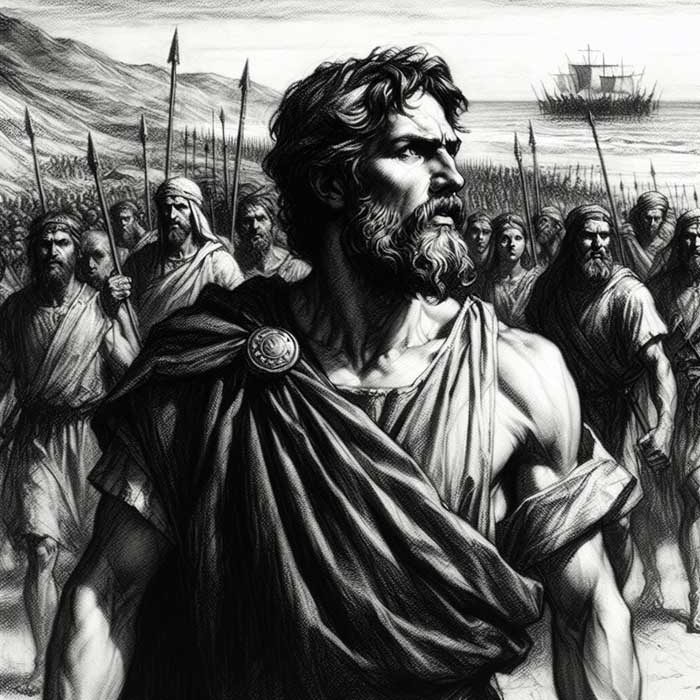
Call and Signs
Yahweh said, “Go in this your might, and save Israel from the hand of Midian. Haven’t I sent you?” (Judges 6:14). Gideon asked for confirmation with a fleece (Judges 6:36–40).
Learn More →Name and Meaning
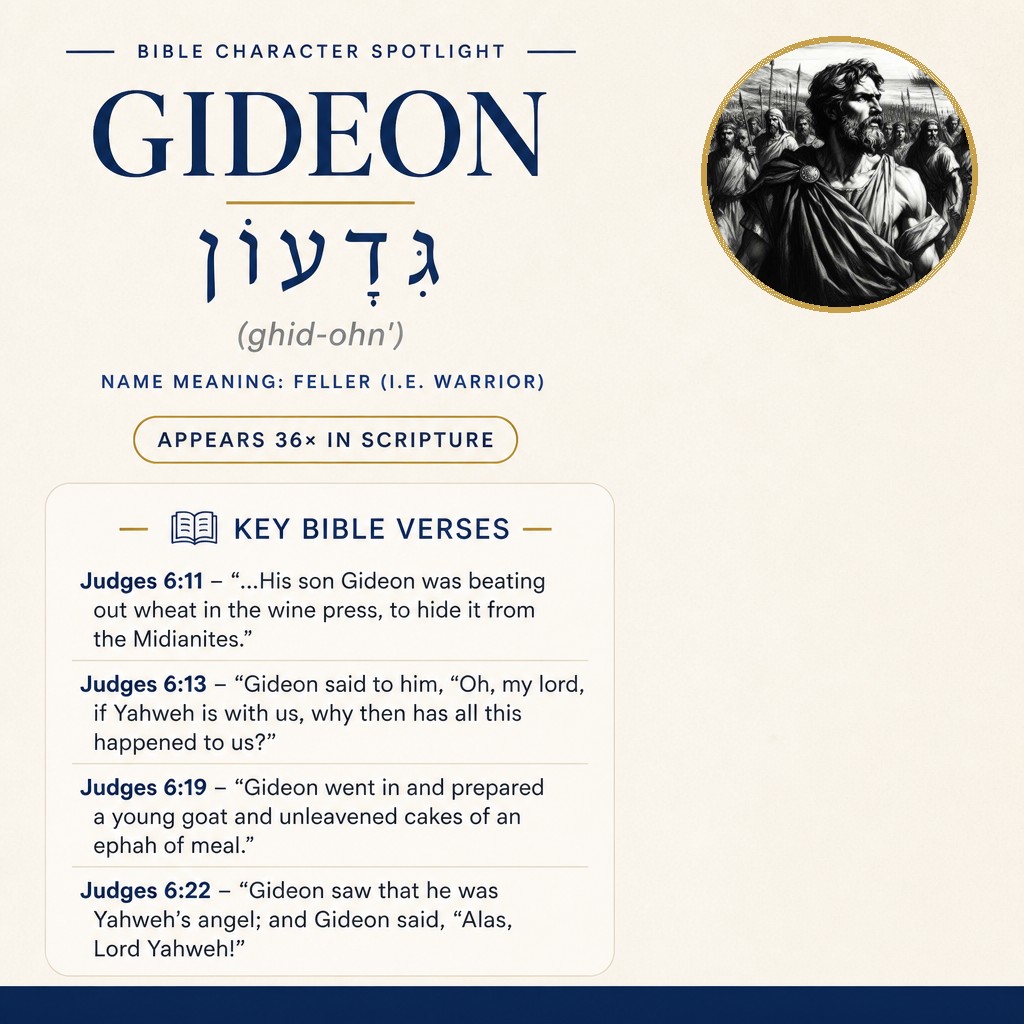
In a lexicon gloss, the name Gideon (Hebrew גִּדְעוֹן, Gid'own) is linked with the idea of a “feller” or warrior, from a root meaning to fell or destroy. In Judges 6, Joash “named him Jerub-Baal” after Gideon broke down Baal’s altar (Judges 6:32).
Learn More →Gideon (Gid’own) is presented as an Israelite, introduced in Judges as the son of Joash the Abiezrite. The lexicon-derived sense of his name is connected with felling or destroying, and so carries the idea of a “feller,” that is, a warrior.
Gideon in Scripture
The narrative setting begins with Israel’s distress: “The children of Israel did that which was evil in Yahweh’s sight, so Yahweh delivered them into the hand of Midian seven years” (Judges 6:1). Midian’s dominance forced survival measures: “because of Midian the children of Israel made themselves the dens which are in the mountains, the caves, and the strongholds” (Judges 6:2). The pressure is described in repeated incursions and loss of produce and livestock (Judges 6:3–5), so that “Israel was brought very low because of Midian; and the children of Israel cried to Yahweh” (Judges 6:6).
In response to their cry, Yahweh sent a prophet who recalled Yahweh’s past deliverance and identified Israel’s disobedience: “Yahweh, the God of Israel, says, ‘I brought you up from Egypt, and brought you out of the house of bondage… But you have not listened to my voice’” (Judges 6:8, 10). Within this setting Gideon is introduced in a specific locale and family line.
“Yahweh’s angel came and sat under the oak which was in Ophrah, that belonged to Joash the Abiezrite. His son Gideon was beating out wheat in the wine press, to hide it from the Midianites.” (Judges 6:11)
Gideon is addressed by Yahweh’s angel with a surprising identification:
“Yahweh’s angel appeared to him, and said to him, ‘Yahweh is with you, you mighty man of valor!’” (Judges 6:12)
Gideon’s first recorded response is a protest shaped by the nation’s suffering and by remembered tradition:
“Gideon said to him, ‘Oh, my lord, if Yahweh is with us, why then has all this happened to us? Where are all his wondrous works which our fathers told us of, saying, “Didn’t Yahweh bring us up from Egypt?” But now Yahweh has cast us off, and delivered us into the hand of Midian.’” (Judges 6:13)
Yahweh’s commission and promise follow, framing Gideon as the appointed means of deliverance:
“Yahweh looked at him, and said, ‘Go in this your might, and save Israel from the hand of Midian. Haven’t I sent you?’” (Judges 6:14)
Gideon replies with humility about his standing within his tribe and household: “Behold, my family is the poorest in Manasseh, and I am the least in my father’s house” (Judges 6:15). Yahweh answers with personal assurance: “Surely I will be with you, and you shall strike the Midianites as one man” (Judges 6:16). Gideon asks for confirmation—“show me a sign that it is you who talk with me” (Judges 6:17)—and prepares a gift for the angel.
“Gideon went in and prepared a young goat and unleavened cakes of an ephah of meal. He put the meat in a basket and he put the broth in a pot, and brought it out to him under the oak, and presented it.” (Judges 6:19)
The sign comes when the offering is consumed by fire from the rock (Judges 6:20–21). Gideon recognizes who he has encountered:
“Gideon saw that he was Yahweh’s angel; and Gideon said, ‘Alas, Lord Yahweh! Because I have seen Yahweh’s angel face to face!’” (Judges 6:22)
Yahweh’s reply is reassurance: “Peace be to you! Don’t be afraid. You shall not die” (Judges 6:23). Gideon responds with worship at the place of encounter:
“Then Gideon built an altar there to Yahweh, and called it ‘Yahweh is Peace.’ To this day it is still in Ophrah of the Abiezrites.” (Judges 6:24)
That same night Gideon receives a command that brings the crisis into his own community: he is told to “throw down the altar of Baal that your father has, and cut down the Asherah that is by it” (Judges 6:25), then to “build an altar to Yahweh your God… and… offer a burnt offering with the wood of the Asherah which you shall cut down” (Judges 6:26). Gideon carries out the command with help but in fear:
“Then Gideon took ten men of his servants, and did as Yahweh had spoken to him. Because he feared his father’s household and the men of the city, he could not do it by day, but he did it by night.” (Judges 6:27)
When the city discovers what happened, the people investigate and identify him explicitly:
“They said to one another, ‘Who has done this thing?’ When they inquired and asked, they said, ‘Gideon the son of Joash has done this thing.’” (Judges 6:29)
The men of the city demand that Joash surrender Gideon for death (Judges 6:30). Joash’s defense challenges Baal’s ability to contend: “If he is a god, let him contend for himself, because someone has broken down his altar!” (Judges 6:31). The episode results in a new name given that day: “Therefore on that day he named him Jerub-Baal, saying, ‘Let Baal contend against him, because he has broken down his altar’” (Judges 6:32). The narrative thereby ties Gideon’s actions directly to conflict with Baal worship in his locality.
As external threat gathers—“all the Midianites and the Amalekites and the children of the east assembled themselves together” and camp in “the valley of Jezreel” (Judges 6:33)—Gideon is empowered and becomes a rallying figure for his kin group and beyond:
“But Yahweh’s Spirit came on Gideon, and he blew a trumpet; and Abiezer was gathered together to follow him.” (Judges 6:34)
He broadens the call: “He sent messengers throughout all Manasseh… [and] to Asher, and to Zebulun, and to Naphtali; and they came up to meet them” (Judges 6:35). Yet Gideon continues to seek confirmation of Yahweh’s promised deliverance. He frames his request in terms of Yahweh’s spoken intention: “If you will save Israel by my hand, as you have spoken” (Judges 6:36). He proposes a test involving a fleece of wool (Judges 6:37). The text records the result: “It was so; for he rose up early on the next day… and wrung the dew out of the fleece, a bowl full of water” (Judges 6:38). Gideon then asks for a second test, carefully requesting patience:
“Gideon said to God, ‘Don’t let your anger be kindled against me, and I will speak but this once. Please let me make a trial just this once with the fleece. Let it now be dry only on the fleece, and on all the ground let there be dew.’” (Judges 6:39)
The chapter concludes with the fulfillment of that request: “God did so that night; for it was dry on the fleece only, and there was dew on all the ground” (Judges 6:40). In the next stage of the story (represented here by selected citations), Yahweh speaks directly to Gideon about the number of people with him, emphasizing that victory should not become Israel’s boast:
“Yahweh said to Gideon, ‘The people who are with you are too many for me to give the Midianites into their hand, lest Israel brag against me, saying, “My own hand has saved me.”’” (Judges 7:2)
Yahweh indicates that further reduction/testing is required: “There are still too many people. Bring them down to the water, and I will test them for you there…” (Judges 7:4). Within the verses provided, this is the extent of the described events beyond Judges 6.
Name and Meaning
The name is written גִּדְעוֹן, transliterated Gid’own, and pronounced “ghid-ohn’.” According to the lexicon-derived explanation, it is connected to a root meaning to fell a tree, and more generally to destroy; from this comes the sense of a “feller,” understood as a warrior. In Judges, the man bearing this name is identified by household and clan setting as “Gideon the son of Joash” (Judges 6:29) in “Ophrah… of the Abiezrites” (Judges 6:24).
Restrained Observation
In the material cited, Gideon is portrayed as both fearful and responsive—acting “by night” because he “feared” (Judges 6:27), yet also building an altar called “Yahweh is Peace” after hearing, “Peace be to you! Don’t be afraid” (Judges 6:23–24).
Frequently Asked Questions
What does the name Gideon mean?
Gideon means “feller,” understood as “warrior.”
How many times does Gideon appear in the Bible?
Gideon occurs 36 times.
Who was Gideon?
Gideon (Gidon) is identified as an Israelite. In Judges 6:11, he is described as the son of Joash, beating out wheat in a wine press.
What did Gideon do when he realized he had seen Yahweh’s angel?
He said, “Alas, Lord Yahweh! Because I have seen Yahweh’s angel face to face!” (Judges 6:22).
Explore Further
If you found this page about Gideon interesting and would like to discover more about other biblical characters, explore our comprehensive Encyclopedia of Biblical Characters. For those looking to delve deeper into the Greek origins of these names and terms, our Greek Lexicon is an invaluable resource.
Sources: Name and occurrence data from Strong’s Exhaustive Concordance and STEPBible reference data (CC BY). Scripture quotations from the World English Bible (public domain).





