Who was Gaal in the bible?
Gaal, the son of Ebed, appears in Judges 9 as a man trusted by Shechem who challenged Abimelech and was later driven out.

What He Said
Gaal said, “Who is Abimelech, and who is Shechem, that we should serve him?” (Judges 9:28). He also said to Abimelech, “Increase your army and come out!” (Judges 9:29).
Learn More →How It Ended
“Gaal went out before the men of Shechem, and fought with Abimelech” (Judges 9:39). “Zebul drove out Gaal and his brothers, that they should not dwell in Shechem” (Judges 9:41).
Learn More →Gaal was an Israelite identified as “Gaal the son of Ebed,” who came to Shechem with his brothers and became a figure of opposition to Abimelech. His name is connected (by lexicon derivation) with the idea of loathing or detesting, with an underlying sense of rejecting.
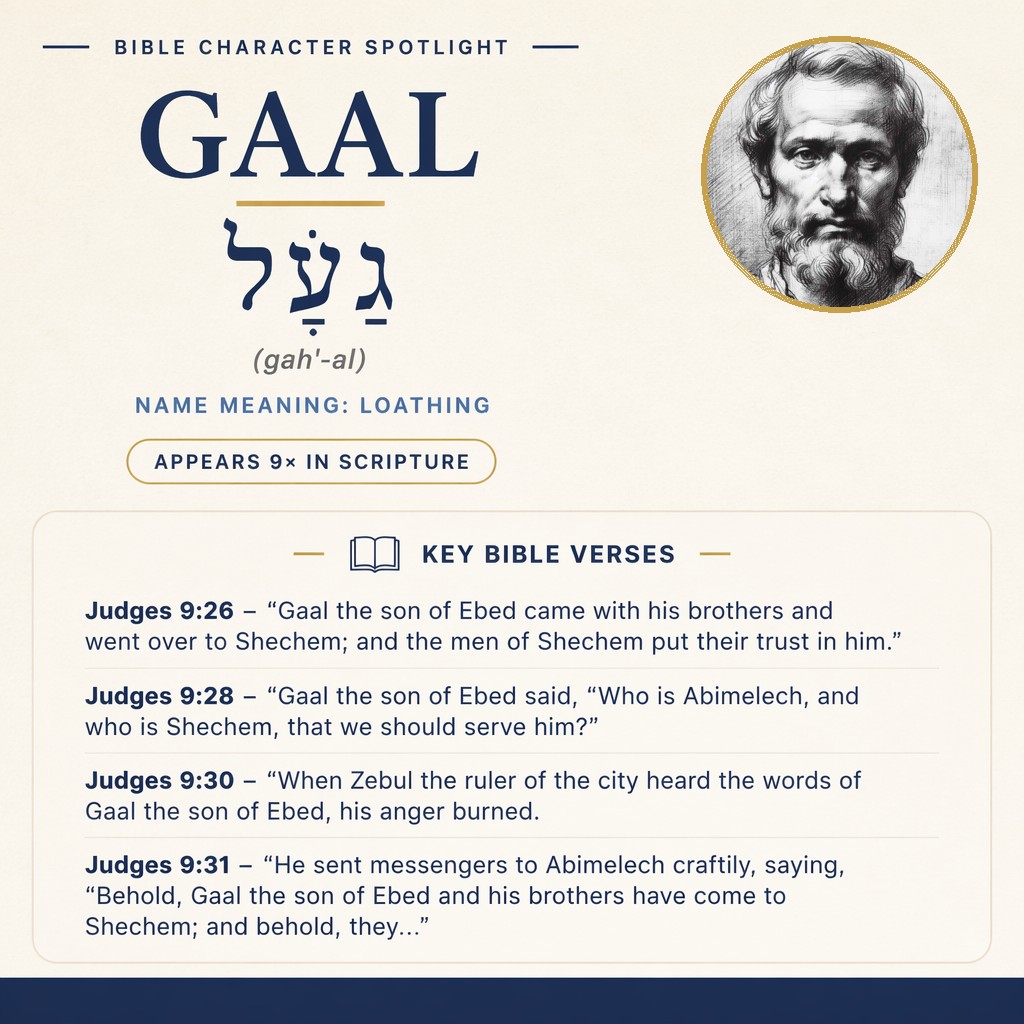
Gaal in Scripture
Gaal appears within the narrative of Judges 9, a chapter centered on Abimelech’s rise to power in Shechem and the subsequent breakdown between Abimelech and the men of Shechem. Abimelech sought rule by appealing to his connection with Shechem through his mother’s family:
Judges 9:2 (WEB): “Please speak in the ears of all the men of Shechem, ‘Is it better for you that all the sons of Jerubbaal, who are seventy persons, rule over you, or that one rule over you?’ Remember also that I am your bone and your flesh.”
The men of Shechem responded by supporting Abimelech:
Judges 9:3 (WEB): “His mother’s brothers spoke of him in the ears of all the men of Shechem all these words. Their hearts inclined to follow Abimelech; for they said, ‘He is our brother.’”
With resources provided from “the house of Baal Berith,” Abimelech gathered followers, killed the sons of Jerubbaal (except Jotham, who escaped), and was made king at Shechem:
Judges 9:4 (WEB): “They gave him seventy pieces of silver out of the house of Baal Berith, with which Abimelech hired vain and reckless fellows who followed him.”
Judges 9:6 (WEB): “All the men of Shechem assembled themselves together with all the house of Millo, and went and made Abimelech king by the oak of the pillar that was in Shechem.”
Jotham publicly addressed the men of Shechem from Mount Gerizim and pronounced a conditional blessing and curse regarding their choice of Abimelech, culminating in this warning:
Judges 9:20 (WEB): “but if not, let fire come out from Abimelech and devour the men of Shechem and the house of Millo; and let fire come out from the men of Shechem and from the house of Millo and devour Abimelech.”
After Abimelech’s time as prince, conflict grew between him and Shechem:
Judges 9:23 (WEB): “Then God sent an evil spirit between Abimelech and the men of Shechem; and the men of Shechem dealt treacherously with Abimelech,”
In this setting, Gaal enters the story. He arrived with his brothers and gained the confidence of the Shechemites:
Judges 9:26 (WEB): “Gaal the son of Ebed came with his brothers and went over to Shechem; and the men of Shechem put their trust in him.”
During festivities associated with vineyard harvest, the people of Shechem “cursed Abimelech” (Judges 9:27). Gaal then spoke openly against Abimelech’s legitimacy and challenged the idea of serving him:
Judges 9:28 (WEB): “Gaal the son of Ebed said, ‘Who is Abimelech, and who is Shechem, that we should serve him? Isn’t he the son of Jerubbaal? Isn’t Zebul his officer? Serve the men of Hamor the father of Shechem, but why should we serve him?’”
Gaal’s opposition went beyond words. He expressed ambition to displace Abimelech and dared him to respond militarily:
Judges 9:29 (WEB): “I wish that this people were under my hand! Then I would remove Abimelech.” He said to Abimelech, “Increase your army and come out!”
At this point the narrative highlights Zebul, described as “the ruler of the city,” who reacted strongly to Gaal’s statements:
Judges 9:30 (WEB): “When Zebul the ruler of the city heard the words of Gaal the son of Ebed, his anger burned.”
Zebul secretly informed Abimelech of Gaal’s presence and influence in Shechem:
Judges 9:31 (WEB): “He sent messengers to Abimelech craftily, saying, ‘Behold, Gaal the son of Ebed and his brothers have come to Shechem; and behold, they incite the city against you.’”
Following Zebul’s counsel, Abimelech positioned forces in ambush by night (Judges 9:32–34). In the morning, Gaal stood at the city gate as Abimelech’s men emerged from concealment:
Judges 9:35 (WEB): “Gaal the son of Ebed went out, and stood in the entrance of the gate of the city. Abimelech rose up, and the people who were with him, from the ambush.”
Gaal saw movement and reported it to Zebul, who attempted at first to dismiss Gaal’s perception:
Judges 9:36 (WEB): “When Gaal saw the people, he said to Zebul, ‘Behold, people are coming down from the tops of the mountains.’ Zebul said to him, ‘You see the shadows of the mountains as if they were men.’”
Gaal insisted, identifying multiple groups advancing:
Judges 9:37 (WEB): “Gaal spoke again and said, ‘Behold, people are coming down by the middle of the land, and one company comes by the way of the oak of Meonenim.’”
Zebul then confronted Gaal with his earlier defiance and pressed him to act on his own challenge:
Judges 9:38 (WEB): “Then Zebul said to him, ‘Now where is your mouth, that you said, ‘Who is Abimelech, that we should serve him?’ Isn’t this the people that you have despised? Please go out now and fight with them.’”
Gaal went out with the men of Shechem and engaged Abimelech:
Judges 9:39 (WEB): “Gaal went out before the men of Shechem, and fought with Abimelech.”
The battle ended in Gaal’s defeat as Abimelech pursued him and inflicted heavy casualties near the city gate (Judges 9:40). Afterward Abimelech remained at Arumah, while Zebul removed Gaal and his brothers from Shechem entirely:
Judges 9:41 (WEB): “Abimelech lived at Arumah; and Zebul drove out Gaal and his brothers, that they should not dwell in Shechem.”
The chapter continues beyond Gaal’s departure with Abimelech’s destructive assault on Shechem, the death of many in the tower of Shechem by fire, and finally Abimelech’s death at Thebez (Judges 9:42–55). The narrative frames these outcomes in terms of repayment for wrongdoing by Abimelech and by Shechem:
Judges 9:56–57 (WEB): “Thus God repaid the wickedness of Abimelech, which he did to his father in killing his seventy brothers; and God repaid all the wickedness of the men of Shechem on their heads; and the curse of Jotham the son of Jerubbaal came on them.”
Name and Meaning
Gaal’s name in Hebrew is גַּעַל, transliterated Gaʾal and pronounced “gah’-al.” According to the lexicon derivation, it comes from a related root associated with loathing, with a component verb meaning “to detest” and, by implication, “to reject.”
Observation
Within Judges 9, Gaal briefly becomes the one the men of Shechem trusted (Judges 9:26), yet his open challenge—“Increase your army and come out!” (Judges 9:29)—ends with him driven from the city along with his brothers (Judges 9:41).
Frequently Asked Questions
What does the name Gaal mean?
The name Gaal means “loathing.”
How many times does Gaal appear in the Bible?
Gaal appears 9 times.
Who was Gaal?
Gaal is identified as an Israelite and is called “Gaal the son of Ebed” (Judges 9:26). He came with his brothers to Shechem, and the men of Shechem put their trust in him (Judges 9:26).
What did Gaal do in Shechem?
Gaal and his brothers came to Shechem and incited the city against Abimelech (Judges 9:26, 9:31). He went out before the men of Shechem and fought with Abimelech (Judges 9:39).
Explore Further
If you found this page about Gaal interesting and would like to discover more about other biblical characters, explore our comprehensive Encyclopedia of Biblical Characters. For those looking to delve deeper into the Greek origins of these names and terms, our Greek Lexicon is an invaluable resource.
Sources: Name and occurrence data from Strong’s Exhaustive Concordance and STEPBible reference data (CC BY). Scripture quotations from the World English Bible (public domain).