Who was Eleasah in the bible?
Eleasah (Elasah) is a name borne by multiple Israelites, appearing in genealogies in 1 Chronicles and in lists in Ezra 10:22 and Jeremiah 29:3.

Other Bearers
Another Eleasah is listed in Benjamin’s genealogy: “Raphah was his son, Eleasah his son, and Azel his son” (1 Chronicles 8:37; 1 Chronicles 9:43).
Learn More →Named Individuals
An Elasah is among “the sons of Pashhur” (Ezra 10:22), and “Elasah the son of Shaphan” carried a message “to Babylon” (Jeremiah 29:3).
Learn More →Eleasah (also spelled Elasah in one passage) is the name of multiple Israelites in the Bible. In the verses provided, bearers of the name appear in genealogies in Chronicles, in a list in Ezra, and as a messenger named in Jeremiah; the name is understood to mean “God has made.”
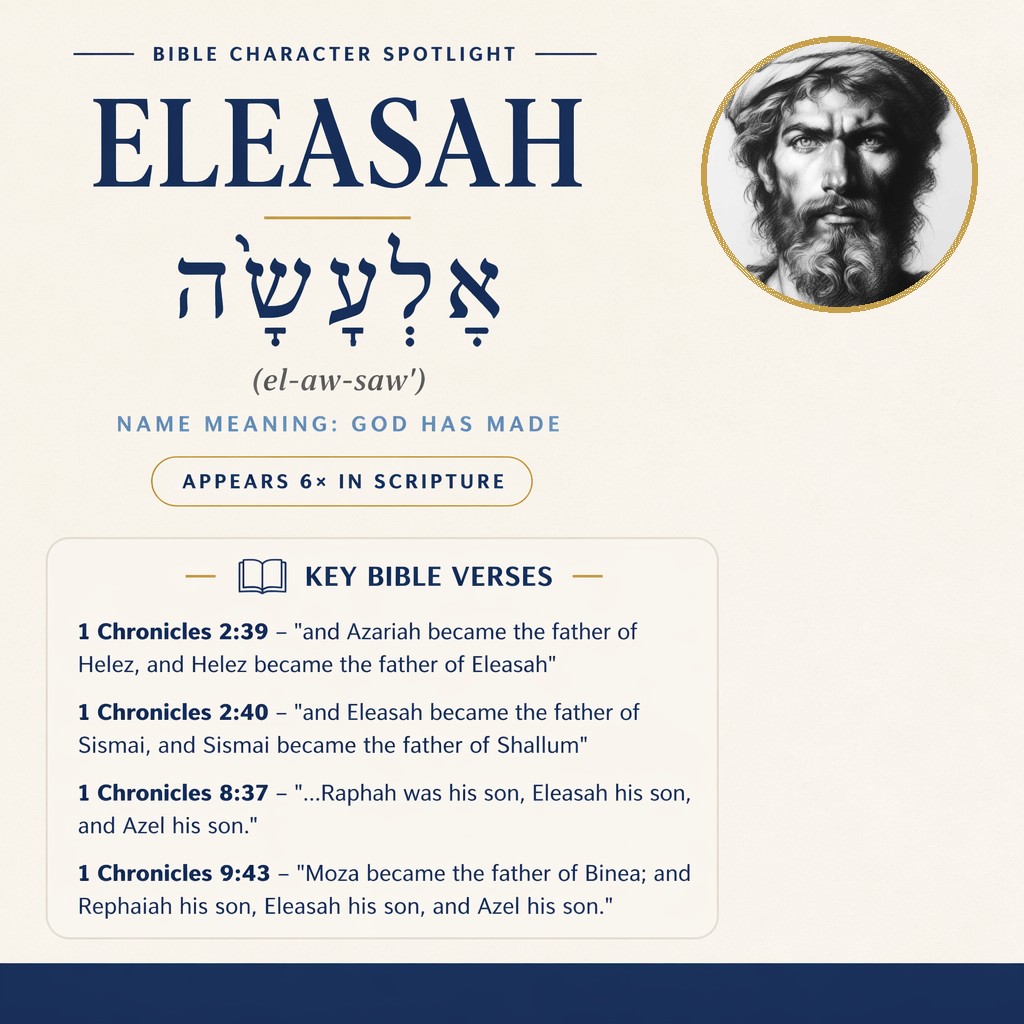
Eleasah in Scripture
In 1 Chronicles, Eleasah appears within a long sequence of genealogies tied to “the sons of Israel” and, more specifically at points, to Judah’s line. The chapter opens broadly:
“These are the sons of Israel: Reuben, Simeon, Levi, Judah, Issachar, Zebulun,” (1 Chronicles 2:1, WEB)
From there, the chapter continues with successive family lines. Within one of these lines, Eleasah is positioned as a descendant in a father-to-son chain that runs through several generations:
“and Obed became the father of Jehu, and Jehu became the father of Azariah, and Azariah became the father of Helez, and Helez became the father of Eleasah,” (1 Chronicles 2:38–39, WEB)
The genealogy then immediately extends beyond him:
“and Eleasah became the father of Sismai, and Sismai became the father of Shallum,” (1 Chronicles 2:40, WEB)
In this setting, Eleasah’s role is purely genealogical: he is identified as the son of Helez and the father of Sismai, placed within a larger record of Israel’s families that includes Judah’s descendants and related lines described throughout the chapter.
A different Eleasah appears in 1 Chronicles 8 and its parallel in 1 Chronicles 9, both of which present genealogical material in the same formulaic style (“became the father of”). In 1 Chronicles 8, Eleasah is named within a line that begins with Moza and moves through successive descendants:
“Moza became the father of Binea. Raphah was his son, Eleasah his son, and Azel his son.” (1 Chronicles 8:37, WEB)
The same structure is repeated in 1 Chronicles 9 with a slightly different spelling for one name in the sequence, but the placement of Eleasah remains the same:
“Moza became the father of Binea; and Rephaiah his son, Eleasah his son, and Azel his son.” (1 Chronicles 9:43, WEB)
These two passages present Eleasah as a son in Moza’s descending line: he is named after Raphah/Rephaiah and before Azel. No further actions or narrative details are attached to him in these verses beyond his place in the genealogy.
In Ezra, the spelling appears as Elasah and the context is a list of names “Of the sons of Pashhur.” In that list, Elasah is one among several individuals:
“Of the sons of Pashhur: Elioenai, Maaseiah, Ishmael, Nethanel, Jozabad, and Elasah.” (Ezra 10:22, WEB)
Here the text does not identify parentage for Elasah beyond association with “the sons of Pashhur,” nor does it provide additional description beyond inclusion in the named group.
In Jeremiah, Elasah is introduced with explicit parentage and with a role connected to an official sending of a message. The verse frames the transmission of a written communication “by the hand of” two named men and identifies them with their fathers, then describes the sender and recipient:
“by the hand of Elasah the son of Shaphan, and Gemariah the son of Hilkiah, (whom Zedekiah king of Judah sent to Babylon to Nebuchadnezzar king of Babylon). It said:” (Jeremiah 29:3, WEB)
In this verse, Elasah is “the son of Shaphan” and functions as one of the intermediaries through whom the message is conveyed; he is linked with Gemariah “the son of Hilkiah,” and both are associated with a mission sent by “Zedekiah king of Judah” to “Babylon” to “Nebuchadnezzar king of Babylon.” The quoted line ends as it introduces the content of what was sent (“It said:”), but the role of Elasah as the named courier is clear from the phrasing.
Multiple bearers
The lexicon gloss identifies Eleasah/Elasah as the name of four Israelites, and the verses provided present the name in several distinct contexts that indicate more than one bearer.
(1) Eleasah in Judah-linked genealogies (1 Chronicles 2). One Eleasah is a descendant named within the wider framework that begins with “the sons of Israel” and traces lines including Judah (1 Chronicles 2:1–40). He is specifically placed as follows:
“Helez became the father of Eleasah,” (1 Chronicles 2:39, WEB)
“Eleasah became the father of Sismai,” (1 Chronicles 2:40, WEB)
(2) Eleasah in the Moza line (1 Chronicles 8; 1 Chronicles 9). Another Eleasah appears as a “son” in a separate genealogical line recorded twice:
“Raphah was his son, Eleasah his son, and Azel his son.” (1 Chronicles 8:37, WEB)
“Rephaiah his son, Eleasah his son, and Azel his son.” (1 Chronicles 9:43, WEB)
These parallel statements locate him between Raphah/Rephaiah and Azel, as part of Moza’s descendants.
(3) Elasah among the sons of Pashhur (Ezra). In Ezra 10:22, Elasah is one of six men named “Of the sons of Pashhur”:
“Elioenai, Maaseiah, Ishmael, Nethanel, Jozabad, and Elasah.” (Ezra 10:22, WEB)
(4) Elasah the son of Shaphan (Jeremiah). In Jeremiah 29:3, Elasah is identified by father’s name and by his role in conveying a message connected with a royal sending:
“Elasah the son of Shaphan” (Jeremiah 29:3, WEB)
Because these references are separated by genre (genealogy, list, and prophetic-historical notice) and supply different identifying markers (different fathers or group associations), the safest reading from the verses provided is that the name belongs to multiple individuals rather than one person appearing across all contexts.
Name and Meaning
The Hebrew form of the name is אֶלְעָשָׂה, transliterated ’El’asah and pronounced el-aw-saw’. Its meaning is given as “God has made,” derived from two Hebrew elements: ’el (אֵל), associated with strength and used as an adjective for “mighty,” and ’asah (עָשָׂה), a verb meaning “to do” or “make” in a broad sense.
Observation
Across the passages, Eleasah/Elasah is remembered either by lineage—“Helez became the father of Eleasah” (1 Chronicles 2:39) and “Eleasah his son” (1 Chronicles 8:37)—or by service as a named messenger, “by the hand of Elasah the son of Shaphan” (Jeremiah 29:3).
Frequently Asked Questions
What does the name Eleasah mean?
Eleasah means “God has made.”
How many times does Eleasah appear in the Bible?
The name Eleasah occurs 6 times.
Who was Eleasah in the Bible?
Eleasah is the name of four Israelites. In 1 Chronicles 2:39–40, one Eleasah is listed in a genealogy as the father of Sismai.
What did Eleasah do in Jeremiah 29:3?
Jeremiah 29:3 mentions “Elasah the son of Shaphan” as connected with a message sent by Zedekiah king of Judah to Babylon.
Explore Further
If you found this page about Eleasah interesting and would like to discover more about other biblical characters, explore our comprehensive Encyclopedia of Biblical Characters. For those looking to delve deeper into the Greek origins of these names and terms, our Greek Lexicon is an invaluable resource.
Sources: Name and occurrence data from Strong’s Exhaustive Concordance and STEPBible reference data (CC BY). Scripture quotations from the World English Bible (public domain).