
Who was Elam in the bible?
Elam is a name in Scripture for Shem’s son, a king of Elam, a province near Susa, and several Israelites listed in Chronicles and Ezra.

Places and Nations
Daniel says, “I was in the citadel of Susa, which is in the province of Elam” (Daniel 8:2). Ezekiel mentions, “There is Elam and all her multitude around her grave” (Ezekiel 32:24).
Learn More →People in Lists
Ezra records returnees as “The children of Elam, one thousand two hundred fifty-four” and also “The children of the other Elam, one thousand two hundred fifty-four” (Ezra 2:7, 31). Individuals named Elam appear in genealogical lists (1 Chronicles 8:24; 26:3).
Learn More →Elam is the name of both a person and a place in the Bible: Elam appears as “a son of Shem,” and the same name is used for a country/province and for several Israelites who bear the name. Lexically, the name is associated with the idea of what is “hidden” or “distant.”
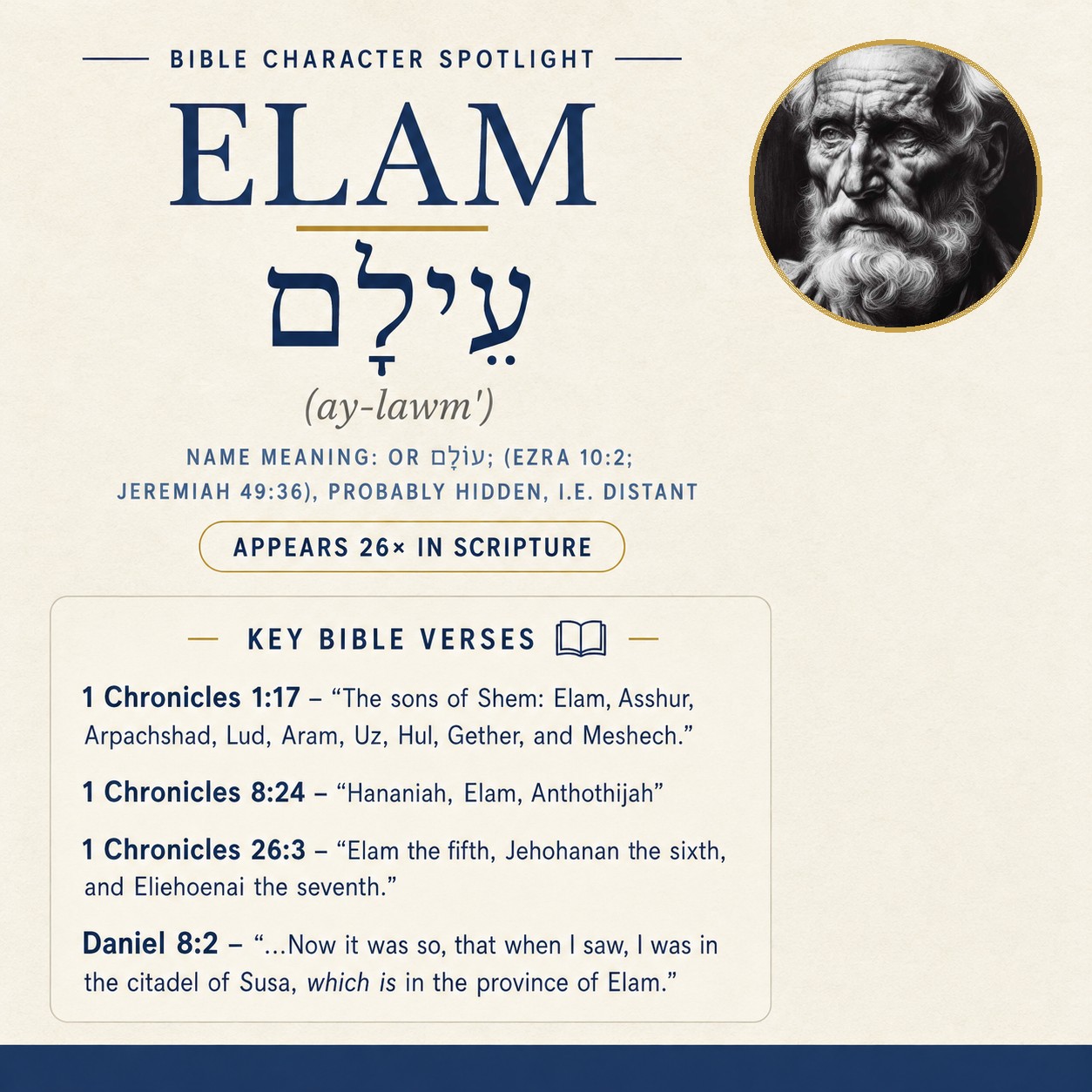
Elam in Scripture
Elam as a son of Shem. In genealogical lists, Elam is named among Shem’s sons.
“The sons of Shem were: Elam, Asshur, Arpachshad, Lud, and Aram.” (Genesis 10:22)
“The sons of Shem: Elam, Asshur, Arpachshad, Lud, Aram, Uz, Hul, Gether, and Meshech.” (1 Chronicles 1:17)
Elam as a kingdom. “Elam” also appears as the name of a kingdom in a war report.
“against Chedorlaomer king of Elam, Tidal king of Goiim, Amraphel king of Shinar, and Arioch king of Ellasar; four kings against the five.” (Genesis 14:9)
Elam as an Israelite name in genealogical lists. The name “Elam” is also borne by an individual listed among descendants in Chronicles.
“Hananiah, Elam, Anthothijah,” (1 Chronicles 8:24)
Another occurrence of “Elam” appears as a name within an ordered set of sons.
“Elam the fifth, Jehohanan the sixth, and Eliehoenai the seventh.” (1 Chronicles 26:3)
Elam as a province. In Daniel’s vision, “Elam” designates a province connected with Susa and the river Ulai.
“I saw the vision. Now it was so, that when I saw, I was in the citadel of Susa, which is in the province of Elam. I saw in the vision, and I was by the river Ulai.” (Daniel 8:2)
Elam as a people associated with death and shame. Ezekiel speaks of Elam collectively, depicting it among the slain.
“There is Elam and all her multitude around her grave; all of them slain, fallen by the sword, who have gone down uncircumcised into the lower parts of the earth, who caused their terror in the land of the living, and have borne their shame with those who go d” (Ezekiel 32:24)
Elam as returning families in Ezra 2. In the register of those who returned to Jerusalem and Judah, “the children of Elam” are included, and later a distinct group is listed as “the other Elam.” The chapter frames these entries as part of a larger accounting of returnees from captivity.
“Now these are the children of the province, who went up out of the captivity of those who had been carried away, whom Nebuchadnezzar the king of Babylon had carried away to Babylon, and who returned to Jerusalem and Judah, everyone to his city;” (Ezra 2:1)
“who came with Zerubbabel, Jeshua, Nehemiah, Seraiah, Reelaiah, Mordecai, Bilshan, Mispar, Bigvai, Rehum, and Baanah. The number of the men of the people of Israel:” (Ezra 2:2)
Within this list of “the number of the men of the people of Israel,” Elam appears twice as a family designation with identical totals.
“The children of Elam, one thousand two hundred fifty-four.” (Ezra 2:7)
“The children of the other Elam, one thousand two hundred fifty-four.” (Ezra 2:31)
Ezra 2 continues by enumerating many other family groups and roles (priests, Levites, singers, gatekeepers, and temple servants), setting “the children of Elam” among a broad assembly. The chapter closes by describing the settlement of these groups in their cities:
“So the priests and the Levites, with some of the people, the singers, the gatekeepers, and the temple servants, lived in their cities, and all Israel in their cities.” (Ezra 2:70)
Elam as an Israelite family in Ezra’s later narratives. Ezra also refers to “the sons of Elam” in additional contexts: in a travel roster and in the episode of addressing marriages with foreign women.
“Of the sons of Elam, Jeshaiah the son of Athaliah; and with him seventy males.” (Ezra 8:7)
In Ezra 10, a speaker is identified as belonging to this same extended group.
“Shecaniah the son of Jehiel, one of the sons of Elam, answered Ezra, ‘We have trespassed against our God, and have married foreign women of the peoples of the land. Yet now there is hope for Israel concerning this thing.’” (Ezra 10:2)
Later in the same chapter, several individuals are listed specifically “of the sons of Elam.”
“Of the sons of Elam: Mattaniah, Zechariah, and Jehiel, and Abdi, and Jeremoth, and Elijah.” (Ezra 10:26)
Multiple Bearers
The name “Elam” refers to more than one bearer in Scripture.
1) Elam the son of Shem. Elam is named among Shem’s sons in Genesis and Chronicles.
2) Elam as a kingdom/province/people. Elam is the realm ruled by “Chedorlaomer king of Elam” (Genesis 14:9). It is also a province associated with “the citadel of Susa” in Daniel’s vision (Daniel 8:2), and it appears as a collective people in Ezekiel’s depiction of the slain (Ezekiel 32:24).
3) Elam as an Israelite personal name. Individuals named Elam appear in lists: “Hananiah, Elam, Anthothijah,” (1 Chronicles 8:24), and “Elam the fifth” (1 Chronicles 26:3).
4) Elam as an Israelite family group (“children/sons of Elam”). Ezra records “The children of Elam” (Ezra 2:7) and separately “The children of the other Elam” (Ezra 2:31), and also speaks of “the sons of Elam” in later rosters and in Ezra 10 (Ezra 8:7; 10:2; 10:26).
Name and Meaning
The name is written in Hebrew as עֵילָם and transliterated ‘Eylam, pronounced “ay-lawm.” Lexically, it is connected (by derivation) with the sense of what is hidden—conveying the idea of being concealed, and therefore “hidden” or “distant”—and it is linked with a Hebrew component word ‘alam (עָלַם) meaning “to veil from sight,” that is, to conceal.
Observation
Across these passages, “Elam” functions as a name that can identify an ancestral figure (Genesis 10:22), a political entity (Genesis 14:9), a geographic province (Daniel 8:2), and distinct Israelite families counted among those who “returned to Jerusalem and Judah” (Ezra 2:1, 2:7, 2:31).
Frequently Asked Questions
What does the name Elam mean?
Elam is given as meaning “hidden,” in the sense of “distant.”
How many times does Elam appear in the Bible?
Elam occurs 26 times.
Who was Elam in the Bible?
Elam is named as a son of Shem (Genesis 10:22; 1 Chronicles 1:17). The name is also used for his descendants and their country, and also for six Israelites.
Where is Elam mentioned in connection with a vision in Daniel?
Daniel says he was “in the citadel of Susa, which is in the province of Elam” when he saw the vision (Daniel 8:2).
Explore Further
If you found this page about Elam interesting and would like to discover more about other biblical characters, explore our comprehensive Encyclopedia of Biblical Characters. For those looking to delve deeper into the Greek origins of these names and terms, our Greek Lexicon is an invaluable resource.
Sources: Name and occurrence data from Strong’s Exhaustive Concordance and STEPBible reference data (CC BY). Scripture quotations from the World English Bible (public domain).




