Who was Claudius in the bible?
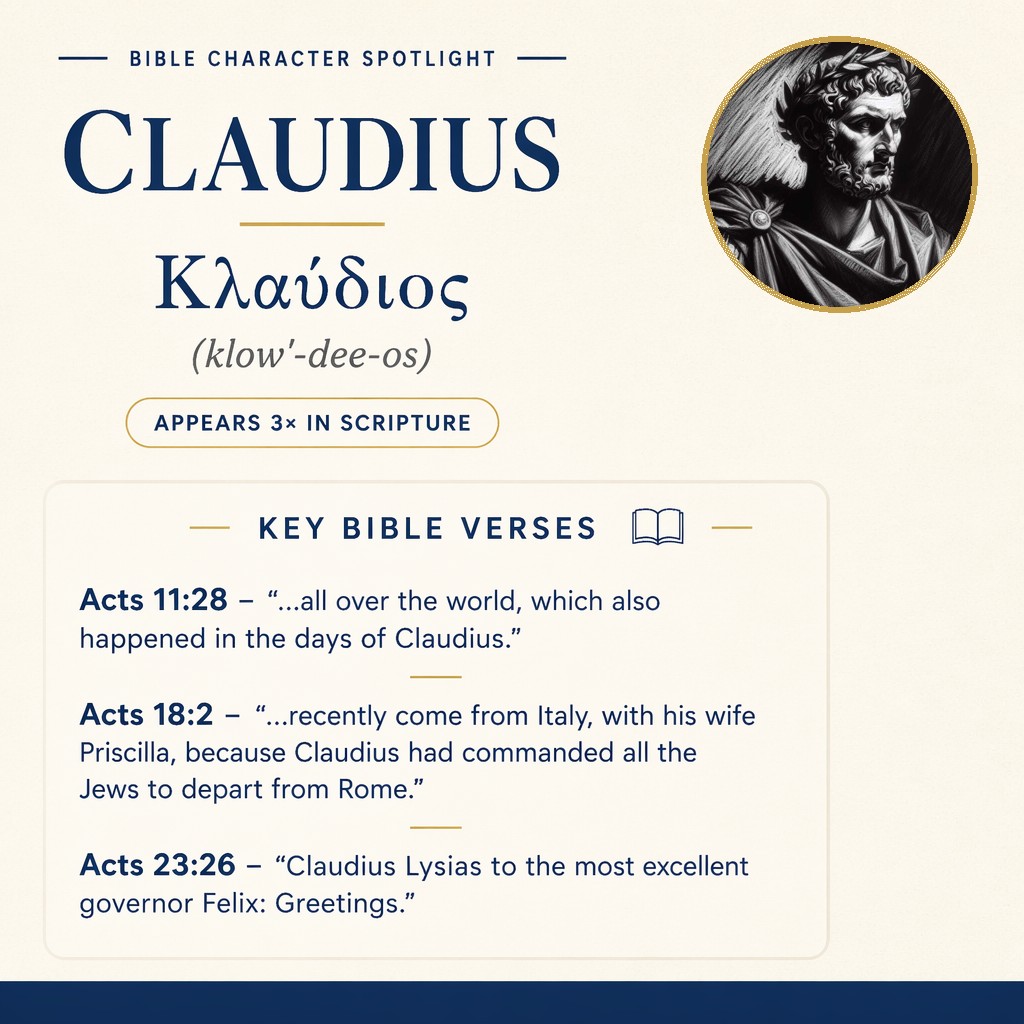
Claudius appears in Acts as the ruler during a foretold famine, as the one who ordered Jews to leave Rome, and in the name “Claudius Lysias” addressing Governor Felix.

Rome Decree
Paul met Aquila and Priscilla, who had come from Italy “because Claudius had commanded all the Jews to depart from Rome” (Acts 18:2).
Learn More →Claudius Lysias
A Roman official writes, “Claudius Lysias to the most excellent governor Felix: Greetings” (Acts 23:26). The letter explains Paul’s rescue and transfer to Felix (Acts 23:27–30).
Learn More →Claudius is a Greek form of a Latin-origin name. In Acts, “Claudius” refers to more than one person: a ruler whose reign marked events mentioned by Luke, and a Roman officer named Claudius Lysias.
Claudius in Scripture
The first mention of Claudius comes in the setting of Antioch, where Barnabas and Saul worked among believers. Luke describes how Barnabas sought Saul and brought him to Antioch, where teaching continued for an extended period: “For a whole year they were gathered together with the assembly, and taught many people. The disciples were first called Christians in Antioch” (Acts 11:26). In that same period, prophetic visitors arrived: “Now in these days, prophets came down from Jerusalem to Antioch” (Acts 11:27).
Among those prophets was Agabus, whose message connected a coming crisis with the days of Claudius:
“One of them named Agabus stood up, and indicated by the Spirit that there should be a great famine all over the world, which also happened in the days of Claudius.” (Acts 11:28)
Luke then narrates the response of the Antioch disciples to this predicted hardship. The community decided on practical aid: “As any of the disciples had plenty, each determined to send relief to the brothers who lived in Judea” (Acts 11:29). Luke adds that they carried out the plan: “which they also did, sending it to the elders by the hands of Barnabas and Saul” (Acts 11:30). In this portion of Acts, Claudius is not shown speaking or acting directly; his “days” are used as the time frame in which Agabus’s prediction was fulfilled.
A second reference to Claudius occurs much later, during Paul’s travels after leaving Athens. Luke writes, “After these things Paul departed from Athens, and came to Corinth” (Acts 18:1). In Corinth Paul encountered Aquila and Priscilla, and their circumstances are explicitly tied to a command attributed to Claudius:
“He found a certain Jew named Aquila, a man of Pontus by race, who had recently come from Italy, with his wife Priscilla, because Claudius had commanded all the Jews to depart from Rome. He came to them,” (Acts 18:2)
Luke continues by showing how this meeting shaped Paul’s daily life and public work in Corinth. Because Paul and Aquila shared an occupation, “because he practiced the same trade, he lived with them and worked, for by trade they were tent makers” (Acts 18:3). Paul also maintained a regular pattern of synagogue persuasion: “He reasoned in the synagogue every Sabbath and persuaded Jews and Greeks” (Acts 18:4). When Silas and Timothy arrived, Luke describes Paul’s intensified testimony: “Paul was compelled by the Spirit, testifying to the Jews that Jesus was the Christ” (Acts 18:5). Opposition followed, and Paul announced a change of focus: “Your blood be on your own heads! I am clean. From now on, I will go to the Gentiles!” (Acts 18:6). He then relocated nearby, “next door to the synagogue” (Acts 18:7), and Luke records notable belief and baptism: “Crispus, the ruler of the synagogue, believed in the Lord with all his house. Many of the Corinthians, when they heard, believed and were baptized” (Acts 18:8). The narrative includes a night vision to Paul—“Don’t be afraid, but speak and don’t be silent; for I am with you” (Acts 18:9–10)—and summarizes a substantial stay: “He lived there a year and six months, teaching the word of God among them” (Acts 18:11). In this chapter, Claudius again is not present in person; he is named as the one whose command resulted in Aquila and Priscilla’s departure from Rome, which in turn brought them into Paul’s life in Corinth.
The third occurrence of the name is the opening line of a letter written by a Roman officer to the governor Felix. In a tense setting involving Paul’s transfer under guard, Luke records preparations for travel: “Prepare two hundred soldiers to go as far as Caesarea, with seventy horsemen, and two hundred men armed with spears, at the third hour of the night” (Acts 23:23). The commander also arranged for Paul’s transport: “He asked them to provide animals, that they might set Paul on one, and bring him safely to Felix the governor” (Acts 23:24). Luke introduces the written correspondence—“He wrote a letter like this” (Acts 23:25)—and then quotes its greeting:
“Claudius Lysias to the most excellent governor Felix: Greetings.” (Acts 23:26)
The letter itself explains why Paul was being sent. Lysias reports the danger Paul faced—“This man was seized by the Jews, and was about to be killed by them” (Acts 23:27)—and describes his intervention: “when I came with the soldiers and rescued him” (Acts 23:27). He notes his motive for inquiry: “Desiring to know the cause why they accused him, I brought him down to their council” (Acts 23:28). The conclusion summarizes Lysias’s findings and actions: “I found him to be accused about questions of their law, but not to be charged with anything worthy of death or of imprisonment” (Acts 23:29), and, on learning of a plot, “I sent him to you immediately” (Acts 23:30). Luke then narrates the delivery: the soldiers “took Paul and brought him by night to Antipatris” (Acts 23:31), then on to Caesarea, where they “delivered the letter to the governor” and “presented Paul to him” (Acts 23:33). Felix read it and asked about Paul’s province, and then ordered custody while awaiting accusers: “I will hear you fully when your accusers also arrive” (Acts 23:35).
Multiple bearers
Acts uses “Claudius” for (1) the ruler whose reign is referenced when a famine prediction is said to have come to pass—“in the days of Claudius” (Acts 11:28)—and who is also credited with a decree affecting Jews in Rome—“because Claudius had commanded all the Jews to depart from Rome” (Acts 18:2); and (2) a Roman commander identified by full name in formal correspondence: “Claudius Lysias” (Acts 23:26).
Name and Meaning
The name appears in Greek as Κλαύδιος (transliteration Klaudios; pronunciation klow’-dee-os). Lexicon information describes it as a name “of Latin origin.”
Observation
In Acts, the name “Claudius” surfaces where public decisions and official actions intersect with the church’s life: a famine “happened in the days of Claudius” (Acts 11:28), a command led Aquila and Priscilla to Corinth (Acts 18:2), and “Claudius Lysias” sought to “bring him safely to Felix the governor” (Acts 23:24–26).
Frequently Asked Questions
What does the name Claudius mean?
Claudius is a name of Latin origin, given in Greek as “Klaudios.”
How many times does Claudius appear in the Bible?
Claudius appears 3 times.
Who was Claudius in the Bible?
The name Claudius appears in Acts in references to Claudius and to “Claudius Lysias” (Acts 23:26). Claudius is also mentioned in connection with events said to have happened “in the days of Claudi” (Acts 11:28) and with a command that affected Aquila and Priscilla (Acts 18:2).
What did Claudius command in Acts 18:2?
Acts 18:2 says that Aquila and Priscilla had recently come from Italy “because Claudius had commanded all the” (Acts 18:2).
Explore Further
If you found this page about Claudius interesting and would like to discover more about other biblical characters, explore our comprehensive Encyclopedia of Biblical Characters. For those looking to delve deeper into the Greek origins of these names and terms, our Greek Lexicon is an invaluable resource.
Sources: Name and occurrence data from Strong’s Exhaustive Concordance and STEPBible reference data (CC BY). Scripture quotations from the World English Bible (public domain).