Who was Barnabas in the bible?
Barnabas is a Levite from Cyprus by race, named in Acts 4, 9, 11–13 as he served with Saul (Paul) and was sent out by the Holy Spirit.

Acts Ministry
“The Holy Spirit said, ‘Separate Barnabas and Saul for me’” (Acts 13:2). “Paul and Barnabas spoke out boldly” and faced persecution (Acts 13:46, 13:50).
Learn More →Barnabas was a man in the book of Acts identified as “a Levite, a man of Cyprus by race,” originally named Joses, whom the apostles also called Barnabas—interpreted as “Son of Encouragement” (Acts 4:36). In Acts he appears as a trusted figure among believers and as a prominent participant in ministry alongside Saul (also called Paul).
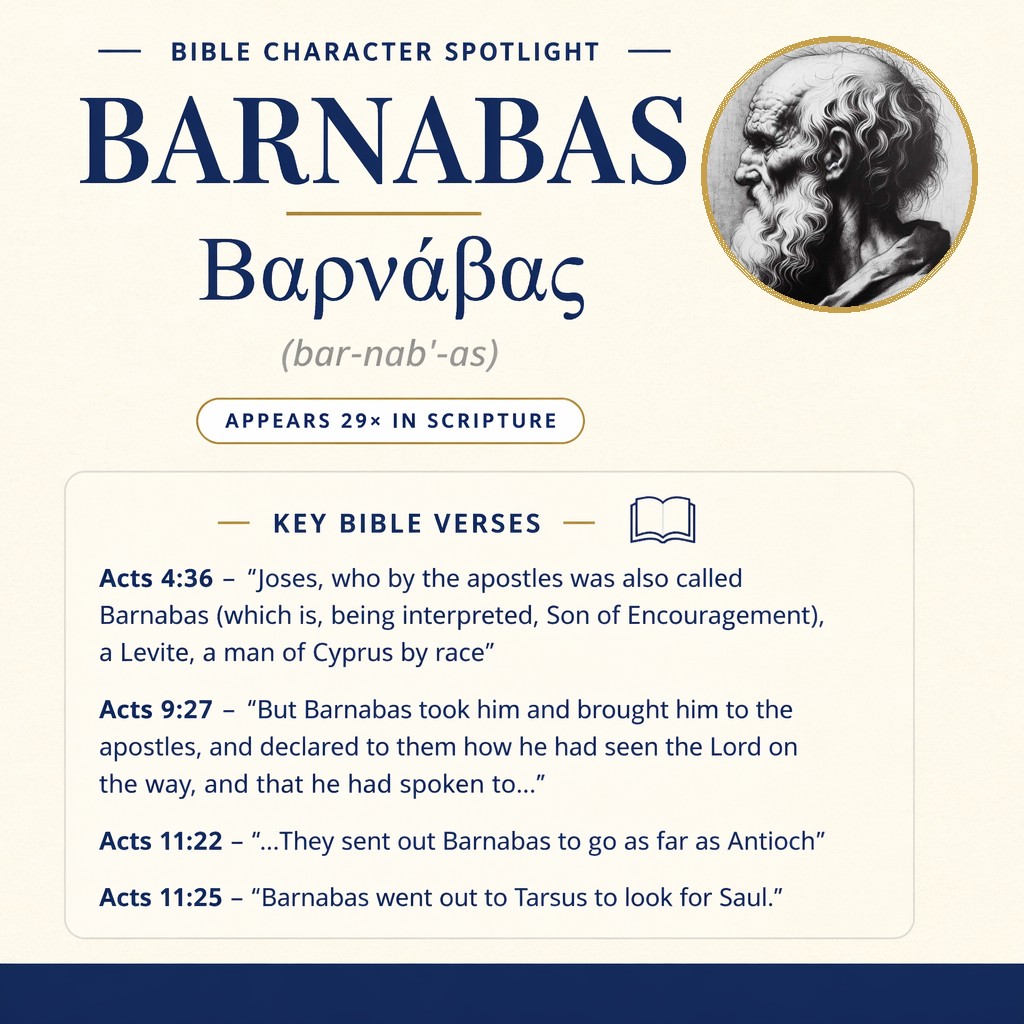
Barnabas in Scripture
“Joses, who by the apostles was also called Barnabas (which is, being interpreted, Son of Encouragement), a Levite, a man of Cyprus by race,” (Acts 4:36)
This introduction identifies Barnabas as Joses by original name, given an additional name by the apostles, and described by tribe and origin: “a Levite” and “a man of Cyprus by race” (Acts 4:36).
“But Barnabas took him and brought him to the apostles, and declared to them how he had seen the Lord on the way, and that he had spoken to him, and how at Damascus he had preached boldly in the name of Jesus.” (Acts 9:27)
Later, Barnabas is shown acting as an advocate and intermediary. He “took him and brought him to the apostles,” and he “declared to them” what had happened on the way and at Damascus, including that the man “had preached boldly in the name of Jesus” (Acts 9:27).
“The report concerning them came to the ears of the assembly which was in Jerusalem. They sent out Barnabas to go as far as Antioch,” (Acts 11:22)
Barnabas was commissioned by the Jerusalem assembly in response to a report: “They sent out Barnabas to go as far as Antioch” (Acts 11:22).
“Barnabas went out to Tarsus to look for Saul.” (Acts 11:25)
After his sending, Barnabas is described as taking initiative: he “went out to Tarsus to look for Saul” (Acts 11:25).
“which they also did, sending it to the elders by the hands of Barnabas and Saul.” (Acts 11:30)
Barnabas also appears as a carrier of a gift (the verse does not specify the contents beyond “it”), sent “to the elders” specifically “by the hands of Barnabas and Saul” (Acts 11:30).
“Barnabas and Saul returned to Jerusalem when they had fulfilled their service, also taking with them John who was called Mark.” (Acts 12:25)
Following this service, the narrative reports that “Barnabas and Saul returned to Jerusalem,” and that they took “John who was called Mark” with them (Acts 12:25).
“Now in the assembly that was at Antioch there were some prophets and teachers: Barnabas, Simeon who was called Niger, Lucius of Cyrene, Manaen the foster brother of Herod the tetrarch, and Saul.” (Acts 13:1)
At Antioch, Barnabas is listed among “some prophets and teachers” in the assembly (Acts 13:1), alongside named companions.
“As they served the Lord and fasted, the Holy Spirit said, ‘Separate Barnabas and Saul for me, for the work to which I have called them.’ ” (Acts 13:2)
Within this setting of worship and fasting, the narrative presents a specific directive: “Separate Barnabas and Saul for me, for the work to which I have called them” (Acts 13:2).
“Then, when they had fasted and prayed and laid their hands on them, they sent them away.” (Acts 13:3)
The assembly’s response includes fasting, prayer, and laying on of hands; then “they sent them away” (Acts 13:3).
“So, being sent out by the Holy Spirit, they went down to Seleucia. From there they sailed to Cyprus.” (Acts 13:4)
The account emphasizes that their mission proceeded under divine sending: “being sent out by the Holy Spirit” (Acts 13:4). Their movements are traced from Seleucia to Cyprus.
“When they were at Salamis, they proclaimed God’s word in the Jewish synagogues. They also had John as their attendant.” (Acts 13:5)
In Salamis, Barnabas and Saul participate in proclamation: “they proclaimed God’s word in the Jewish synagogues,” with “John as their attendant” (Acts 13:5).
“When they had gone through the island to Paphos, they found a certain sorcerer, a false prophet, a Jew, whose name was Bar Jesus,” (Acts 13:6)
Traveling “through the island to Paphos,” they encounter “a certain sorcerer, a false prophet, a Jew,” named Bar Jesus (Acts 13:6).
“who was with the proconsul, Sergius Paulus, a man of understanding. This man summoned Barnabas and Saul, and sought to hear the word of God.” (Acts 13:7)
The sorcerer is connected with “the proconsul, Sergius Paulus,” described as “a man of understanding” (Acts 13:7). The proconsul “summoned Barnabas and Saul” because he “sought to hear the word of God” (Acts 13:7).
“But Elymas the sorcerer (for so is his name by interpretation) withstood them, seeking to turn the proconsul away from the faith.” (Acts 13:8)
Opposition arises: “Elymas the sorcerer…withstood them,” attempting “to turn the proconsul away from the faith” (Acts 13:8). The narrative then focuses on Saul (also called Paul) confronting Elymas (Acts 13:9–11).
“Then the proconsul, when he saw what was done, believed, being astonished at the teaching of the Lord.” (Acts 13:12)
After what occurs, the proconsul “believed,” and the reason given is that he was “astonished at the teaching of the Lord” (Acts 13:12).
“Now Paul and his company set sail from Paphos, and came to Perga in Pamphylia. John departed from them and returned to Jerusalem.” (Acts 13:13)
The travel narrative continues from Paphos to Perga; at this point “John departed from them and returned to Jerusalem” (Acts 13:13). Barnabas remains among Paul’s company as the chapter proceeds, including ministry in a synagogue (Acts 13:14–41).
“Now when the synagogue broke up, many of the Jews and of the devout proselytes followed Paul and Barnabas; who, speaking to them, urged them to continue in the grace of God.” (Acts 13:43)
After synagogue proceedings, “many…followed Paul and Barnabas,” and the two are described as speaking in a way that “urged them to continue in the grace of God” (Acts 13:43).
“Paul and Barnabas spoke out boldly, and said, ‘It was necessary that God’s word should be spoken to you first. Since indeed you thrust it from yourselves, and judge yourselves unworthy of eternal life, behold, we turn to the Gentiles.’ ” (Acts 13:46)
When contradicted, the pair “spoke out boldly” and explained a turning in their outreach: “behold, we turn to the Gentiles” (Acts 13:46). The chapter continues with the Lord’s word spreading widely in the region (Acts 13:49).
“But the Jews stirred up the devout and prominent women and the chief men of the city, and stirred up a persecution against Paul and Barnabas, and threw them out of their borders.” (Acts 13:50)
Hostility escalates into civic action: a persecution is “stirred up…against Paul and Barnabas,” and they are “threw…out of their borders” (Acts 13:50). The narrative closes with their departure and the condition of the disciples: “The disciples were filled with joy and with the Holy Spirit” (Acts 13:52).
Name and Meaning
The name is written in Greek as Βαρνάβας, transliterated Barnabas, and pronounced bar-nab’-as. A lexicon identifies it as being of Chaldee origin, derived from two component words (H01247 and H05029). Acts itself supplies the interpreted sense of the apostolic nickname: Barnabas is “being interpreted, Son of Encouragement” (Acts 4:36).
Observation
Across these passages Barnabas repeatedly appears in roles that connect people and communities—he “brought him to the apostles” (Acts 9:27), was sent by the Jerusalem assembly (Acts 11:22), and was set apart with Saul for work by the Holy Spirit (Acts 13:2).
Frequently Asked Questions
What does the name Barnabas mean?
Barnabas means “Son of Encouragement” (Acts 4:36).
How many times does Barnabas appear in the Bible?
Barnabas occurs 29 times.
Who was Barnabas?
Barnabas (also called Barnabas by the apostles) is described as a Levite and “a man of Cyprus by race” (Acts 4:36).
What did the Holy Spirit say about Barnabas and Saul?
The Holy Spirit said, “Separate Barnabas and Saul for me, for the work to which I have called them” (Acts 13:2).
Explore Further
If you found this page about Barnabas interesting and would like to discover more about other biblical characters, explore our comprehensive Encyclopedia of Biblical Characters. For those looking to delve deeper into the Greek origins of these names and terms, our Greek Lexicon is an invaluable resource.
Sources: Name and occurrence data from Strong’s Exhaustive Concordance and STEPBible reference data (CC BY). Scripture quotations from the World English Bible (public domain).