Who was Annas in the bible?
Annas is named as a high priest in Luke, John, and Acts, appearing in Luke 3:2; John 18:13, 18:24; and Acts 4:6.

In John 18
After Jesus was seized and bound, they “led him to Annas first” (John 18:13). “Annas sent him bound to Caiaphas, the high priest” (John 18:24).
Learn More →Family Link
John states they led Jesus to Annas first, “for he was father-in-law to Caiaphas” (John 18:13). Caiaphas is identified there as “high priest that year” (John 18:13).
Learn More →Annas (Greek Ἄννας) is named in the New Testament as a figure associated with the high priesthood and with proceedings involving Jesus and later the apostles. The lexicon notes the name is of Hebrew origin.
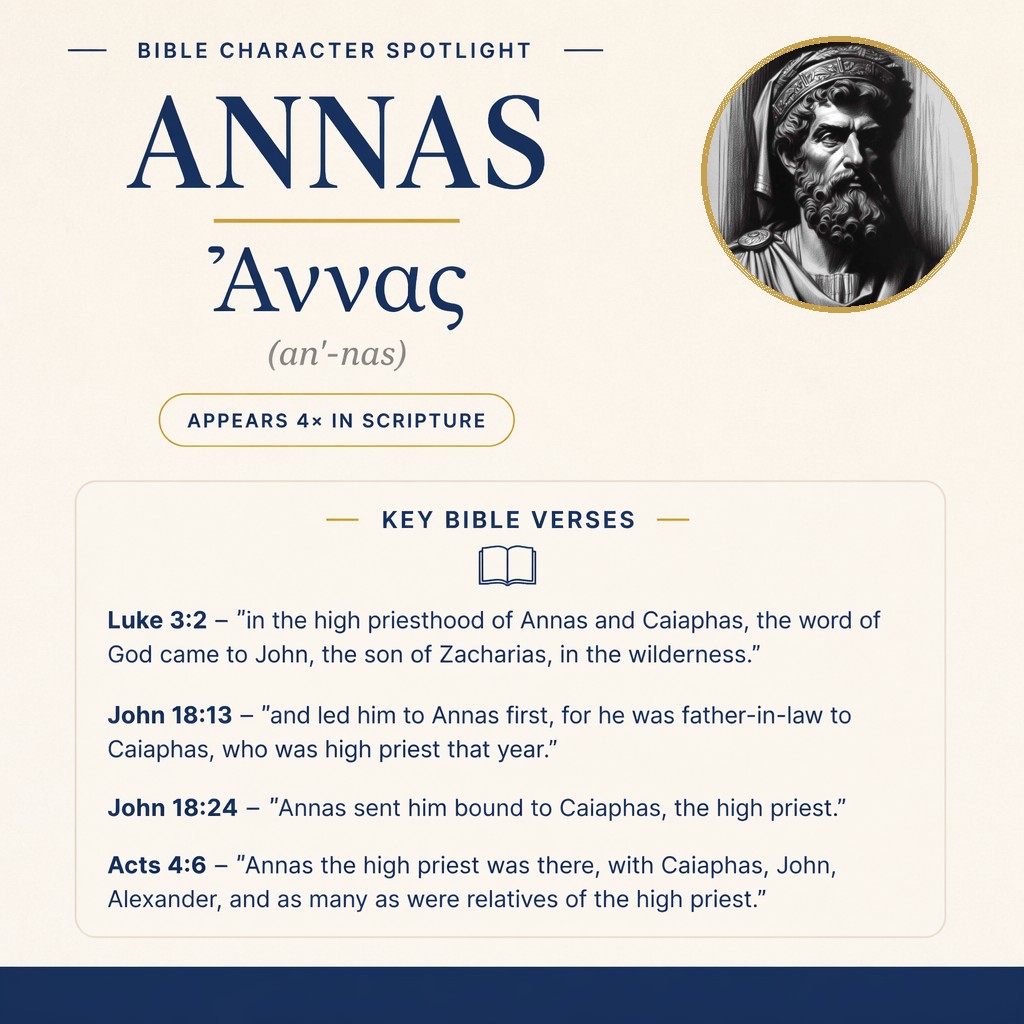
Annas in Scripture
Annas first appears in Luke in a setting statement that frames the beginning of John the Baptist’s public ministry. Luke places the coming of God’s word to John within a political and religious context, including mention of a shared or paired high-priestly leadership.
“Now in the fifteenth year of the reign of Tiberius Caesar, Pontius Pilate being governor of Judea, and Herod being tetrarch of Galilee, and his brother Philip tetrarch of the region of Ituraea and Trachonitis, and Lysanias tetrarch of Abilene,” (Luke 3:1)
“in the high priesthood of Annas and Caiaphas, the word of God came to John, the son of Zacharias, in the wilderness.” (Luke 3:2)
Luke then continues by describing John’s activity in the region around the Jordan and his message, giving the immediate narrative environment in which Annas is named.
“He came into all the region around the Jordan, preaching the baptism of repentance for remission of sins.” (Luke 3:3)
In John’s Gospel, Annas is named within the sequence of events surrounding Jesus’ arrest. After Jesus addresses Peter, Jesus is seized and bound by a detachment and officers, and then brought first to Annas. John explains Annas’s connection to Caiaphas and identifies Caiaphas as high priest “that year.”
“Jesus therefore said to Peter, “Put the sword into its sheath. The cup which the Father has given me, shall I not surely drink it?”” (John 18:11)
“So the detachment, the commanding officer, and the officers of the Jews seized Jesus and bound him,” (John 18:12)
“and led him to Annas first, for he was father-in-law to Caiaphas, who was high priest that year.” (John 18:13)
John adds a brief identifying note about Caiaphas’s prior counsel, continuing to keep Annas in view through Annas’s relationship to the acting high priest.
“Now it was Caiaphas who advised the Jews that it was expedient that one man should perish for the people.” (John 18:14)
As the narrative proceeds, Simon Peter and another disciple follow. The other disciple is described as known to “the high priest,” enters the court, and then helps Peter enter as well. During this larger scene, Jesus is treated as if being addressed by a high priestly authority; an officer challenges Jesus’ manner of speaking and strikes him, and Jesus replies by calling for testimony if he has spoken wrongly. Then Annas sends Jesus on to Caiaphas, explicitly identifying Caiaphas again as “the high priest.”
“Simon Peter followed Jesus, as did another disciple. Now that disciple was known to the high priest, and entered in with Jesus into the court of the high priest;” (John 18:15)
“but Peter was standing at the door outside. So the other disciple, who was known to the high priest, went out and spoke to her who kept the door, and brought in Peter.” (John 18:16)
“When he had said this, one of the officers standing by slapped Jesus with his hand, saying, “Do you answer the high priest like that?”” (John 18:22)
“Jesus answered him, “If I have spoken evil, testify of the evil; but if well, why do you beat me?”” (John 18:23)
“Annas sent him bound to Caiaphas, the high priest.” (John 18:24)
Immediately after Annas sends Jesus to Caiaphas, John’s narrative continues with Peter standing and being questioned about whether he is a disciple; he denies it, is challenged again, and denies it a second time.
“Now Simon Peter was standing and warming himself. They said therefore to him, “You aren’t also one of his disciples, are you?” He denied it and said, “I am not.”” (John 18:25)
“One of the servants of the high priest, being a relative of him whose ear Peter had cut off, said, “Didn’t I see you in the garden with him?”” (John 18:26)
“Peter therefore denied it again, and immediately the rooster crowed.” (John 18:27)
In Acts, Annas appears again in Jerusalem in connection with a formal gathering of Jewish leadership following the growth of belief among those who heard the message. The rulers, elders, and scribes assemble, and Annas is explicitly called “the high priest.” He is listed alongside Caiaphas and others, including “as many as were relatives of the high priest.” The assembled group questions Peter and John about the source of their authority.
“But many of those who heard the word believed, and the number of the men came to be about five thousand.” (Acts 4:4)
“In the morning, their rulers, elders, and scribes were gathered together in Jerusalem.” (Acts 4:5)
“Annas the high priest was there, with Caiaphas, John, Alexander, and as many as were relatives of the high priest.” (Acts 4:6)
“When they had stood Peter and John in the middle of them, they inquired, “By what power, or in what name, have you done this?”” (Acts 4:7)
Peter responds to these authorities by addressing them as leaders of Israel and framing the inquiry as an examination concerning a good deed and healing.
“Then Peter, filled with the Holy Spirit, said to them, “You rulers of the people, and elders of Israel,” (Acts 4:8)
“if we are examined today concerning a good deed done to a crippled man, by what means this man has been healed,” (Acts 4:9)
Name and Meaning
The name appears in Greek as Ἄννας, transliterated Annas and pronounced “an’-nas.” The lexicon associates it with Hebrew origin (H02608), indicating that the Greek form reflects a name rooted in Hebrew usage.
Brief observation
Across Luke, John, and Acts, Annas is consistently presented in proximity to high-priestly authority—named with Caiaphas in Luke’s framing of John’s ministry, receiving Jesus first after his arrest in John, and appearing as “Annas the high priest” in the Jerusalem assembly that questions Peter and John in Acts.
Frequently Asked Questions
What does the name Annas mean?
The name Annas is a Greek form of a name of Hebrew origin.
How many times does Annas appear in the Bible?
Annas appears 4 times.
Who was Annas?
Annas is identified as a high priest (Acts 4:6). Luke 3:2 mentions “the high priesthood of Annas and Caiaphas.”
What role did Annas have in Jesus’ arrest?
After Jesus was seized, he was led to Annas first (John 18:13). Annas then sent him bound to Caiaphas the high priest (John 18:24).
Explore Further
If you found this page about Annas interesting and would like to discover more about other biblical characters, explore our comprehensive Encyclopedia of Biblical Characters. For those looking to delve deeper into the Greek origins of these names and terms, our Greek Lexicon is an invaluable resource.
Sources: Name and occurrence data from Strong’s Exhaustive Concordance and STEPBible reference data (CC BY). Scripture quotations from the World English Bible (public domain).