
Who was Abishua in the bible?
Abishua is a name borne by two Israelites, appearing in priestly genealogies in 1 Chronicles 6 and Ezra 7, and in a Benjaminite list in 1 Chronicles 8.

Sons of Aaron
In the listing of Aaron’s descendants: “Eleazar his son, Phinehas his son, Abishua his son” (1 Chronicles 6:50). Ezra’s genealogy includes “the son of Abishua” (Ezra 7:5).
Learn More →Benjaminite List
A separate Abishua appears in a Benjaminite list: “Abishua, Naaman, Ahoah” (1 Chronicles 8:4). The verses give no further details about this Abishua.
Learn More →Abishua (a name that Strong’s Hebrew lexicon derives as meaning “father of plenty,” i.e., “prosperous”) is presented in Scripture as the name of two Israelites. One Abishua appears in a priestly genealogy descending from Aaron; another Abishua appears in a brief genealogical list in 1 Chronicles 8.
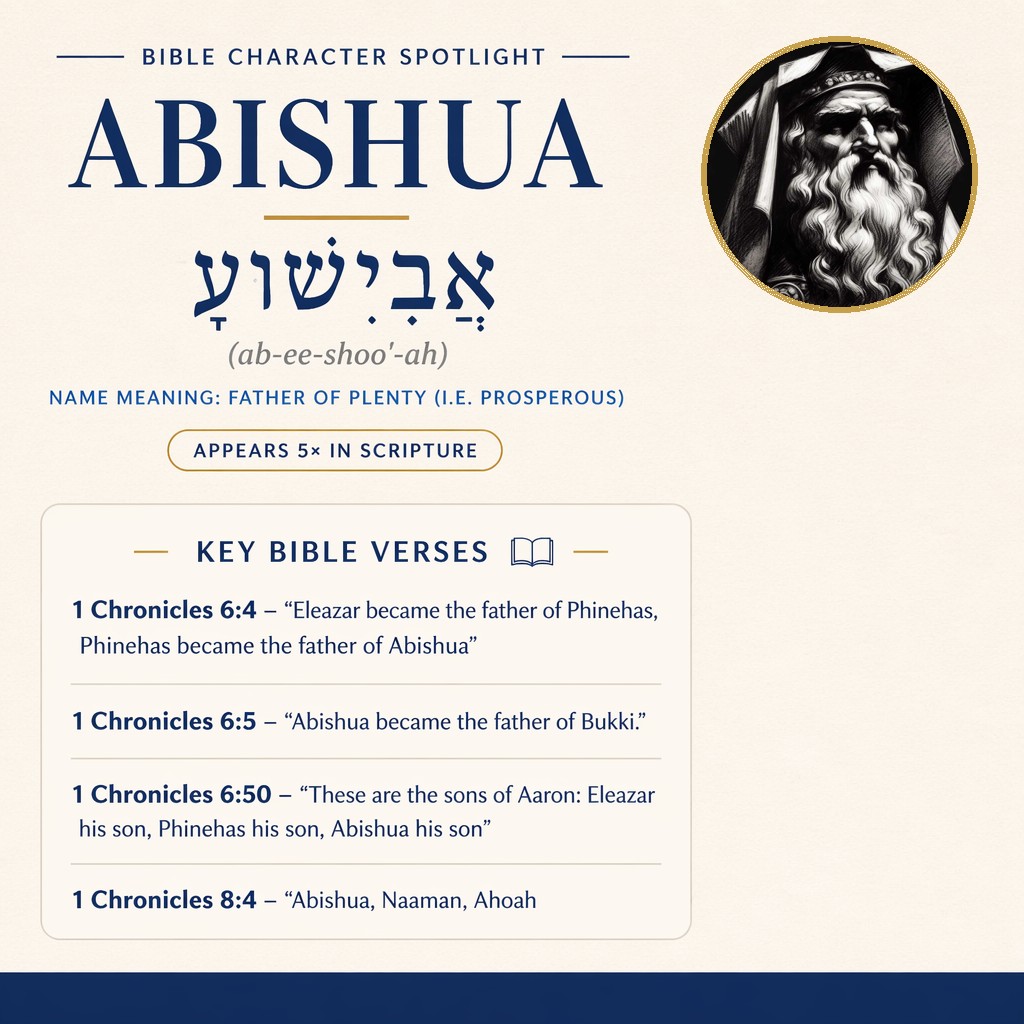
Abishua in Scripture
Abishua is first mentioned within 1 Chronicles 6, a chapter that begins with Levi’s line and then narrows to the priestly family of Aaron. The chapter frames the larger setting with the opening genealogy:
The children of Amram: Aaron, Moses, and Miriam. The sons of Aaron: Nadab, Abihu, Eleazar, and Ithamar. (1 Chronicles 6:3, WEB)
Within this Aaronic line, Abishua is identified by direct descent: Eleazar to Phinehas to Abishua. The text states:
Eleazar became the father of Phinehas, Phinehas became the father of Abishua, (1 Chronicles 6:4, WEB)
Abishua is then placed as the father of Bukki, continuing the same line:
Abishua became the father of Bukki. Bukki became the father of Uzzi. (1 Chronicles 6:5, WEB)
The narrative of 1 Chronicles 6 proceeds by extending this genealogy through many generations, tracing a continuous succession of “became the father of” statements. In this extended list, the priestly line moves from Uzzi onward (“Uzzi became the father of Zerahiah,” and so forth), eventually reaching figures identified with later priestly service:
Johanan became the father of Azariah, who executed the priest’s office in the house that Solomon built in Jerusalem. (1 Chronicles 6:10, WEB)
After completing a long chain of descent, the chapter returns to summarize the Aaronic line again, explicitly naming Abishua as part of “the sons of Aaron” by lineage sequence rather than immediate parentage. The summary reads:
These are the sons of Aaron: Eleazar his son, Phinehas his son, Abishua his son, (1 Chronicles 6:50, WEB)
This restatement positions Abishua as a named link in the priestly family line, situated between Phinehas and Bukki:
Bukki his son, Uzzi his son, Zerahiah his son, (1 Chronicles 6:51, WEB)
In the same chapter, the priestly family is placed within the larger description of Levitical service. Immediately before repeating the Aaronic line, the chapter describes the distinct work associated with Aaron and his sons:
But Aaron and his sons offered on the altar of burnt offering, and on the altar of incense, for all the work of the most holy place, and to make atonement for Israel, according to all that Moses the servant of God had commanded. (1 Chronicles 6:49, WEB)
While Abishua is not singled out for an individual action, he is included in the genealogy that stands in the context of this description of Aaron’s priestly house and its duties.
A further occurrence of this same priestly Abishua appears in Ezra, where a genealogy is given that includes Abishua in the same priestly chain, placing him between Phinehas and Eleazar and Aaron:
the son of Abishua, the son of Phinehas, the son of Eleazar, the son of Aaron the chief priest— (Ezra 7:5, WEB)
This confirms the same genealogical identification of Abishua as descended from Phinehas and Eleazar within Aaron’s line, and it sets Abishua as an ancestor in the ancestry being traced in Ezra 7.
A different Abishua appears in 1 Chronicles 8, in a short list of names with no explicit relational markers in the verse provided. The text reads:
Abishua, Naaman, Ahoah, (1 Chronicles 8:4, WEB)
In this occurrence, Abishua is simply one of several names presented together, and the verse does not provide a direct statement of parentage or role for him.
Multiple bearers
The lexicon gloss identifies Abishua as “the name of two Israelites,” and the verses reflect two distinct placements:
First, Abishua in the priestly genealogy: he appears in the line that begins with “Aaron” and continues through “Eleazar,” “Phinehas,” and then “Abishua,” followed by “Bukki” (1 Chronicles 6:3–5). This same genealogical placement is reiterated when 1 Chronicles summarizes “These are the sons of Aaron” and includes “Abishua his son” in the chain (1 Chronicles 6:50), and when Ezra lists him in a priestly ancestry: “the son of Abishua, the son of Phinehas, the son of Eleazar, the son of Aaron the chief priest—” (Ezra 7:5).
Second, Abishua in 1 Chronicles 8: he is listed without further description: “Abishua, Naaman, Ahoah,” (1 Chronicles 8:4). The verse itself does not connect this Abishua to the priestly line in 1 Chronicles 6, and it provides no additional identification beyond the name.
Name and Meaning
The name is written in Hebrew as אֲבִישׁוּעַ, transliterated ’Abiyshuwa’ and pronounced “ab-ee-shoo’-ah.” Strong’s name-derivation explains it as coming from elements meaning “father” (’ab) and a term associated with a “noble” or “liberal, opulent” sense (showa’), yielding the sense “father of plenty,” that is, “prosperous.”
Observation
Across the passages that name him, Abishua is consistently presented through genealogy—“Phinehas became the father of Abishua” (1 Chronicles 6:4) and “the son of Abishua, the son of Phinehas” (Ezra 7:5)—showing him primarily as a link in recorded family descent rather than through narrated deeds.
Frequently Asked Questions
What does the name Abishua mean?
Abishua means “father of plenty,” that is, “prosperous.”
How many times does Abishua appear in the Bible?
Abishua appears 5 times.
Who was Abishua?
Abishua is the name of two Israelites.
Where is Abishua shown in a family line?
In a priestly genealogy, Abishua is listed as the son of Phinehas and the father of Bukki (1 Chronicles 6:4–5).
Explore Further
If you found this page about Abishua interesting and would like to discover more about other biblical characters, explore our comprehensive Encyclopedia of Biblical Characters. For those looking to delve deeper into the Greek origins of these names and terms, our Greek Lexicon is an invaluable resource.
Sources: Name and occurrence data from Strong’s Exhaustive Concordance and STEPBible reference data (CC BY). Scripture quotations from the World English Bible (public domain).





