Who was Abagtha in the bible?
Abagtha is named among “the seven eunuchs who served in the presence of Ahasuerus the king” in Esther 1:10.

In The Passage
“On the seventh day, when the heart of the king was merry with wine,” Ahasuerus “commanded… Abagtha” and the other eunuchs (Esther 1:10).
Learn More →Name And Origin
The lexicon describes Abagtha as a eunuch of Xerxes and says the name is of foreign origin.
Learn More →Abagtha is a personal name of foreign origin; in Scripture he appears as one of the eunuchs who served in the presence of King Ahasuerus.
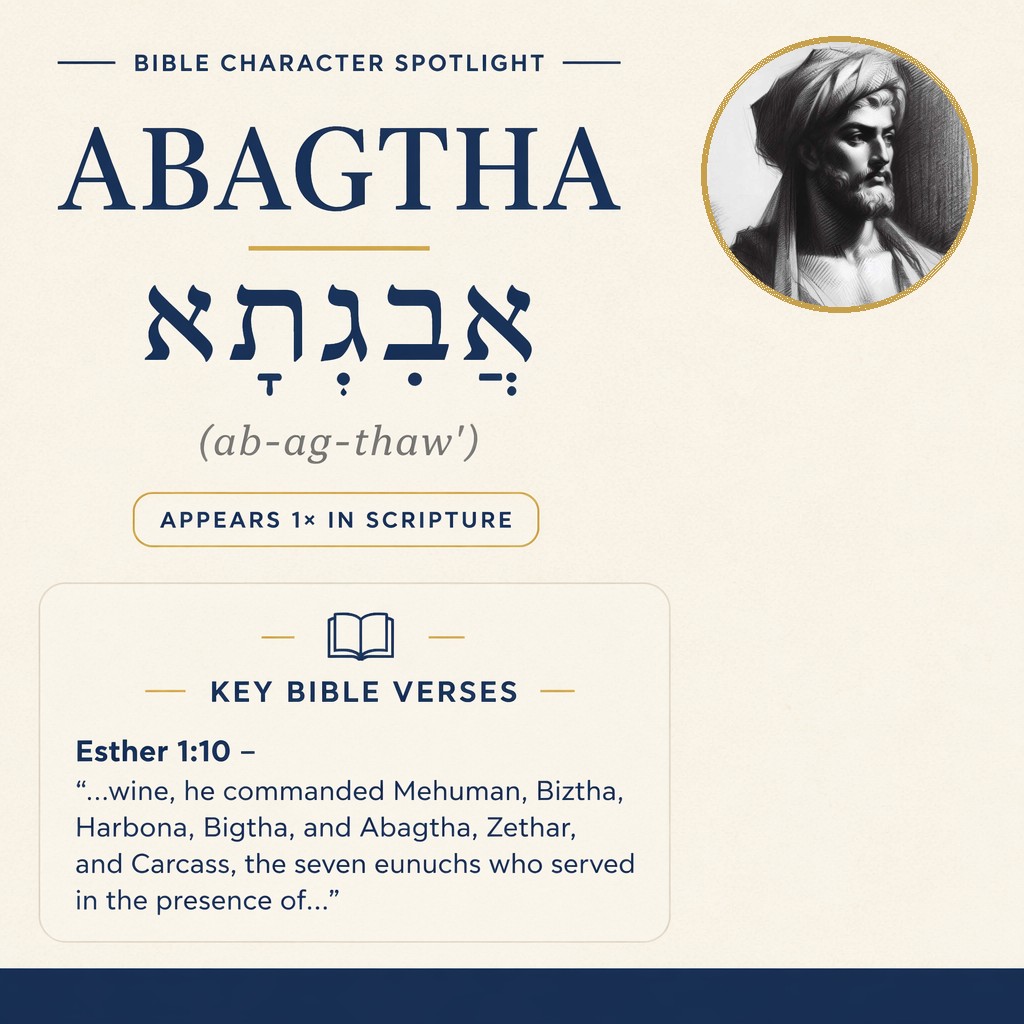
He is mentioned when the king, made merry with wine during a royal feast, issued orders through his eunuchs.
Abagtha in Scripture
Abagtha is named within the court setting of a feast hosted by King Ahasuerus. The narrative context first describes how the king regulated the drinking at his banquet:
“In accordance with the law, the drinking was not compulsory; for so the king had instructed all the officials of his house, that they should do according to every man’s pleasure.” (Esther 1:8, WEB)
At the same time, Queen Vashti is described as hosting her own feast in the royal house:
“Also Vashti the queen made a feast for the women in the royal house which belonged to King Ahasuerus.” (Esther 1:9, WEB)
Against that backdrop, Abagtha appears on a particular day of the festivities, when the king gave a command. The text states that this occurred “on the seventh day,” and it specifies the king’s condition and the role of the servants who received the command:
“On the seventh day, when the heart of the king was merry with wine, he commanded Mehuman, Biztha, Harbona, Bigtha, and Abagtha, Zethar, and Carcass, the seven eunuchs who served in the presence of Ahasuerus the king,” (Esther 1:10, WEB)
In this list, Abagtha is one of “the seven eunuchs who served in the presence of Ahasuerus the king,” and he is included among those directly addressed by the king. The immediate purpose of the command is then given: the eunuchs were instructed
“to bring Vashti the queen before the king with the royal crown, to show the people and the princes her beauty; for she was beautiful.” (Esther 1:11, WEB)
The narrative continues by describing the outcome of the king’s command: although it was carried “by the eunuchs,” Vashti did not comply. The refusal triggers the king’s anger:
“But the queen Vashti refused to come at the king’s commandment by the eunuchs. Therefore the king was very angry, and his anger burned in him.” (Esther 1:12, WEB)
Finally, the passage shows the king responding to this development by consulting a particular group characterized as knowledgeable in law and judgment:
“Then the king said to the wise men, who knew the times (for it was the king’s custom to consult those who knew law and judgment;” (Esther 1:13, WEB)
Within this chapter context, Abagtha’s role is limited to being one of the eunuchs commanded by Ahasuerus at the feast, in connection with the instruction to bring Queen Vashti before the king.
Name and Meaning
The Hebrew form of the name is אֲבַגְתָא, transliterated Abagtha and pronounced ab-ag-thaw’. The name is described in lexicon material as being of foreign origin, and Abagtha is identified there as a eunuch of Xerxes.
Closing Observation
In Esther 1, Abagtha is presented as a court servant acting within the king’s immediate presence—one of those through whom the king’s command regarding Vashti was conveyed (Esther 1:10–12).
Frequently Asked Questions
What does the name Abagtha mean?
Abagtha is a name of foreign origin.
How many times does Abagtha appear in the Bible?
Abagtha appears 1 time in the Bible.
Who was Abagtha?
Abagtha was a eunuch of Xerxes.
What is Abagtha doing in Esther 1:10?
In Esther 1:10, King Xerxes commanded Abagtha and other eunuchs on the seventh day when the king’s heart was merry with wine (Esther 1:10).
Explore Further
If you found this page about Abagtha interesting and would like to discover more about other biblical characters, explore our comprehensive Encyclopedia of Biblical Characters. For those looking to delve deeper into the Greek origins of these names and terms, our Greek Lexicon is an invaluable resource.
Sources: Name and occurrence data from Strong’s Exhaustive Concordance and STEPBible reference data (CC BY). Scripture quotations from the World English Bible (public domain).