
Who was Zephaniah in the bible?
Zephaniah is the name of multiple Israelites mentioned in 1 Chronicles, 2 Kings, Jeremiah, and Zechariah, including priests and men identified through family lines.

Priest in Jeremiah
One Zephaniah is “Zephaniah the son of Maaseiah, the priest” (Jeremiah 29:25). “Zephaniah the priest read this letter in the hearing of Jeremiah the prophet” (Jeremiah 29:29).
Learn More →Other Mentions
A Zephaniah is named among priests taken by the captain of the guard: “Zephaniah the second priest” (2 Kings 25:18; Jeremiah 52:24). Zechariah mentions “Josiah the son of Zephaniah” (Zechariah 6:10) and “Hen the son of Zephaniah” (Zechariah 6:14).
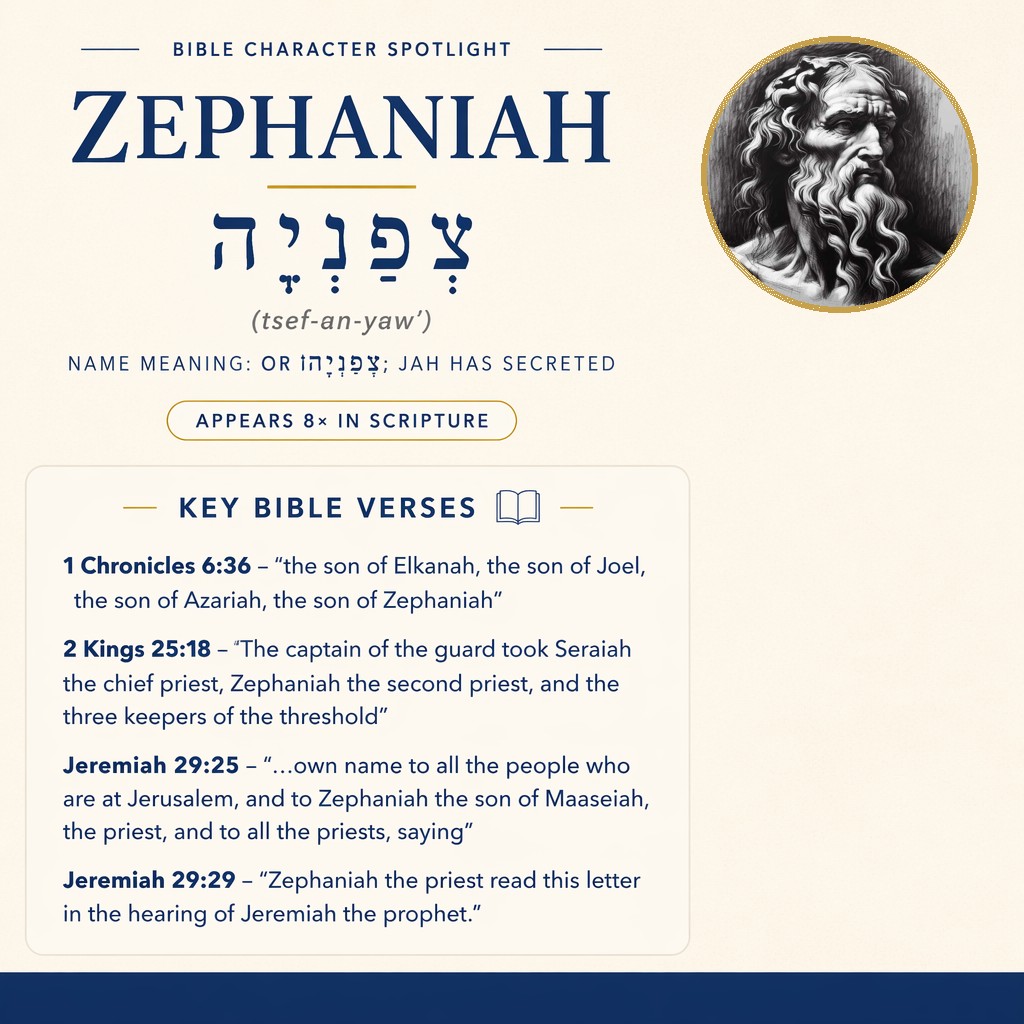
Learn More →Zephaniah (Tsephanyah) is a Hebrew name whose sense, by lexicon derivation, is “Jah has secreted” (i.e., Yah has hidden). In Scripture, this name refers to multiple Israelites, including a man named in a Levitical-style genealogy, a priest involved in events surrounding Jeremiah, and individuals identified through their fathers in Zechariah.
Zephaniah in Scripture
The earliest occurrence in the provided verses is a genealogical notice in Chronicles, where Zephaniah appears as an ancestor in a line of “son of” relationships.
“the son of Elkanah, the son of Joel, the son of Azariah, the son of Zephaniah,” (1 Chronicles 6:36)
In Kings (and in a parallel notice in Jeremiah), Zephaniah is identified as “the second priest” in a list of temple-related officials seized by “the captain of the guard.”
“The captain of the guard took Seraiah the chief priest, Zephaniah the second priest, and the three keepers of the threshold;” (2 Kings 25:18)
“The captain of the guard took Seraiah the chief priest, and Zephaniah the second priest, and the three keepers of the threshold:” (Jeremiah 52:24)
The fullest narrative material involving a Zephaniah in the provided data comes in Jeremiah 29 and related references. This Zephaniah is specifically named as a priest and as the son of Maaseiah. The chapter begins by framing Jeremiah’s message as a letter “sent from Jerusalem” to various groups among the exiles in Babylon.
“Now these are the words of the letter that Jeremiah the prophet sent from Jerusalem to the residue of the elders of the captivity, and to the priests, to the prophets, and to all the people whom Nebuchadnezzar had carried away captive from Jerusalem to Babylon,” (Jeremiah 29:1)
Within that broader setting, Yahweh’s message is presented as instruction for the captives’ life in Babylon: they are told to settle, establish households, and seek the welfare of the city where they live in exile.
“Build houses and dwell in them. Plant gardens and eat their fruit.” (Jeremiah 29:5)
“Seek the peace of the city where I have caused you to be carried away captive, and pray to Yahweh for it; for in its peace you will have peace.” (Jeremiah 29:7)
The letter also warns against false prophetic claims among the exiles and speaks of Yahweh’s intention to “visit” and “cause you to return to this place,” setting the message within a longer horizon of restoration.
“For they prophesy falsely to you in my name. I have not sent them,” says Yahweh.” (Jeremiah 29:9)
“After seventy years are accomplished for Babylon, I will visit you and perform my good word toward you, in causing you to return to this place.” (Jeremiah 29:10)
As the chapter continues, it turns to a dispute sparked by letters sent “in your own name” by Shemaiah the Nehelamite. In Yahweh’s quoted response, Zephaniah is singled out as a recipient of those letters: “Zephaniah the son of Maaseiah, the priest.”
“Yahweh of Armies, the God of Israel, says, ‘Because you have sent letters in your own name to all the people who are at Jerusalem, and to Zephaniah the son of Maaseiah, the priest, and to all the priests, saying,” (Jeremiah 29:25)
Shemaiah’s letter (as quoted in Jeremiah) asserts that Zephaniah has been installed as priest “in the place of Jehoiada the priest,” and urges him to restrain prophetic activity associated with Jeremiah.
“Yahweh has made you priest in the place of Jehoiada the priest, that there may be officers in Yahweh’s house, for every man who is crazy, and makes himself a prophet, that you should put him in the stocks and in shackles.” (Jeremiah 29:26)
“Now therefore, why have you not rebuked Jeremiah of Anathoth, who makes himself a prophet to you,” (Jeremiah 29:27)
The chapter’s narrative highlights Zephaniah’s immediate role: he reads this letter aloud to Jeremiah.
“Zephaniah the priest read this letter in the hearing of Jeremiah the prophet.” (Jeremiah 29:29)
After this reading, Jeremiah 29 reports that “Yahweh’s word came to Jeremiah,” announcing judgment on Shemaiah for prophesying without being sent and for leading people to trust in a lie.
“Then Yahweh’s word came to Jeremiah, saying,” (Jeremiah 29:30)
“Because Shemaiah has prophesied to you, and I didn’t send him, and he has caused you to trust in a lie;” (Jeremiah 29:31)
Zephaniah son of Maaseiah also appears later in Jeremiah as an envoy of King Zedekiah, sent alongside another official to ask Jeremiah for intercession.
“Zedekiah the king sent Jehucal the son of Shelemiah, and Zephaniah the son of Maaseiah, the priest, to the prophet Jeremiah, saying, “Pray now to Yahweh our God for us.”” (Jeremiah 37:3)
In Zechariah, a “Zephaniah” is not the main actor in the oracle, but he is named as the father of Josiah and of Hen. Zechariah’s instructions involve going to the house of Josiah son of Zephaniah, connected with those who “have come from Babylon.”
“Take of them of the captivity, even of Heldai, of Tobijah, and of Jedaiah; and come the same day, and go into the house of Josiah the son of Zephaniah, where they have come from Babylon.” (Zechariah 6:10)
A later verse mentions that “the crowns” will be for several people, including “Hen the son of Zephaniah,” “for a memorial in Yahweh’s temple.”
“The crowns shall be to Helem, and to Tobijah, and to Jedaiah, and to Hen the son of Zephaniah, for a memorial in Yahweh’s temple.” (Zechariah 6:14)
Multiple Bearers
The lexicon identity gloss states that Tsephanjah is “the name of four Israelites,” and the verses reflect distinct people identified by different contexts and family markers.
1) Zephaniah in a genealogy (Chronicles). This Zephaniah is named as an ancestor in a chain of descent: “the son of Azariah, the son of Zephaniah” (1 Chronicles 6:36). No further details are given in the provided verse.
2) Zephaniah the priest, son of Maaseiah (Jeremiah). He is addressed as a priest in correspondence: “Zephaniah the son of Maaseiah, the priest” (Jeremiah 29:25). He is also described acting as a public reader of Shemaiah’s letter to Jeremiah: “Zephaniah the priest read this letter in the hearing of Jeremiah the prophet” (Jeremiah 29:29). Later, he is part of a royal mission to Jeremiah: “Zedekiah the king sent … Zephaniah the son of Maaseiah, the priest” (Jeremiah 37:3).
3) Zephaniah the second priest (Kings; Jeremiah). A Zephaniah is listed among temple officials seized by the captain of the guard: “Zephaniah the second priest” (2 Kings 25:18; Jeremiah 52:24). The provided verses do not explicitly identify him as the same person as Zephaniah son of Maaseiah.
4) Zephaniah as a father named in Zechariah. Zechariah refers to “Josiah the son of Zephaniah” (Zechariah 6:10) and to “Hen the son of Zephaniah” (Zechariah 6:14). These references locate Zephaniah within the family identification of others involved in a temple-related “memorial.”
Name and Meaning
The name is written in Hebrew as צְפַנְיָה (also noted in the derivation as a longer form, צְפַנְיָהוּ), transliterated Tsephanyah and pronounced tsef-an-yaw’. By lexicon derivation, it is formed from the verb tsaphan (צָפַן), “to hide (by covering over),” together with Yahh (יָהּ), “Jah,” the sacred name; the resulting sense is that “Jah has secreted” (that is, Yah has hidden).
Observation
Across the provided passages, the most direct action attributed to a Zephaniah is the priestly figure who publicly conveys disputed correspondence—“Zephaniah the priest read this letter in the hearing of Jeremiah the prophet” (Jeremiah 29:29)—placing him at a key point where competing messages about Jeremiah are brought into the open.
Frequently Asked Questions
What does the name Zephaniah mean?
Zephaniah means “Jah has secreted.”
How many times does Zephaniah appear in the Bible?
Zephaniah appears 8 times.
Who was Zephaniah in the Bible?
Zephaniah is the name of four Israelites. One Zephaniah is called “the second priest” (2 Kings 25:18), and another is “the priest” who read a letter in Jeremiah’s hearing (Jeremiah 29:29).
What is one specific moment involving Zephaniah in Jeremiah?
“Zephaniah the priest read this letter in the hearing of Jeremiah the prophet” (Jeremiah 29:29).
Explore Further
If you found this page about Zephaniah interesting and would like to discover more about other biblical characters, explore our comprehensive Encyclopedia of Biblical Characters. For those looking to delve deeper into the Greek origins of these names and terms, our Greek Lexicon is an invaluable resource.
Sources: Name and occurrence data from Strong’s Exhaustive Concordance and STEPBible reference data (CC BY). Scripture quotations from the World English Bible (public domain).





