
Who was Zacharias in the bible?
Zacharias is the name of a priest in Luke 1 and John’s father in Luke 3:2, and it also appears in Jesus’ sayings in Matthew 23:35 and Luke 11:51.
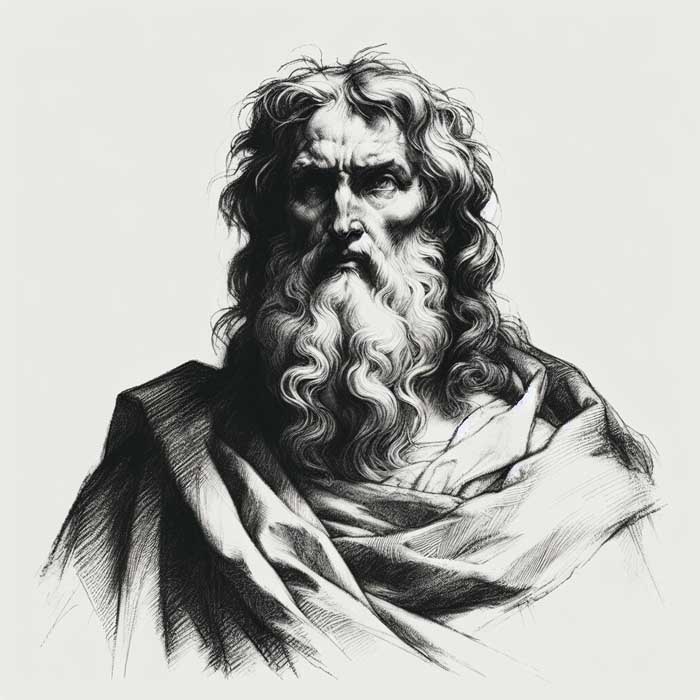
Temple Vision
An angel appeared to him as he burned incense in the temple, and “Zacharias was troubled” (Luke 1:9-12). Gabriel told him, “Your wife, Elizabeth, will bear you a son, and you shall call his name John” (Luke 1:13,19).
Learn More →Two Uses
Luke identifies “John, the son of Zacharias” (Luke 3:2). Separately, Jesus spoke of “Zachariah… whom you killed between the sanctuary and the altar” (Matthew 23:35; Luke 11:51).
Learn More →Zacharias (Greek Ζαχαρίας, a form of the Hebrew name Zechariah) refers in the New Testament to (1) a priest connected with the birth and naming of John, and (2) a man called “Zachariah son of Barachiah,” whose blood is mentioned in Jesus’ denunciation of shedding righteous blood.
Zacharias in Scripture
In the Gospel narratives, the most detailed account concerns a priest named Zacharias. Luke sets him in a particular historical setting and priestly role:
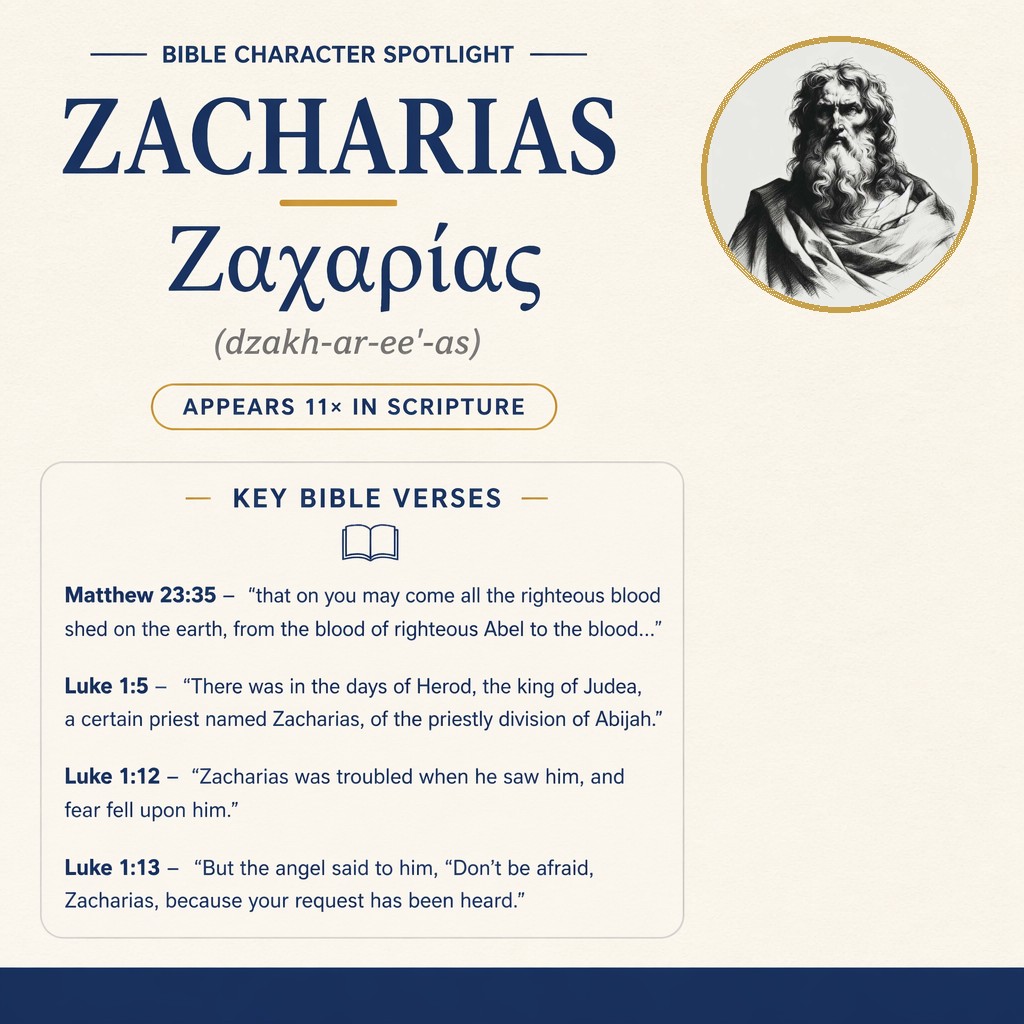
“There was in the days of Herod, the king of Judea, a certain priest named Zacharias, of the priestly division of Abijah. He had a wife of the daughters of Aaron, and her name was Elizabeth.” (Luke 1:5)
Luke also characterizes the couple’s life and situation:
“They were both righteous before God, walking blamelessly in all the commandments and ordinances of the Lord. But they had no child, because Elizabeth was barren, and they both were well advanced in years.” (Luke 1:6–7)
While Zacharias “executed the priest’s office before God” (Luke 1:8), his assigned duty brought him into the temple: “his lot was to enter into the temple of the Lord and burn incense” (Luke 1:9). At that time, “The whole multitude of the people were praying outside at the hour of incense.” (Luke 1:10)
Luke narrates a dramatic encounter during this service:
“An angel of the Lord appeared to him, standing on the right side of the altar of incense. Zacharias was troubled when he saw him, and fear fell upon him.” (Luke 1:11–12)
The angel addressed him by name and announced that his prayer had been heard, linking the message directly to his marriage and to the naming of a promised child:
“But the angel said to him, “Don’t be afraid, Zacharias, because your request has been heard. Your wife, Elizabeth, will bear you a son, and you shall call his name John.” (Luke 1:13)
The angel’s words described the future child’s impact and calling: “many will rejoice at his birth” (Luke 1:14); “he will be great in the sight of the Lord” (Luke 1:15); and “He will turn many of the children of Israel to the Lord their God.” (Luke 1:16) The message concludes with a purpose statement: “to prepare a people prepared for the Lord.” (Luke 1:17)
Zacharias responded with a question grounded in his and Elizabeth’s age:
“Zacharias said to the angel, “How can I be sure of this? For I am an old man, and my wife is well advanced in years.”” (Luke 1:18)
The angel identified himself and declared the consequence of Zacharias’s unbelief:
“The angel answered him, “I am Gabriel, who stands in the presence of God. I was sent to speak to you and to bring you this good news. Behold, you will be silent and not able to speak until the day that these things will happen, because you didn’t believe my words, which will be fulfilled in their proper time.”” (Luke 1:19–20)
Outside the temple, those waiting noticed the unusual delay:
“The people were waiting for Zacharias, and they marveled that he delayed in the temple.” (Luke 1:21)
When he emerged, Zacharias’s condition signaled to others that something extraordinary had happened:
“When he came out, he could not speak to them. They perceived that he had seen a vision in the temple. He continued making signs to them, and remained mute.” (Luke 1:22)
After completing his service, “he departed to his house” (Luke 1:23), and the promise began to unfold: “After these days Elizabeth his wife conceived” (Luke 1:24). Elizabeth herself interpreted this change in personal terms: “Thus has the Lord done to me… to take away my reproach among men.” (Luke 1:25)
Later in the same chapter, the narrative notes that Mary “entered into the house of Zacharias and greeted Elizabeth.” (Luke 1:40) This situates Zacharias’s household as the setting for Elizabeth’s Spirit-filled response to Mary’s visit (Luke 1:41–45), while Zacharias remains in the background until the child’s birth and naming.
When Elizabeth gave birth, the question of the child’s name brought Zacharias back to the center:
“On the eighth day, they came to circumcise the child; and they would have called him Zacharias, after the name of his father.” (Luke 1:59)
Elizabeth insisted otherwise—“Not so; but he will be called John.” (Luke 1:60)—and the group turned to Zacharias for confirmation, using signs because of his inability to speak (Luke 1:62). Zacharias confirmed the name in writing:
“He asked for a writing tablet, and wrote, “His name is John.” They all marveled.” (Luke 1:63)
Immediately following this, Luke records a change that corresponds to the angel’s earlier words:
“His mouth was opened immediately and his tongue freed, and he spoke, blessing God.” (Luke 1:64)
The response of those nearby emphasizes the public impact of the events:
“Fear came on all who lived around them, and all these sayings were talked about throughout all the hill country of Judea.” (Luke 1:65)
The chapter then introduces Zacharias’s prophetic speech as a Spirit-enabled act:
“His father Zacharias was filled with the Holy Spirit, and prophesied, saying,” (Luke 1:67)
His prophecy begins with praise to God for visiting and redeeming his people and for raising salvation:
“Blessed be the Lord, the God of Israel, for he has visited and redeemed his people; and has raised up a horn of salvation for us in the house of his servant David” (Luke 1:68–69)
He frames this as consistent with what God spoke “by the mouth of his holy prophets who have been from of old” (Luke 1:70) and describes its aims as “salvation from our enemies” (Luke 1:71) and showing covenant mercy (Luke 1:72–73), enabling God’s people “to serve him without fear, in holiness and righteousness before him all the days of our life.” (Luke 1:74–75)
Turning to the child, Zacharias declares John’s role:
“And you, child, will be called a prophet of the Most High; for you will go before the face of the Lord to prepare his ways, to give knowledge of salvation to his people by the remission of their sins” (Luke 1:76–77)
He ends with imagery of divine visitation and guidance: “to shine on those who sit in darkness and the shadow of death; to guide our feet into the way of peace.” (Luke 1:79) Luke closes the chapter by noting John’s development and setting: “The child was growing and becoming strong in spirit, and was in the desert until the day of his public appearance to Israel.” (Luke 1:80)
Elsewhere, Luke identifies John by his parentage in a chronological notice:
“the word of God came to John, the son of Zacharias, in the wilderness.” (Luke 3:2)
Multiple Bearers
The name Zacharias (Zachariah) also appears in sayings of Jesus about accountability for righteous bloodshed. In Matthew, Jesus names a specific figure and a familial descriptor:
“that on you may come all the righteous blood shed on the earth, from the blood of righteous Abel to the blood of Zachariah son of Barachiah, whom you killed between the sanctuary and the altar.” (Matthew 23:35)
Luke’s parallel saying mentions the same death scene without the patronymic:
“from the blood of Abel to the blood of Zachariah, who perished between the altar and the sanctuary.’ Yes, I tell you, it will be required of this generation.” (Luke 11:51)
These references portray a Zachariah whose death occurred “between the sanctuary and the altar” / “between the altar and the sanctuary,” distinct in context from the priest Zacharias associated with Elizabeth and John.
Name and Meaning
In Greek the name is written Ζαχαρίας (transliteration: Zacharias; pronunciation: dzakh-ar-ee’-as). It is described in the lexicon material as being of Hebrew origin (linked with H02148) and corresponds to the Hebrew name Zechariah.
Observation
Luke presents Zacharias both as a temple-serving priest who “remained mute” after a vision (Luke 1:22) and as one who later “was filled with the Holy Spirit, and prophesied” (Luke 1:67), marking a narrative movement from silence to proclamation.
Frequently Asked Questions
What does the name Zacharias mean?
Zacharias means Zechariah.
How many times does Zacharias appear in the Bible?
Zacharias appears 11 times.
Who was Zacharias in the Bible?
In Luke 1:5, Zacharias is named as a priest in the days of Herod, king of Judea, of the priestly division of Abijah, with a wife named Elizabeth from the daughters of Aaron. Luke 3:2 identifies John as “the son of Zacharias.”
What happened when Zacharias saw the angel?
Luke 1:12 says Zacharias was troubled when he saw him, and fear fell upon him.
Explore Further
If you found this page about Zacharias interesting and would like to discover more about other biblical characters, explore our comprehensive Encyclopedia of Biblical Characters. For those looking to delve deeper into the Greek origins of these names and terms, our Greek Lexicon is an invaluable resource.
Sources: Name and occurrence data from Strong’s Exhaustive Concordance and STEPBible reference data (CC BY). Scripture quotations from the World English Bible (public domain).





