Who was Mordecai in the bible?
Mordecai was a Jew in the citadel of Susa, mentioned in Esther 2–3 as Esther’s guardian and a man who sat in the king’s gate.
Esther’s Guardian
“He brought up Hadassah, that is, Esther, his uncle’s daughter… Mordecai took her for his own daughter” (Esther 2:7). Esther concealed her relatives and people “because Mordecai had instructed her that she should not make it known” (Esther 2:10).
Learn More →Court Actions
Mordecai “was sitting in the king’s gate” (Esther 2:19) and reported a plot: “This thing became known to Mordecai, who informed Esther the queen” (Esther 2:22). He also refused to honor Haman: “Mordecai didn’t bow down or pay him homage” (Esther 3:2).
Learn More →Mordecai (a name of foreign derivation) is presented as an Israelite Jew living in the citadel of Susa, identified by a Benjamite lineage. In Esther, he appears as the guardian of Hadassah—also called Esther—and as a figure active at the king’s gate.
Mordecai in Scripture
After King Ahasuerus’ anger over Vashti subsided, the king’s attendants proposed a search for a new queen. They said,
“Let beautiful young virgins be sought for the king.” (Esther 2:2, WEB)
They further advised that the young women be gathered “to the citadel of Susa” under Hegai’s oversight, and that “the maiden who pleases the king be queen instead of Vashti” (Esther 2:3–4). It is in this setting that Mordecai is introduced:
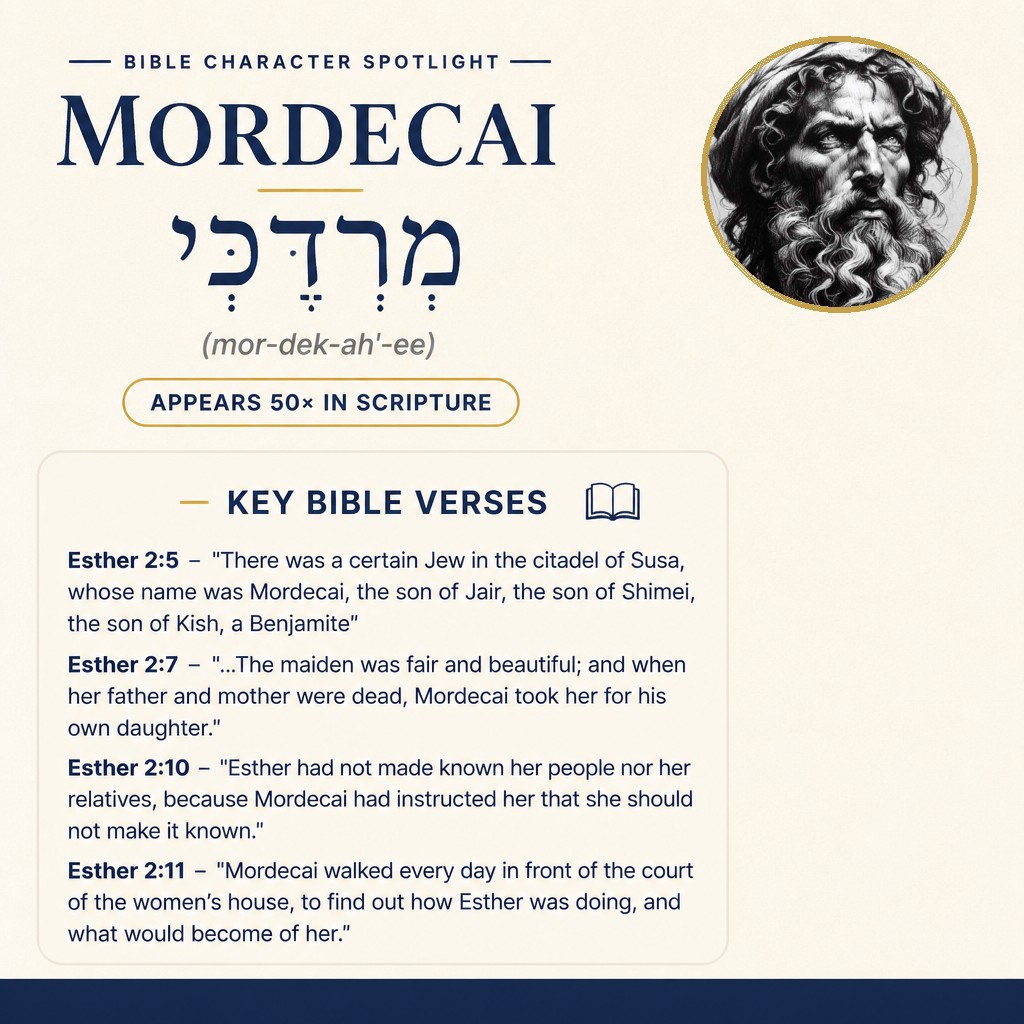
“There was a certain Jew in the citadel of Susa, whose name was Mordecai, the son of Jair, the son of Shimei, the son of Kish, a Benjamite,” (Esther 2:5, WEB)
The narrative adds that he was among those affected by an earlier deportation:
“who had been carried away from Jerusalem with the captives who had been carried away with Jeconiah king of Judah, whom Nebuchadnezzar the king of Babylon had carried away.” (Esther 2:6, WEB)
Mordecai’s most immediate role is familial and protective. He became the caregiver of Hadassah, also called Esther, described as his uncle’s daughter. The text explains both her vulnerability and his response:
“He brought up Hadassah, that is, Esther, his uncle’s daughter; for she had neither father nor mother. The maiden was fair and beautiful; and when her father and mother were dead, Mordecai took her for his own daughter.” (Esther 2:7, WEB)
As the king’s plan proceeded, “many maidens were gathered together to the citadel of Susa” (Esther 2:8). Esther was taken into the king’s house under Hegai, and as her situation changed, Mordecai continued to influence her conduct. A key instruction attributed to him is that Esther should conceal her people and family connections:
“Esther had not made known her people nor her relatives, because Mordecai had instructed her that she should not make it known.” (Esther 2:10, WEB)
His ongoing concern is portrayed as consistent daily attention outside the women’s quarters:
“Mordecai walked every day in front of the court of the women’s house, to find out how Esther was doing, and what would become of her.” (Esther 2:11, WEB)
As the account describes the preparations and process by which young women approached the king (Esther 2:12–14), it returns to Esther’s turn, explicitly tying her to Mordecai’s earlier adoption of her:
“Now when the turn of Esther, the daughter of Abihail the uncle of Mordecai, who had taken her for his daughter, came to go in to the king, she required nothing but what Hegai the king’s eunuch, the keeper of the women, advised.” (Esther 2:15, WEB)
Esther’s favorable reception culminated in her being made queen instead of Vashti (Esther 2:17), followed by royal celebration (Esther 2:18). In the midst of these court movements, Mordecai is pictured in a public, strategic location within the royal complex:
“When the virgins were gathered together the second time, Mordecai was sitting in the king’s gate.” (Esther 2:19, WEB)
The earlier instruction to conceal Esther’s identity remains in force even after she becomes queen. The text restates both Mordecai’s directive and Esther’s continuing obedience to him:
“Esther had not yet made known her relatives nor her people, as Mordecai had commanded her; for Esther obeyed Mordecai, like she did when she was brought up by him.” (Esther 2:20, WEB)
While Mordecai is sitting at the king’s gate, he becomes aware of a threat against King Ahasuerus from two doorkeepers. The narrative reports their intent:
“In those days, while Mordecai was sitting in the king’s gate, two of the king’s eunuchs, Bigthan and Teresh, who were doorkeepers, were angry, and sought to lay hands on the King Ahasuerus.” (Esther 2:21, WEB)
Mordecai responds by relaying the information through Esther, and the report is formally connected to him:
“This thing became known to Mordecai, who informed Esther the queen; and Esther informed the king in Mordecai’s name.” (Esther 2:22, WEB)
The court investigates and confirms the report; the outcome is recorded officially in the king’s presence (Esther 2:23).
Later in the narrative excerpts provided, Mordecai appears again among those stationed at the king’s gate as royal policy demanded public honor toward Haman. The text contrasts universal compliance with Mordecai’s refusal:
“All the king’s servants who were in the king’s gate bowed down, and paid homage to Haman; for the king had so commanded concerning him. But Mordecai didn’t bow down or pay him homage.” (Esther 3:2, WEB)
Other servants challenge him directly:
“Then the king’s servants, who were in the king’s gate, said to Mordecai, ‘Why do you disobey the king’s commandment?’” (Esther 3:3, WEB)
When pressed repeatedly, Mordecai continues his stance. The account reports that the servants informed Haman, and it gives the reason Mordecai had already shared:
“Now it came to pass, when they spoke daily to him, and he didn’t listen to them, that they told Haman, to see whether Mordecai’s reason would stand; for he had told them that he was a Jew.” (Esther 3:4, WEB)
Name and Meaning
The Hebrew form is מׇרְדְּכַי, transliterated Mordekay and pronounced “mor-dek-ah’-ee.” Strong’s describes the name as being of foreign derivation, and identifies Mordecai in Esther as an Israelite.
Observation
Across these scenes, Mordecai is repeatedly shown in positions of watchfulness and resolve—walking daily to learn Esther’s condition (Esther 2:11), reporting a threat to the king (Esther 2:22), and refusing commanded homage at the gate (Esther 3:2).
Frequently Asked Questions
What does the name Mordecai mean?
Mordecai is a name of foreign derivation.
How many times does Mordecai appear in the Bible?
Mordecai occurs 50 times.
Who was Mordecai?
Mordecai was an Israelite Jew in the citadel of Susa, described as the son of Jair, the son of Shimei, the son of Kish, a Benjamite (Esther 2:5). He brought up Hadassah (Esther), his uncle’s daughter (Esther 2:7).
What did Mordecai do when people were told to honor Haman?
Mordecai didn’t bow down or pay homage to Haman, even though the king had commanded it (Esther 3:2).
Explore Further
If you found this page about Mordecai interesting and would like to discover more about other biblical characters, explore our comprehensive Encyclopedia of Biblical Characters. For those looking to delve deeper into the Greek origins of these names and terms, our Greek Lexicon is an invaluable resource.
Sources: Name and occurrence data from Strong’s Exhaustive Concordance and STEPBible reference data (CC BY). Scripture quotations from the World English Bible (public domain).