
Who was Judah in the bible?
Judah (Yehuwdah/Iouda) appears in genealogies and tribal references in 1 Chronicles, and as Judah/Judea in Daniel, Ezra, Matthew, and Luke.

Family Line
“Tamar his daughter-in-law bore him Perez and Zerah” (1 Chronicles 2:4). “Ram became the father of Amminadab… Nahshon, prince of the children of Judah” (1 Chronicles 2:10).
Learn More →Land and People
“Hebron in the land of Judah” is named among allotted places (1 Chronicles 6:55). “A man of the children of the captivity of Judah” is how Daniel is described (Daniel 2:25).
Learn More →Judah (Hebrew Yehuwdah) is presented in Scripture as one of the sons of Israel and the ancestor from whom the “children of Judah,” their tribal identity, and the “land of Judah” are named (1 Chronicles 2:1; 1 Chronicles 6:55). The name is also used for the province/territory called Judah (including in Aramaic and Greek forms), such as “Bethlehem, land of Judah” (Matthew 2:6).
Judah in Scripture
“These are the sons of Israel: Reuben, Simeon, Levi, Judah, Issachar, Zebulun,” (1 Chronicles 2:1).
In Chronicles, Judah appears first in a list of Israel’s sons, then in genealogical detail. Judah’s immediate family line is given with specific names and counts.
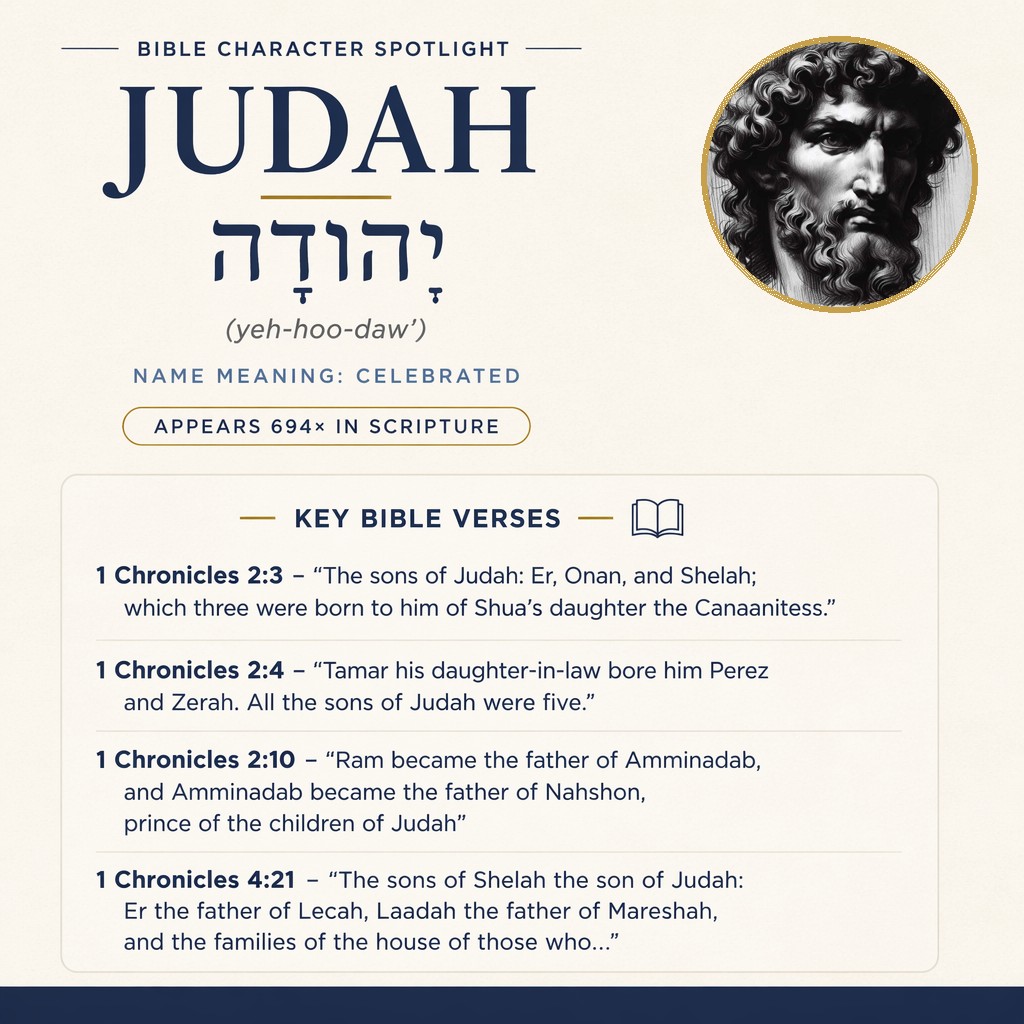
“The sons of Judah: Er, Onan, and Shelah; which three were born to him of Shua’s daughter the Canaanitess. Er, Judah’s firstborn, was wicked in Yahweh’s sight; and he killed him.” (1 Chronicles 2:3).
“Tamar his daughter-in-law bore him Perez and Zerah. All the sons of Judah were five.” (1 Chronicles 2:4).
The chapter continues by tracing Judah’s descendants through Perez and onward, naming later figures and lines connected to leadership within Judah.
“Ram became the father of Amminadab, and Amminadab became the father of Nahshon, prince of the children of Judah;” (1 Chronicles 2:10).
Other passages show “Judah” as the tribal group and its relative prominence.
“For Judah prevailed above his brothers, and from him came the prince; but the birthright was Joseph’s)—” (1 Chronicles 5:2).
Chronicles also uses Judah to describe land allotments and residences. For example, priests are assigned cities in Judah’s territory, and Jerusalem is said to include people from Judah among others.
“to them they gave Hebron in the land of Judah, and its pasture lands around it;” (1 Chronicles 6:55).
“In Jerusalem lived of the children of Judah, of the children of Benjamin, and of the children of Ephraim and Manasseh:” (1 Chronicles 9:3).
Judah is also the setting for royal-era references (“Hezekiah king of Judah,” “Jotham king of Judah”), and for a captivity described as affecting Judah and Jerusalem.
“These written by name came in the days of Hezekiah king of Judah, and struck their tents. The Meunim who were found there, and they destroyed them utterly to this day, and lived in their place; because there was pasture there for their flocks.” (1 Chronicles 4:41).
“Jehozadak went into captivity, when Yahweh carried Judah and Jerusalem away by the hand of Nebuchadnezzar.” (1 Chronicles 6:15).
In Daniel, “Judah” appears (in Aramaic form) in court scenes where Daniel is identified by his origin among captives from Judah. In the narrative of Daniel 2, the king’s demand for the dream and its interpretation leads to Daniel being brought forward, and Judah is part of the way Daniel is introduced.
“Then Arioch brought in Daniel before the king in haste, and said this to him: “I have found a man of the children of the captivity of Judah who will make known to the king the interpretation.”” (Daniel 2:25).
Daniel himself responds by directing the king away from human ability and toward divine revelation.
“Daniel answered before the king, and said, “The secret which the king has demanded can’t be shown to the king by wise men, enchanters, magicians, or soothsayers;” (Daniel 2:27).
“but there is a God in heaven who reveals secrets, and he has made known to the king Nebuchadnezzar what will be in the latter days.” (Daniel 2:28).
Other court questions return to Judah as the point of origin for Daniel: “Are you that Daniel of the children of the captivity of Judah…?” (Daniel 5:13), and an accusation identifies him similarly: “That Daniel, who is of the children of the captivity of Judah…” (Daniel 6:13).
In Ezra, Judah appears as the province where building activity and inquiry are reported.
“Be it known to the king that we went into the province of Judah, to the house of the great God, which is built with great stones, and timber is laid in the walls. This work goes on with diligence and prospers in their hands.” (Ezra 5:8).
“Because you are sent by the king and his seven counselors, to inquire concerning Judah and Jerusalem, according to the law of your God which is in your hand,” (Ezra 7:14).
In the New Testament, Judah (Greek form) appears in a quotation spoken to identify Bethlehem’s significance, using Judah both for the land and for its rulers (“princes of Judah”). The scene is framed by King Herod’s consultation with chief priests and scribes about where the Christ would be born.
“Gathering together all the chief priests and scribes of the people, he asked them where the Christ would be born.” (Matthew 2:4).
“‘You Bethlehem, land of Judah, are in no way least among the princes of Judah: for out of you shall come a governor, who shall shepherd my people, Israel.’ ” (Matthew 2:6).
Luke uses Judah geographically as part of Mary’s travel narrative, describing her destination as “a city of Judah.”
“Mary arose in those days and went into the hill country with haste, into a city of Judah,” (Luke 1:39).
Multiple Uses of “Judah”
In the verses cited, “Judah” is used in more than one way. (1) Judah is a person: listed among Israel’s sons and described as having sons and descendants (1 Chronicles 2:1–4). (2) Judah is a people/tribe: “the children of Judah,” with a named “prince of the children of Judah” (1 Chronicles 2:10), and “Judah prevailed above his brothers” (1 Chronicles 5:2). (3) Judah is a land/province: “Hebron in the land of Judah” (1 Chronicles 6:55), “the province of Judah” (Ezra 5:8), and “Bethlehem, land of Judah” (Matthew 2:6). (4) Judah is linked to captivity language in Daniel: “the captivity of Judah” as a descriptor for Daniel’s origin (Daniel 2:25; Daniel 5:13; Daniel 6:13).
Name and Meaning
The Hebrew name is written יְהוּדָה, transliterated Yehuwdah (pronounced yeh-hoo-daw’). In Strong’s lexicon, it is explained as coming from a root (H3034) associated with being “celebrated,” and it is connected with the component word yadah (יָדָה), described there as “physically, to throw (a stone, an arrow).” In Aramaic, a contracted form appears as יְהוּד (Yehuwd, pronounced yeh-hood’), used for Judah and by extension Judaea; and in Greek it appears as Ἰουδά (Iouda, pronounced ee-oo-dah’).
Observation
Across the passages, Judah functions as a personal ancestor in genealogies and as the name for a people and place—so that the same name can introduce a family line (“The sons of Judah…,” 1 Chronicles 2:3) and also locate events (“the province of Judah,” Ezra 5:8; “Bethlehem, land of Judah,” Matthew 2:6).
Frequently Asked Questions
What does the name Judah mean?
Judah means “celebrated.”
How many times does Judah appear in the Bible?
Across the Hebrew, Aramaic, and Greek forms listed, Judah appears 694 times total.
Who was Judah?
Judah (Jehudah) is the name of five Israelites, and it is also the name of the tribe descended from the first Judah and of its territory. 1 Chronicles 2:3–4 mentions Judah’s sons Er, Onan, and Shelah, and that Tamar bore him Perez and Zerah.
Was there more than one person named Judah?
Yes. Judah is stated to be the name of five Israelites, and the same name is also used for the tribe and its territory; the Aramaic form can refer to Judah and, by extension, Judaea.
Explore Further
If you found this page about Judah interesting and would like to discover more about other biblical characters, explore our comprehensive Encyclopedia of Biblical Characters. For those looking to delve deeper into the Greek origins of these names and terms, our Greek Lexicon is an invaluable resource.
Sources: Name and occurrence data from Strong’s Exhaustive Concordance and STEPBible reference data (CC BY). Scripture quotations from the World English Bible (public domain).





