Who was Eve in the bible?
Eve (Chavvah/Eua) is Adam’s wife, named as mother of all the living, mentioned in Genesis 3:20; 2 Corinthians 11:3; and 1 Timothy 2:13.

Mentioned in Letters
Paul refers to “Eve” when warning, “as the serpent deceived Eve in his craftiness” (2 Corinthians 11:3).
Learn More →Eve (Hebrew Chavvah; Greek Eua) is presented as Adam’s wife, named because “she would be the mother of all the living” (Genesis 3:20), and referenced in the New Testament as the woman whom “the serpent deceived… in his craftiness” (2 Corinthians 11:3). Her name is associated, in a lexicon gloss, with the first woman and with the idea of being a “life-giver.”
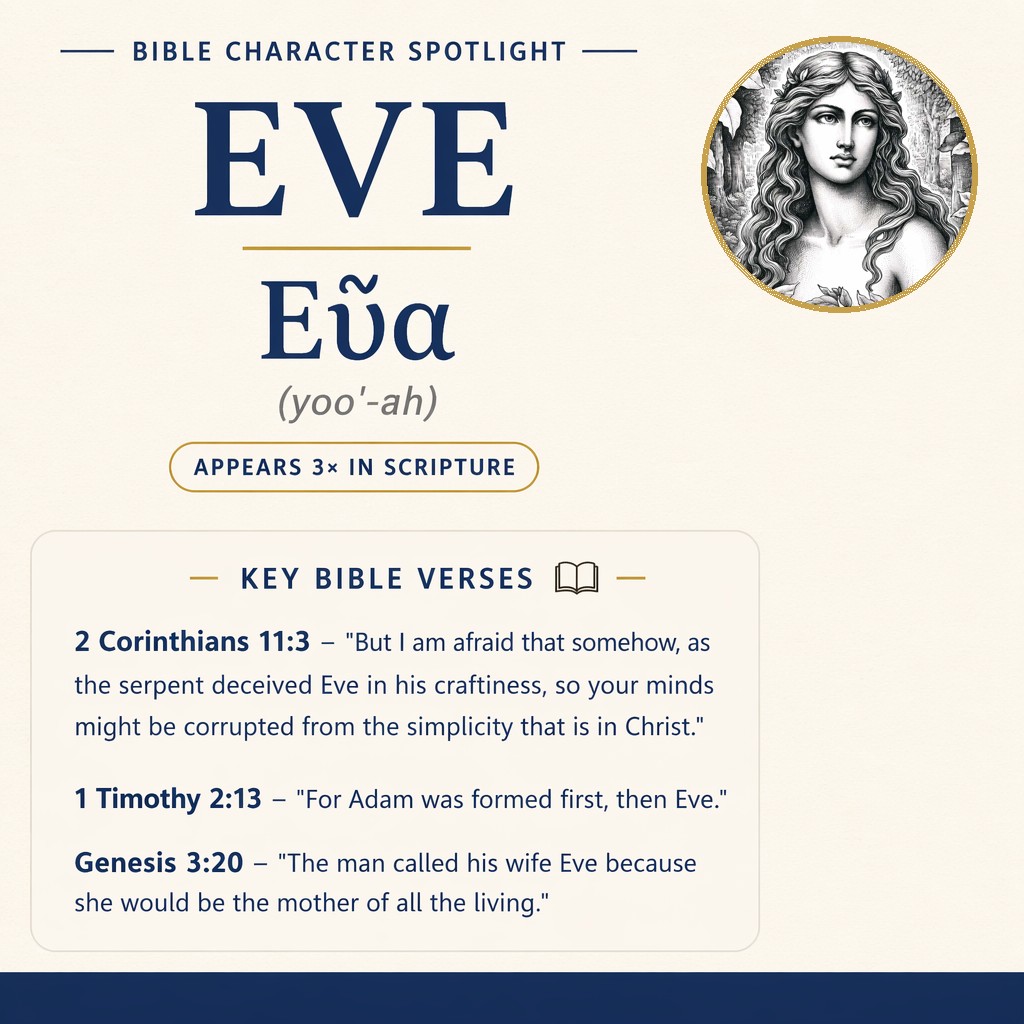
Eve in Scripture
In Genesis, Eve appears within a scene of divine speech directed first to Adam and then encompassing Adam and his wife. Yahweh God addresses Adam with an oracle tied to his action and its consequences in work, food, and mortality. The speech begins with a stated reason and a curse upon the ground:
“To Adam he said, ‘Because you have listened to your wife’s voice, and ate from the tree, about which I commanded you, saying, ‘You shall not eat of it,’ the ground is cursed for your sake. You will eat from it with much labor all the days of your life.’” (Genesis 3:17)
The oracle continues by describing what the ground will produce and how Adam will eat, stressing hardship and the return to the ground:
“It will yield thorns and thistles to you; and you will eat the herb of the field. You will eat bread by the sweat of your face until you return to the ground, for you were taken out of it. For you are dust, and you shall return to dust.” (Genesis 3:18–19)
Against that backdrop, Adam names his wife. The text states both the act of naming and the reason for the name, linking Eve to life and descent:
“The man called his wife Eve because she would be the mother of all the living.” (Genesis 3:20)
The narrative immediately notes Yahweh God’s provision of clothing for Adam and his wife:
“Yahweh God made garments of animal skins for Adam and for his wife, and clothed them.” (Genesis 3:21)
Yahweh God then speaks about “the man” having become like one who knows “good and evil,” and expresses concern about access to “the tree of life” and living forever:
“Yahweh God said, ‘Behold, the man has become like one of us, knowing good and evil. Now, lest he reach out his hand, and also take of the tree of life, and eat, and live forever—’” (Genesis 3:22)
The result is expulsion from Eden: “Therefore Yahweh God sent him out from the garden of Eden, to till the ground from which he was taken” (Genesis 3:23). The account concludes with the driving out of “the man” and the guarding of the way back:
“So he drove out the man; and he placed cherubim at the east of the garden of Eden, and a flaming sword which turned every way, to guard the way to the tree of life.” (Genesis 3:24)
In the New Testament, Eve is cited as a well-known figure whose deception by the serpent becomes an analogy for spiritual danger. In 2 Corinthians, Paul expresses concern for his audience and compares their potential corruption to Eve’s deception:
“But I am afraid that somehow, as the serpent deceived Eve in his craftiness, so your minds might be corrupted from the simplicity that is in Christ.” (2 Corinthians 11:3)
This reference sits within Paul’s broader statement of concern and his description of the Corinthians’ relationship to Christ: “For I am jealous over you with a godly jealousy. For I married you to one husband, that I might present you as a pure virgin to Christ” (2 Corinthians 11:2), and his warning about tolerating a different message: “For if he who comes preaches another Jesus… you put up with that well enough” (2 Corinthians 11:4).
In 1 Timothy, Eve is mentioned in a sequence of reasoning that begins with the order of formation and continues with a contrast involving deception and disobedience. First, the formation order is stated plainly:
“For Adam was formed first, then Eve.” (1 Timothy 2:13)
Then the passage adds:
“Adam wasn’t deceived, but the woman, being deceived, has fallen into disobedience;” (1 Timothy 2:14)
These statements occur in a context addressing conduct and roles: “Let a woman learn in quietness with full submission” (1 Timothy 2:11) and “I don’t permit a woman to teach, nor to exercise authority over a man, but to be in quietness” (1 Timothy 2:12), framed by a call to “good works” fitting “women professing godliness” (1 Timothy 2:10).
Name and Meaning
In Hebrew, Eve’s name is written חַוָּה, transliterated Chavvah and pronounced khav-vaw’. A lexicon note derives it causatively from H2331 and paraphrases its sense as “life-giver,” connecting it with a component חָוָה (chavah), glossed as “to live.” In Greek, the name appears as Εὖα, transliterated Eua and pronounced yoo’-ah, described in a lexicon note as of Hebrew origin.
Observation
Across these passages, Eve is consistently identified by her place alongside Adam—named as “the mother of all the living” (Genesis 3:20) and recalled in later teaching as one whom “the serpent deceived… in his craftiness” (2 Corinthians 11:3).
Frequently Asked Questions
What does the name Eve mean?
Eve is described as meaning “life-giver.”
How many times does Eve appear in the Bible?
Eve appears 3 times total across the listed entries.
Who was Eve?
Eve is identified as the first woman. Genesis 3:20 says the man called his wife Eve because she would be the mother of all the living.
Was there more than one person named Eve?
No. The entries present the same person under Greek (Eua) and Hebrew (Chavvah/Eve) forms of her name.
Explore Further
If you found this page about Eve interesting and would like to discover more about other biblical characters, explore our comprehensive Encyclopedia of Biblical Characters. For those looking to delve deeper into the Greek origins of these names and terms, our Greek Lexicon is an invaluable resource.
Sources: Name and occurrence data from Strong’s Exhaustive Concordance and STEPBible reference data (CC BY). Scripture quotations from the World English Bible (public domain).