Who was Ahasuerus in the bible?
Ahasuerus is a Persian king in the book of Esther, ruling from India to Ethiopia and seated on his throne in Susa the palace (Esther 1:1-2).

Royal Court Events
In the third year of his reign he “made a feast for all his princes and his servants” and later held “a seven day feast” in Susa (Esther 1:3, 1:5). He commanded Vashti to appear, and after her refusal a decree was issued regarding her royal estate (Esther 1:11-12, 1:19).
Learn More →Name and Title
Strong’s H325 identifies Achashverosh (Ahasuerus) as a Persian royal title rather than a personal name. The gloss associates it with Xerxes in this context.
Learn More →Ahasuerus (Hebrew אֲחַשְׁוֵרוֹשׁ, ʾAchashverowsh) is presented in Esther as a Persian king—described in the lexicon gloss as a royal title rather than a personal name—who ruled a vast empire and held court in Susa.
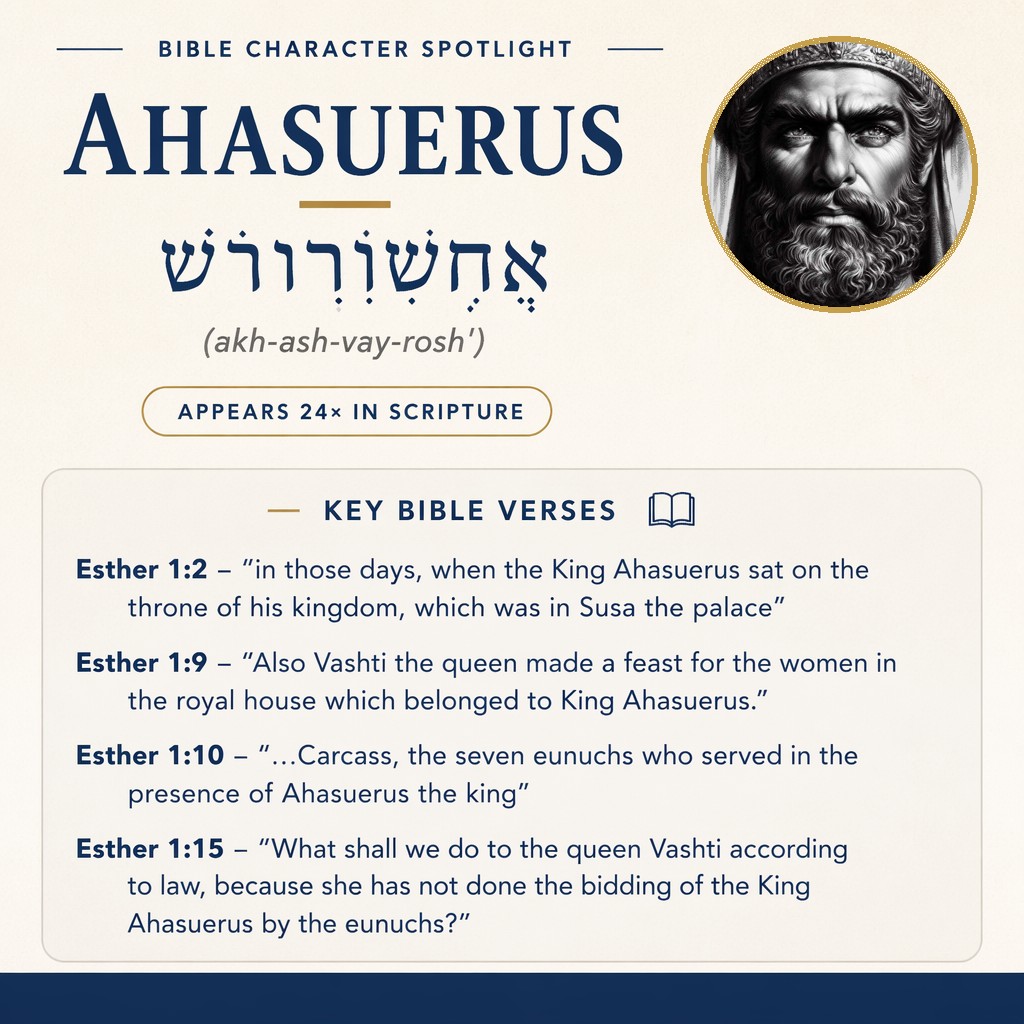
Ahasuerus in Scripture
The book of Esther opens by locating Ahasuerus in time and scope, identifying him as the ruler of an extensive realm:
“Now in the days of Ahasuerus (this is Ahasuerus who reigned from India even to Ethiopia, over one hundred twenty-seven provinces),” (Esther 1:1, WEB)
The narrative immediately places him on his royal seat in a specific setting:
“in those days, when the King Ahasuerus sat on the throne of his kingdom, which was in Susa the palace,” (Esther 1:2, WEB)
In the third year of his reign, Ahasuerus convenes a major court gathering, described as a feast for officials and regional leaders. The account emphasizes both the audience and the display of wealth and royal grandeur: “he made a feast for all his princes and his servants; the power of Persia and Media, the nobles and princes of the provinces, being before him” (Esther 1:3, WEB), and “He displayed the riches of his glorious kingdom and the honor of his excellent majesty many days, even one hundred eighty days” (Esther 1:4, WEB). After that extended display, the king hosts a further, shorter feast for those present in Susa, “both great and small,” held in “the court of the garden of the king’s palace” (Esther 1:5, WEB). The chapter lingers on the palace décor and abundance, including “drinks in golden vessels of various kinds, including royal wine in abundance, according to the bounty of the king” (Esther 1:7, WEB).
Within this festive setting, the text notes a policy about drinking: “In accordance with the law, the drinking was not compulsory; for so the king had instructed all the officials of his house, that they should do according to every man’s pleasure” (Esther 1:8, WEB). Alongside the king’s banquet, the queen also holds her own feast:
“Also Vashti the queen made a feast for the women in the royal house which belonged to King Ahasuerus.” (Esther 1:9, WEB)
The central conflict of Esther 1 arises on the seventh day of the king’s feast. When “the heart of the king was merry with wine,” he issues a command through seven named eunuchs “who served in the presence of Ahasuerus the king” (Esther 1:10, WEB). The king’s directive is explicit:
“to bring Vashti the queen before the king with the royal crown, to show the people and the princes her beauty; for she was beautiful.” (Esther 1:11, WEB)
Vashti refuses: “But the queen Vashti refused to come at the king’s commandment by the eunuchs” (Esther 1:12, WEB). The refusal provokes a strong reaction: “Therefore the king was very angry, and his anger burned in him” (Esther 1:12, WEB). Ahasuerus then turns to advisers, described as “the wise men, who knew the times,” and the text explains that “it was the king’s custom to consult those who knew law and judgment” (Esther 1:13, WEB). It also names seven princes of Persia and Media who “saw the king’s face, and sat first in the kingdom” (Esther 1:14, WEB), highlighting the formal, legal-political framework in which Ahasuerus responds.
The king frames the issue as a matter requiring a legal remedy, asking:
“What shall we do to the queen Vashti according to law, because she has not done the bidding of the King Ahasuerus by the eunuchs?” (Esther 1:15, WEB)
Memucan answers in the king’s presence, presenting Vashti’s action as not merely a personal slight but something with empire-wide implications: “Vashti the queen has not done wrong to just the king, but also to all the princes, and to all the people who are in all the provinces of the King Ahasuerus” (Esther 1:16, WEB). Memucan argues that the story will spread and change household dynamics throughout the king’s realm, quoting what would be reported: “King Ahasuerus commanded Vashti the queen to be brought in before him, but she didn’t come” (Esther 1:17, WEB). He predicts “much contempt and wrath” among elites and households (Esther 1:18, WEB), and advises a binding royal action.
Memucan proposes that the king issue an irreversible decree “among the laws of the Persians and the Medes, so that it cannot be altered,” with the specific outcome “that Vashti may never again come before King Ahasuerus; and let the king give her royal estate to another who is better than she” (Esther 1:19, WEB). The rationale includes the expectation that a published decree across the whole kingdom—“for it is great”—will produce the desired social effect: “all the wives will give their husbands honor, both great and small” (Esther 1:20, WEB). The narrative then reports that the advice “pleased the king and the princes,” and “the king did according to the word of Memucan” (Esther 1:21, WEB). He sends letters “into all the king’s provinces,” multilingual and tailored to each region, commanding “that every man should rule his own house, speaking in the language of his own people” (Esther 1:22, WEB).
Later references in Esther continue to situate Ahasuerus as the royal figure at the center of court life. The process by which “Each young woman’s turn came to go in to King Ahasuerus after her purification for twelve months” is described (Esther 2:12, WEB), and the text records a key moment of royal reception:
“So Esther was taken to King Ahasuerus into his royal house in the tenth month, which is the month Tebeth, in the seventh year of his reign.” (Esther 2:16, WEB)
The king is also the target of a plot: “two of the king’s eunuchs, Bigthan and Teresh, who were doorkeepers, were angry, and sought to lay hands on the King Ahasuerus” while “Mordecai was sitting in the king’s gate” (Esther 2:21, WEB).
In the conflict that follows, Ahasuerus’s kingdom is the arena for a sweeping threat. Regarding Haman, the text says: “Therefore Haman sought to destroy all the Jews who were throughout the whole kingdom of Ahasuerus, even Mordecai’s people” (Esther 3:6, WEB). It also places a decision-making moment in relation to the king’s regnal year:
“In the first month, which is the month Nisan, in the twelfth year of King Ahasuerus, they cast Pur, that is, the lot, before Haman from day to day, and from month to month, and chose the twelfth month, which is the month Adar.” (Esther 3:7, WEB)
Name and Meaning
The name is written in Hebrew as אֲחַשְׁוֵרוֹשׁ (transliteration: ʾAchashverowsh; pronunciation: akh-ash-vay-rosh). According to the Strong’s lexicon notes provided, it is of Persian origin and may appear in a shortened form (אַחַשְׁרֹשׁ, cited there with Esther 10:1). The accompanying identity gloss describes “Achashverosh” as a royal title used for a Persian king—identified in that gloss as corresponding in this case to Xerxes.
Observation
Across these scenes, Ahasuerus is portrayed as a monarch whose personal decisions move through court procedure and written decrees, from the question “What shall we do…according to law” (Esther 1:15, WEB) to letters sent “into all the king’s provinces” (Esther 1:22, WEB).
Frequently Asked Questions
What does the name Ahasuerus mean?
Ahasuerus (Achashverosh) is a Persian royal title for a king; in this case it refers to Xerxes.
How many times does Ahasuerus appear in the Bible?
Ahasuerus appears 24 times.
Who was Ahasuerus in the Bible?
Ahasuerus is presented as a Persian king who sat on the throne of his kingdom in Susa the palace (Esther 1:2).
Where was King Ahasuerus when he sat on the throne of his kingdom?
He sat on the throne of his kingdom in Susa the palace (Esther 1:2).
Explore Further
If you found this page about Ahasuerus interesting and would like to discover more about other biblical characters, explore our comprehensive Encyclopedia of Biblical Characters. For those looking to delve deeper into the Greek origins of these names and terms, our Greek Lexicon is an invaluable resource.
Sources: Name and occurrence data from Strong’s Exhaustive Concordance and STEPBible reference data (CC BY). Scripture quotations from the World English Bible (public domain).