Exploring the Meaning of Katakrino in Greek
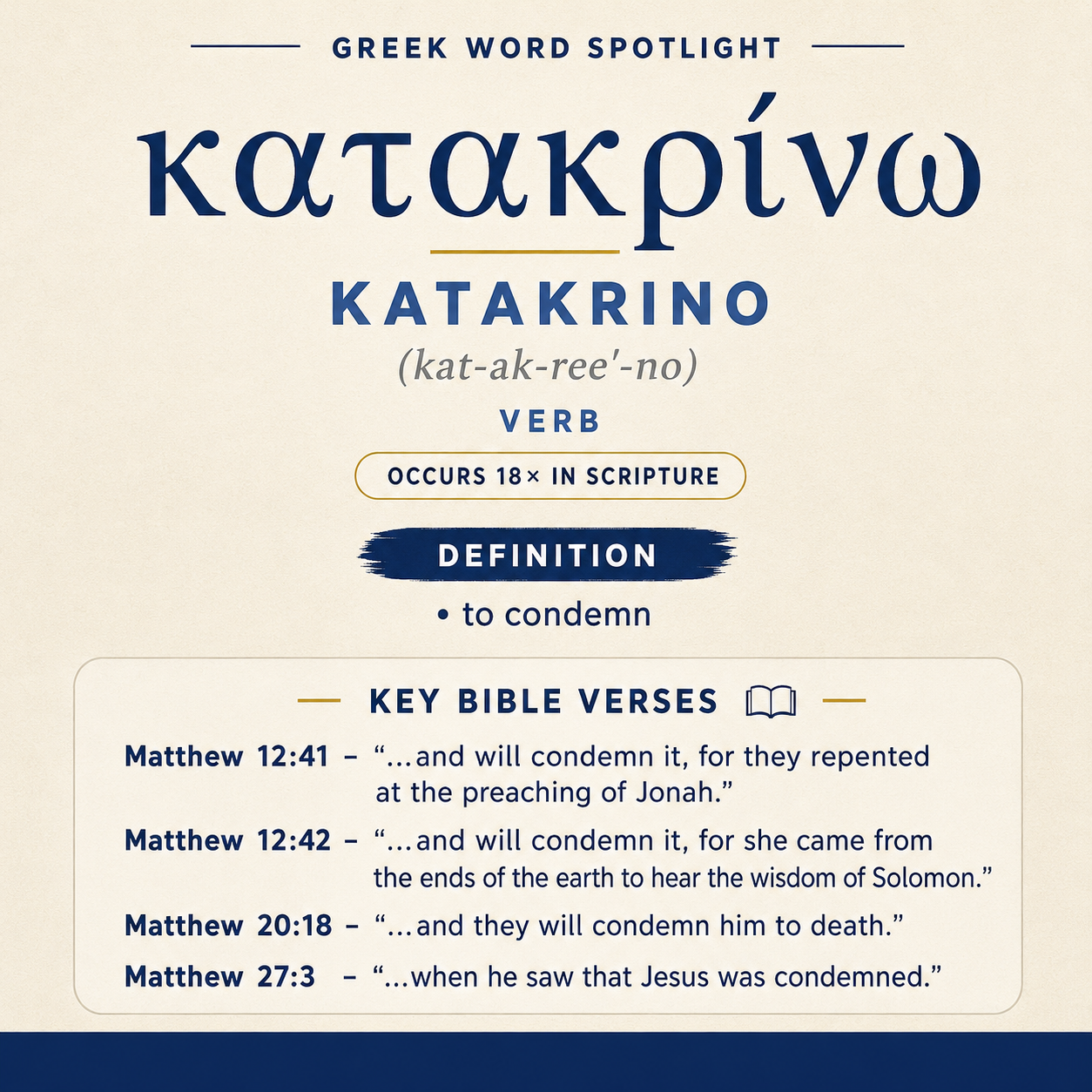
κατακρίνω means “to condemn” and occurs 18 times in Scripture, including Matthew 12, Matthew 20, Matthew 27, Mark 10, Mark 14, Mark 16, and Luke 11.
Core Meaning
κατακρίνω means “to condemn.” In the cited passages it describes condemnation in judgment and in legal verdicts.
Learn More →Judgment Scenes
In Matthew 12:41–42 and Luke 11:31, the men of Nineveh and the Queen of the South rise in judgment and condemn that generation. These texts frame condemnation within the setting of judgment.
Learn More →Gospel Narrative
In Matthew 20:18 and Mark 10:33, Jesus says He will be delivered and condemned. Mark 14:64 reports the leaders condemning Him as worthy of death, and Mark 16:16 contrasts belief and condemnation.
Learn More →κατακρίνω expresses the act of condemning in settings ranging from courtroom-like decisions to eschatological judgment scenes and personal moral reckoning. In the passages where it appears here, the verb regularly frames a decisive verdict—sometimes rendered by human authorities, sometimes anticipated in “the judgment,” and sometimes refused by Jesus in a moment charged with accusation.
Occurrences
Matthew 12:41 — “The men of Nineveh will stand up in the judgment with this generation, and will condemn it, for they repented at the preaching of Jonah; and behold, someone greater than Jonah is here.”
Here κατακρίνω is placed within “the judgment,” picturing a future courtroom scene. The men of Nineveh function as witnesses whose very response—repentance at Jonah’s preaching—sets a standard by which “this generation” is condemned. The condemnation is not described as a separate speech-act; it is anchored in the contrast between repentance and refusal in the presence of “someone greater than Jonah.”
Matthew 12:42 — “The Queen of the South will rise up in the judgment with this generation, and will condemn it, for she came from the ends of the earth to hear the wisdom of Solomon; and behold, someone greater than Solomon is here.”
κατακρίνω again belongs to “the judgment,” but now the condemning figure is the Queen of the South. Her costly pursuit—coming “from the ends of the earth” to hear Solomon’s wisdom—becomes the basis of condemnation against those who have nearer access to someone “greater than Solomon.” Condemnation is portrayed as an evaluative verdict produced by a stark comparison of responses to wisdom.
Matthew 20:18 — ““Behold, we are going up to Jerusalem, and the Son of Man will be delivered to the chief priests and scribes, and they will condemn him to death,”
In this prediction of events “up to Jerusalem,” κατακρίνω describes the official action of “the chief priests and scribes” toward “the Son of Man.” The verb is tied to a specific outcome—“to death”—so the condemnation is not merely disapproval but a decisive legal judgment leading to a fatal sentence.
Matthew 27:3 — “Then Judas, who betrayed him, when he saw that Jesus was condemned, felt remorse, and brought back the thirty pieces of silver to the chief priests and elders,”
Here κατακρίνω is presented as a completed reality: “Jesus was condemned.” The narrative effect is to make the condemnation the turning point that triggers Judas’s remorse and his attempt to return “the thirty pieces of silver.” The verb carries the weight of an irrevocable verdict whose consequences ripple into the betrayer’s response and interaction with the religious leadership.
Mark 10:33 — ““Behold, we are going up to Jerusalem. The Son of Man will be delivered to the chief priests and the scribes. They will condemn him to death, and will deliver him to the Gentiles.”
Mark pairs κατακρίνω with a chain of actions: being “delivered,” condemned “to death,” and then “deliver[ed]…to the Gentiles.” Condemnation stands as the pivotal judicial decision that enables the transfer of custody. The verb thus marks the moment a religious tribunal’s verdict becomes the gateway to broader political involvement.
Mark 14:64 — “You have heard the blasphemy! What do you think?” They all condemned him to be worthy of death.
κατακρίνω appears as the collective act of “they all,” following the charge: “You have heard the blasphemy!” The condemnation is framed as a deliberative response—“What do you think?”—ending in a unanimous verdict that he is “worthy of death.” The verb conveys not only sentencing but the declaration of deservingness within that group’s judgment.
Mark 16:16 — “He who believes and is baptized will be saved; but he who disbelieves will be condemned.”
In this succinct alternative, κατακρίνω functions as the negative counterpart to “will be saved.” The condemned person is defined not by a human trial but by a stance toward belief: “he who disbelieves.” The verb therefore carries a stark finality: condemnation is the outcome attached to disbelief, set in direct contrast with salvation.
Luke 11:31 — “The Queen of the South will rise up in the judgment with the men of this generation, and will condemn them: for she came from the ends of the earth to hear the wisdom of Solomon; and behold, one greater than Solomon is here.”
Luke parallels Matthew’s judgment scene, but adds “with the men of this generation,” placing the Queen alongside contemporaries as the scene’s audience. κατακρίνω (“will condemn them”) highlights the comparative logic: her journey to hear Solomon’s wisdom becomes evidence against those confronted with “one greater than Solomon.” The condemnation falls on “them” as a group, emphasizing corporate accountability.
Luke 11:32 — “The men of Nineveh will stand up in the judgment with this generation, and will condemn it: for they repented at the preaching of Jonah, and behold, one greater than Jonah is here.”
Again the men of Nineveh “stand up” in the judgment, and κατακρίνω depicts their role as condemners of “this generation.” The explanatory “for” ties condemnation to repentance: their responsiveness to Jonah becomes the implicit indictment of those unmoved by someone greater. The verb serves to portray condemnation as emerging from a contrast in moral response.
John 8:10 — “Jesus, standing up, saw her and said, “Woman, where are your accusers? Did no one condemn you?””
Here κατακρίνω is framed as a question posed to a woman surrounded by “accusers.” The verb belongs to the sphere of accusation and verdict: “Did no one condemn you?” The question presumes condemnation as the expected end of accusation, and it draws attention to the surprising absence of anyone willing or able to pronounce that verdict.
John 8:11 — “She said, “No one, Lord.” Jesus said, “Neither do I condemn you. Go your way. From now on, sin no more.””
κατακρίνω is directly negated by Jesus: “Neither do I condemn you.” The refusal to condemn is not presented as indifference to wrongdoing, since it is followed by the directive, “From now on, sin no more.” In this scene the verb marks the boundary between verdict and moral exhortation: Jesus withholds condemnation while still addressing the reality of sin and calling for a changed course.
Romans 2:1 — “Therefore you are without excuse, O man, whoever you are who judge. For in that which you judge another, you condemn yourself. For you who judge practice the same things.”
Paul places κατακρίνω in the interior, reflexive realm of moral reasoning: the one who “judge[s] another” thereby “condemn[s] yourself.” Condemnation is not a formal sentence imposed by a court but a self-incurred verdict produced by hypocrisy—“you who judge practice the same things.” The verb thus exposes condemnation as something that can rebound upon the judge when standards are inconsistently applied.

Sense and Usage
Across these passages, κατακρίνω consistently operates as a decisive verdict, but the settings vary: public judicial action, future judgment imagery, interpersonal accusation, and self-incrimination. In the Passion predictions and trial scenes (Matthew 20:18; Matthew 27:3; Mark 10:33; Mark 14:64), the verb is explicitly linked with death, so condemnation is portrayed as a juridical act with lethal consequence. It is carried out by identifiable authorities (“chief priests and scribes”) or a unified council (“they all”), and it serves as the hinge between custody and execution: once condemned, the condemned can be “deliver[ed]…to the Gentiles” (Mark 10:33).
In the judgment-oracles of Matthew 12 and Luke 11, κατακρίνω takes on a comparative, evidentiary force. The condemners (Nineveh’s men; the Queen of the South) are not presented as officials issuing a sentence on procedural grounds; rather, their lives become testimony. Their repentance and their pursuit of wisdom become embodied standards that “this generation” fails to meet. The scenes also sharpen the seriousness of rejecting a greater messenger: condemnation arises “for” a specific reason—because those earlier figures responded rightly to lesser light, while contemporaries refuse what is greater.
In John 8:10–11, the verb moves into a confrontational, personal moment: accusation presses toward condemnation, but Jesus’s words interrupt the expected trajectory. His “Neither do I condemn you” shows condemnation as a discretionary verdict that can be withheld even in the presence of accusers, while his “sin no more” keeps the encounter from becoming permission. The passage thus places condemnation and moral summons side by side without collapsing them into the same act.
Romans 2:1 extends the verb into moral self-exposure. Condemnation can be something a person brings upon himself by judging others while practicing the same things. Here κατακρίνω highlights the logic that a verdict can be implied by one’s own standards: to pronounce judgment is to establish a measure that, when mirrored back upon the judge’s conduct, becomes self-condemnation.
Imagery
The imagery surrounding κατακρίνω in these texts is often courtroom-like: “the judgment,” accusers, deliberation (“What do you think?”), and a verdict “to death.” Even when the scene is not a formal trial (Romans 2:1; John 8:10–11), the language evokes the same moral architecture of charge and sentence—either turned inward as self-condemnation or halted by Jesus’s refusal to condemn while calling for a life redirected away from sin.
Sources: Lexical data from Strong’s Exhaustive Concordance and the Translators Brief Lexicon of Extended Strongs for Greek (STEPBible, CC BY). Occurrence data from the Translators Amalgamated Greek New Testament (STEPBible, CC BY). Scripture quotations from the World English Bible (public domain).