Exploring the Meaning of Kamelos in Greek
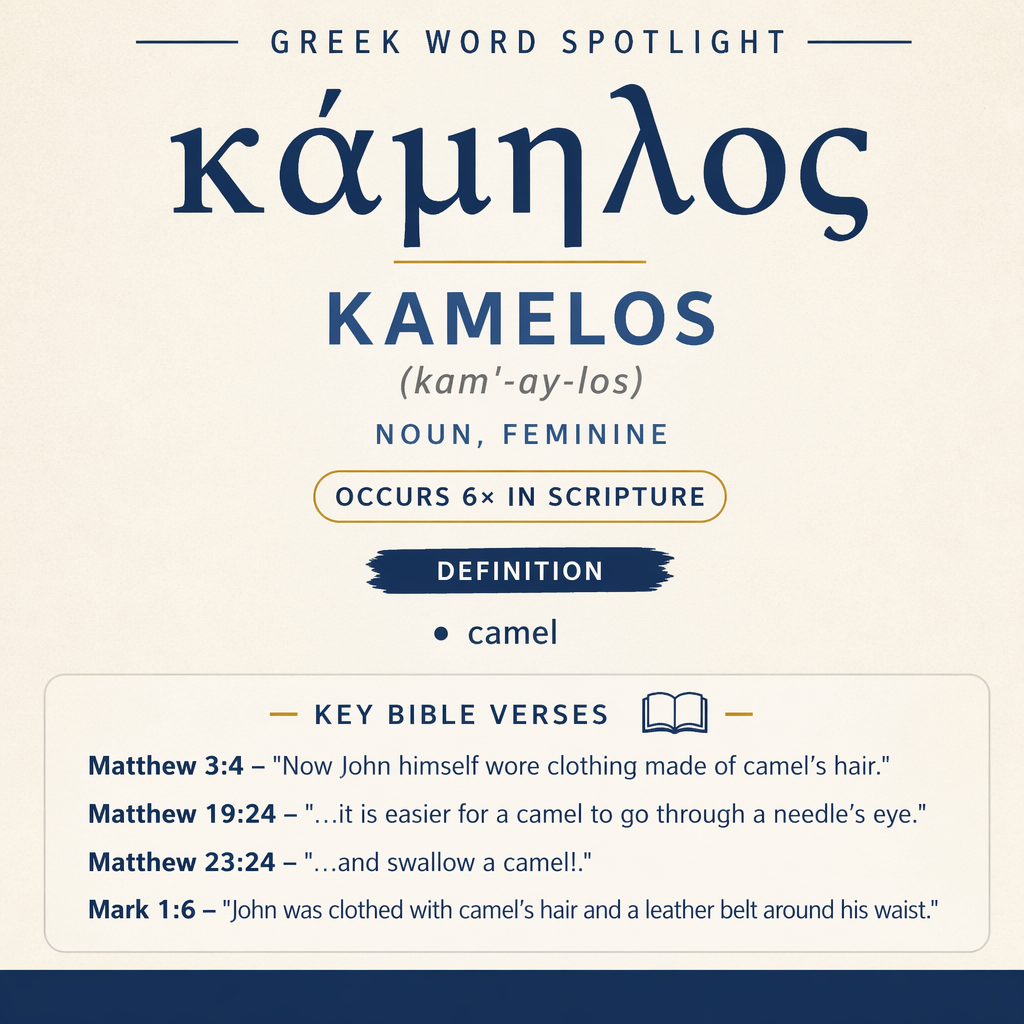
κάμηλος (Kamelos) means “camel” and occurs 6 times in Scripture in Matthew, Mark, and Luke.
Gospel Occurrences
It appears in Matthew 3:4; 19:24; 23:24, Mark 1:6; 10:25, and Luke 18:25.
Learn More →Usage Examples
It describes camel’s hair clothing worn by John (Matthew 3:4; Mark 1:6). It also appears in sayings about a camel and a needle’s eye (Matthew 19:24; Mark 10:25; Luke 18:25).
Learn More →κάμηλος refers to a camel. In the Gospels it appears both in straightforward description (material made from a camel) and in memorable comparisons where a camel functions as a vivid point of reference.
Occurrences
“Now John himself wore clothing made of camel’s hair, with a leather belt around his waist. His food was locusts and wild honey.” (Matthew 3:4)
Here κάμηλος contributes concrete detail about John’s clothing: it is “made of camel’s hair.” The camel is not presented as an animal in the scene but as the source of a durable material; the word anchors the description in something tangible and recognizably coarse. In the same sentence, the verse sets this clothing alongside a “leather belt” and a simple diet (“locusts and wild honey”), so “camel’s hair” becomes part of a tightly drawn picture of John’s outward mode of life.
“Again I tell you, it is easier for a camel to go through a needle’s eye, than for a rich man to enter into God’s Kingdom.” (Matthew 19:24)
In this saying, the camel is the primary object in a comparison about ease and difficulty: “easier for a camel to go through a needle’s eye.” The point depends on pairing an animal that is plainly large with a “needle’s eye,” a phrase that evokes a tiny opening. κάμηλος supplies the weight of the illustration by naming a creature whose size makes the stated action feel impossible within ordinary experience, setting up the force of the contrast that follows (“than for a rich man to enter into God’s Kingdom”).
“You blind guides, who strain out a gnat, and swallow a camel!” (Matthew 23:24)
Here κάμηλος appears in a sharp rebuke framed as an absurd sequence of actions: carefully “strain out a gnat” but then “swallow a camel.” The camel’s role is to mark the far end of a scale in which something minute (a gnat) is contrasted with something massive (a camel). The verb “swallow” makes the camel image intentionally jarring: κάμηλος intensifies the critique by presenting the second action as wildly out of proportion to the first.
“John was clothed with camel’s hair and a leather belt around his waist. He ate locusts and wild honey.” (Mark 1:6)
This description parallels the Matthean portrayal, again using κάμηλος in the phrase “camel’s hair.” The word functions as a material designation that shapes how the reader imagines the clothing—practical and rugged—especially when placed beside the “leather belt.” Because the verse also notes what John ate, the mention of camel’s hair helps form a coherent portrait: a person marked by plain, austere external features rather than luxury.
“It is easier for a camel to go through a needle’s eye than for a rich man to enter into God’s Kingdom.” (Mark 10:25)
Mark records the same kind of comparison as Matthew, with κάμηλος again paired to “a needle’s eye.” The camel is the concrete, visible element in a statement about what is “easier” versus what is harder; the animal’s implied bulk provides the imaginative resistance that makes the comparison striking. Because the sentence is structured as a single, balanced contrast (“easier…than”), κάμηλος bears much of the rhetorical weight in the first half, preparing the listener for the moral point in the second.
“For it is easier for a camel to enter in through a needle’s eye than for a rich man to enter into God’s Kingdom.” (Luke 18:25)
Luke’s form of the saying keeps the same essential imagery while adjusting the verb phrase: “enter in through a needle’s eye.” κάμηλος remains the large, embodied subject attempting passage through a very small opening. By using “enter,” Luke keeps the focus on movement into a space, which closely parallels the later clause’s repeated “enter into God’s Kingdom,” allowing the camel image to function as an intentionally extreme picture of failed entry.

Sense and Usage
Across these passages, κάμηλος is used with two main kinds of reference. In Matthew 3:4 and Mark 1:6 it appears in a genitival phrase (“camel’s hair”), where the camel is not a participant in the action but a source for an object worn. In those scenes the word is tactile: it invites the reader to imagine a specific kind of garment material, set among other plain items (“leather belt,” a simple diet). The camel, then, is evoked indirectly as part of John’s outward appearance, furnishing a concrete detail that helps define the scene without requiring any further explanation within the verse itself.
In Matthew 19:24, Mark 10:25, and Luke 18:25 the camel becomes the subject of a comparison about what is “easier” and what is not. The effectiveness of the comparison rests on the camel’s physicality: κάμηλος names an animal that can be pictured at once as a whole body with mass, so that the phrase “needle’s eye” functions as an intuitive counter-image—an opening too small for such a body. These sayings repeat “enter” language in the second clause (“enter into God’s Kingdom”), so κάμηλος serves as an imaginative measuring stick for difficulty of entry, making the comparison memorable because it is framed in spatial, bodily terms rather than in abstract language.
Matthew 23:24 uses κάμηλος in a different rhetorical setting: an accusation against “blind guides.” The camel is part of a paired image: “strain out a gnat” versus “swallow a camel.” Here the word does not illustrate difficulty of entry but rather disparity of attention and judgment. The camel stands for something immensely larger than a gnat, so the sequence of actions becomes comically disproportionate. In this use κάμηλος functions as the endpoint of an implied scale, creating a contrast that is immediately graspable even without additional context.
Taken together, these uses show κάμηλος operating both as a literal referent (a camel, and by extension what comes from a camel) and as a stable piece of imagery for size and proportion. Whether the comparison is framed as a camel confronting a “needle’s eye” or as a camel being “swallow[ed],” the camel supplies the same basic contribution: a concrete, oversized referent that makes the verbal picture forceful.
Imagery
In the John-the-Baptist descriptions, κάμηλος evokes the feel of a garment—“clothing made of camel’s hair”—and sets a visual tone alongside “a leather belt.” In the sayings about the “needle’s eye,” the camel becomes a large-bodied subject whose attempted passage through a tiny opening sharpens the statement’s contrast. And in “swallow a camel,” the same animal is used for shock and scale, turning a rebuke into an image that arrests the listener by its sheer improbability.
Sources: Lexical data from Strong’s Exhaustive Concordance and the Translators Brief Lexicon of Extended Strongs for Greek (STEPBible, CC BY). Occurrence data from the Translators Amalgamated Greek New Testament (STEPBible, CC BY). Scripture quotations from the World English Bible (public domain).