
Exploring the Meaning of Kalupto in Greek
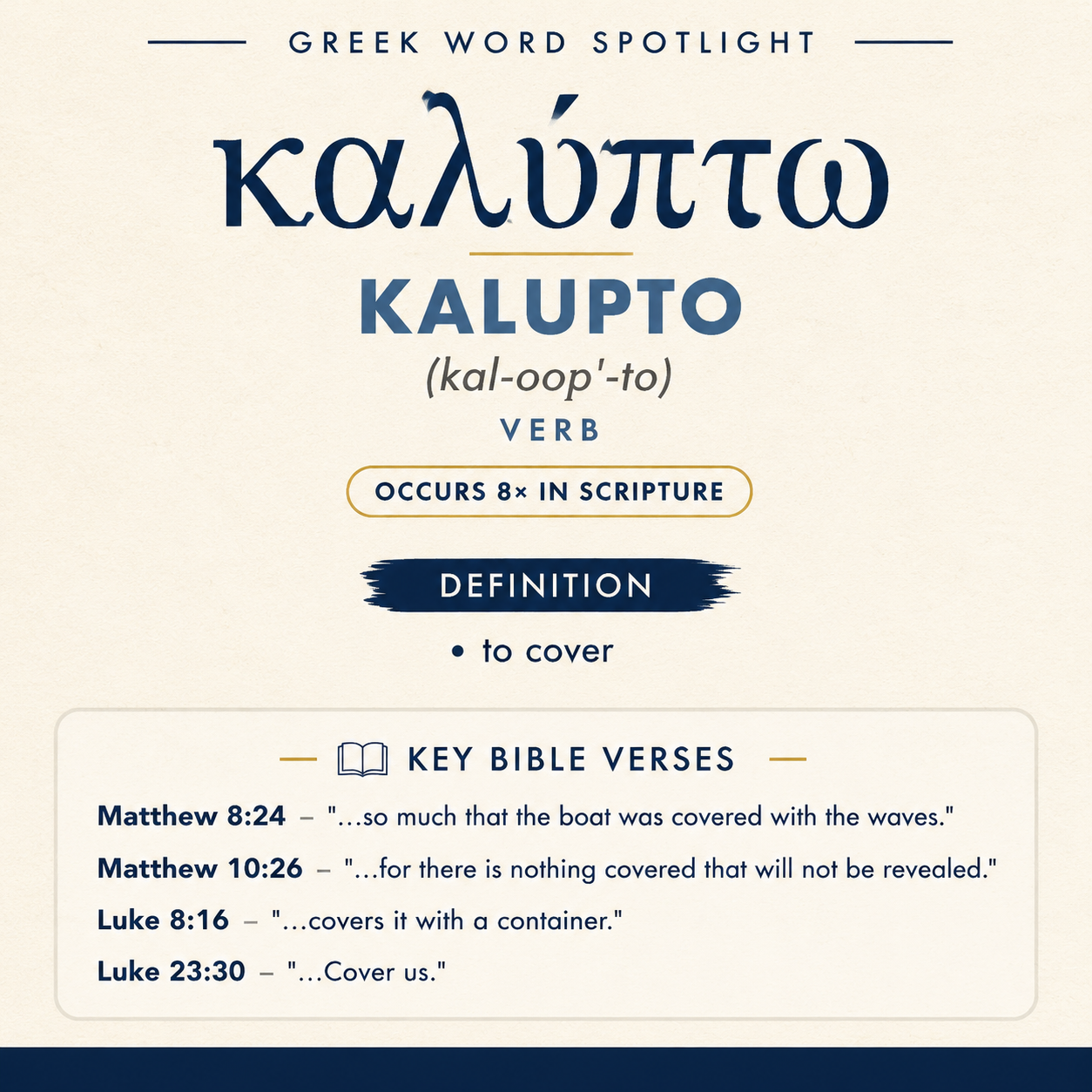
καλύπτω means “to cover” and occurs 8 times in Scripture, including Matthew 8:24; Luke 23:30; 2 Corinthians 4:3; and 1 Peter 4:8.
Core Meaning
καλύπτω means “to cover.” It is used for both literal and figurative covering.
Learn More →Gospel Examples
In Matthew 8:24, the boat was covered with the waves. In Luke 8:16, it describes covering a lit lamp with a container.
Learn More →Other Uses
In 2 Corinthians 4:3, it appears in the context of the Good News being veiled. In 1 Peter 4:8, love covers a multitude of sins.
Learn More →καλύπτω expresses the action of covering, whether by waves, objects, terrain, or by figurative concealment. In the passages where it appears, the verb moves between concrete scenes (boat, lamp, mountains) and settings where what is “covered” is conceptual (a message, sins).
Occurrences
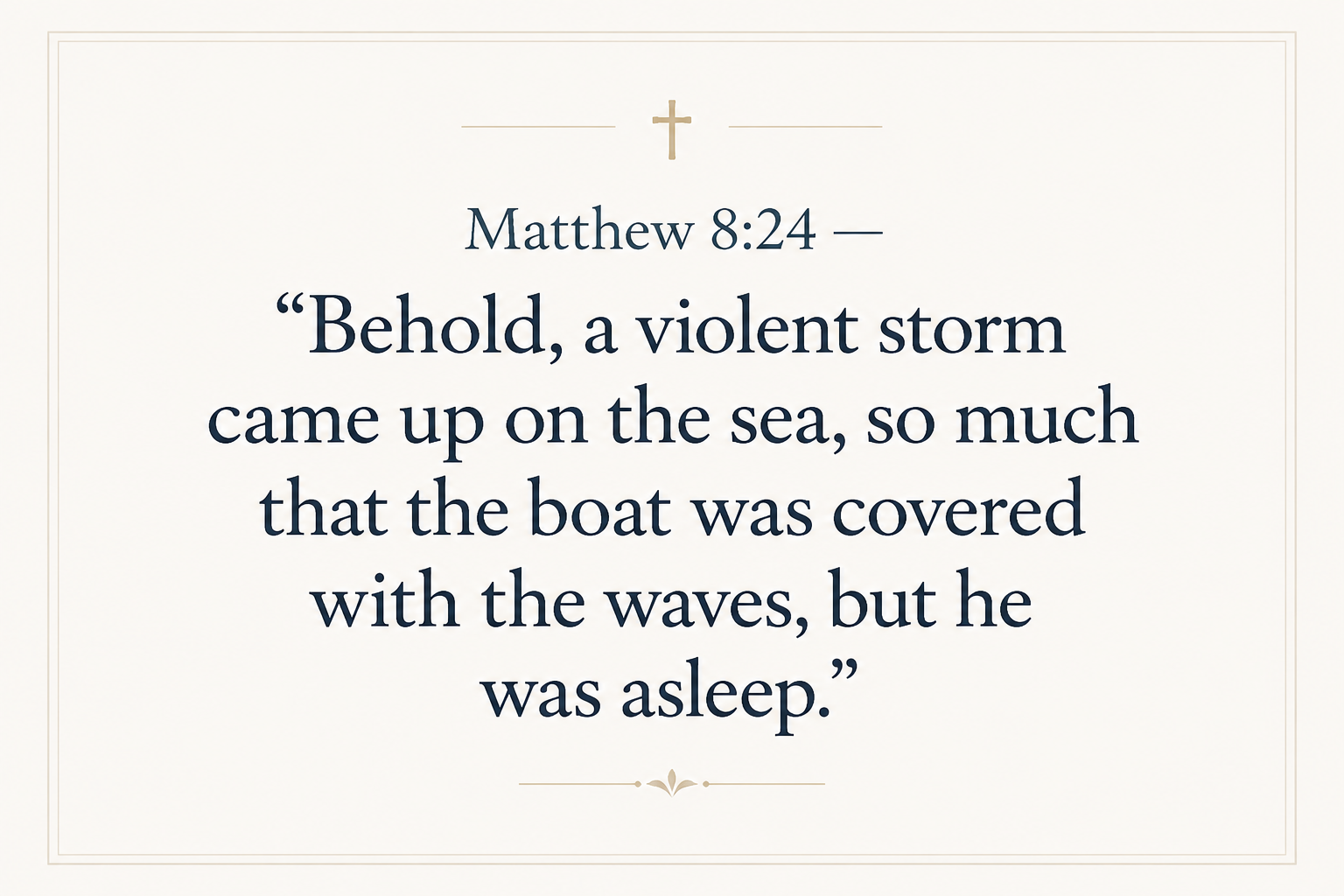
Matthew 8:24 — “Behold, a violent storm came up on the sea, so much that the boat was covered with the waves, but he was asleep.”
Here καλύπτω belongs to a physical emergency: the waves rise to the point that the boat is “covered.” The verb portrays an external force spreading over something smaller, so that the boat is no longer simply struck by waves but overwhelmed by what comes upon it. The narrative contrast heightens the scene: the boat is being covered with waves “but he was asleep,” placing the covering action in tension with calm within the boat.
Matthew 10:26 — “Therefore don’t be afraid of them, for there is nothing covered that will not be revealed; and hidden that will not be known.”
In this saying, καλύπτω frames concealment as temporary. The focus is not on what does the covering but on the status of a thing as “covered,” paired with “hidden.” The point of the line is forward-looking: what is now covered “will not” remain so, because it will be “revealed.” καλύπτω thus serves as one side of a contrast between concealment and disclosure, making “covered” a condition that is destined to be undone.
Luke 8:16 — ““No one, when he has lit a lamp, covers it with a container, or puts it under a bed; but puts it on a stand, that those who enter in may see the light.”
Here καλύπτω describes an everyday action—placing a container over a lamp. The logic depends on the nature of a lamp: it is lit for visibility, and covering it contradicts that purpose. The verse reinforces the idea by adding a second image, putting it under a bed, and then reverses both actions with the intended placement “on a stand.” καλύπτω contributes the concrete, practical picture of obstructing light by placing something over it.
Luke 23:30 — “Then they will begin to tell the mountains, ‘Fall on us!’ and tell the hills, ‘Cover us.’”
In this cry, καλύπτω is an urgent imperative addressed to the landscape. “Mountains” and “hills” are treated as agents able to spread over the speakers, enclosing or hiding them from whatever is coming. The pairing “Fall on us!” with “Cover us.” presents covering as something sought for protection or escape: the desired covering is not a thin layer but a crushing, total concealment under the terrain.
2 Corinthians 4:3 — “Even if our Good News is veiled, it is veiled in those who are dying,”
Here καλύπτω functions through the image of a veil. The verse speaks of “our Good News” as being “veiled,” and then locates that veiling “in those who are dying.” The covering is thus not described as something done to the message by external opponents in the sentence itself, but as a condition associated with a particular group. The verb’s covering idea is applied to perception and reception: a veil covers so that what is present is not openly seen.
James 5:20 — “let him know that he who turns a sinner from the error of his way will save a soul from death and will cover a multitude of sins.”
In James, καλύπτω is linked to a change in a person’s course: one who “turns a sinner from the error of his way” both “will save a soul from death” and “will cover a multitude of sins.” The covering is expressed as an outcome alongside rescue, and the object being covered is not a person or thing but “sins,” multiplied into a “multitude.” The verb paints sins as something that can be spread over, concealed, or dealt with in such a way that they are no longer exposed in the same manner.
1 Peter 4:8 — “And above all things be earnest in your love among yourselves, for love covers a multitude of sins.”
This occurrence echoes the phrasing about “a multitude of sins,” but places the action explicitly in “love.” Love is presented as the agent that performs the covering, and the command “be earnest in your love among yourselves” supplies the community setting in which that covering operates. καλύπτω therefore serves to describe what love does in relation to sins within a group: love spreads over them rather than leaving them exposed.

Sense and Usage
Across these passages καλύπτω keeps a consistent core idea—bringing something over something else—while the scenes show how flexible that action can be. At its most literal, the verb depicts one object being overlaid by another: the boat in the storm is covered by waves (Matthew 8:24), and a lamp can be covered by a container (Luke 8:16). These images share a spatial direction: something comes over the top of another thing, changing what is visible or what functions. The boat’s covering signals peril because the waves belong outside the boat, and their presence over it suggests inundation. The lamp’s covering signals futility because the light is meant to be seen, and the container blocks what the lamp is for.
Other occurrences apply the same covering motion to concealment in social or spiritual discourse. Matthew 10:26 speaks of “covered” and “hidden” as conditions that can characterize realities now, but that will be reversed by being “revealed” and “known.” Even though the verse does not specify the material of the covering, the imagery remains: something lies over the truth, and that overlay can be removed. 2 Corinthians 4:3 intensifies the concealment imagery by naming it as being “veiled.” A veil is a kind of covering defined by what it does—limiting what can be seen—so the verb’s basic action becomes a way to speak about obscured understanding. In both of these, καλύπτω communicates not destruction but blockage: what is covered exists but is not openly accessible.
Luke 23:30 uses covering as a desperate request for the opposite reason: not to keep something unseen for deceit or misunderstanding, but to be hidden from unbearable circumstances. The imperative “Cover us” directed to hills turns the geography into a potential sheltering layer, like a covering that would remove the speakers from view and exposure. This expands καλύπτω beyond accidental covering (waves) or misguided covering (lamp) into chosen covering—sought as refuge, even at the cost implied by the accompanying “Fall on us!”
The last two occurrences apply καλύπτω to “sins,” and both keep the same picture of an overlay, though the field is moral rather than physical. In James 5:20, covering sins stands next to “save a soul from death,” connecting the verb’s imagery to the outcome of turning someone from “error.” In 1 Peter 4:8, “love” is the stated agent of the covering, and the command focuses on relationships “among yourselves.” In these lines, καλύπτω describes an action upon a collective weight—“a multitude”—suggesting extensive coverage. The consistent metaphor is that sins are like something exposed that can be spread over, so that they are no longer in the same open state.
Taken together, the passages show that καλύπτω can describe covering that is accidental and threatening (waves), intentional and obstructive (container over a lamp), pleaded for as protection (hills covering), and expressed as concealment or limitation of access (covered things that will be revealed; a veiled message). When applied to sins, the verb retains the same basic movement—covering over—while the agent shifts from natural forces to human action (“he who turns…”) and to an inner communal posture (“love”).
Imagery
The word’s imagery repeatedly turns on what happens when something is placed over something else: visibility changes, exposure changes, and the situation of the covered object is transformed. A boat under waves and a lamp under a container show how covering can overwhelm or suppress, while the sayings about what is covered being revealed and about love covering sins place that same spatial picture into speech about disclosure, perception, and life together.
Sources: Lexical data from Strong’s Exhaustive Concordance and the Translators Brief Lexicon of Extended Strongs for Greek (STEPBible, CC BY). Occurrence data from the Translators Amalgamated Greek New Testament (STEPBible, CC BY). Scripture quotations from the World English Bible (public domain).




