Exploring the Meaning of Kamno in Greek
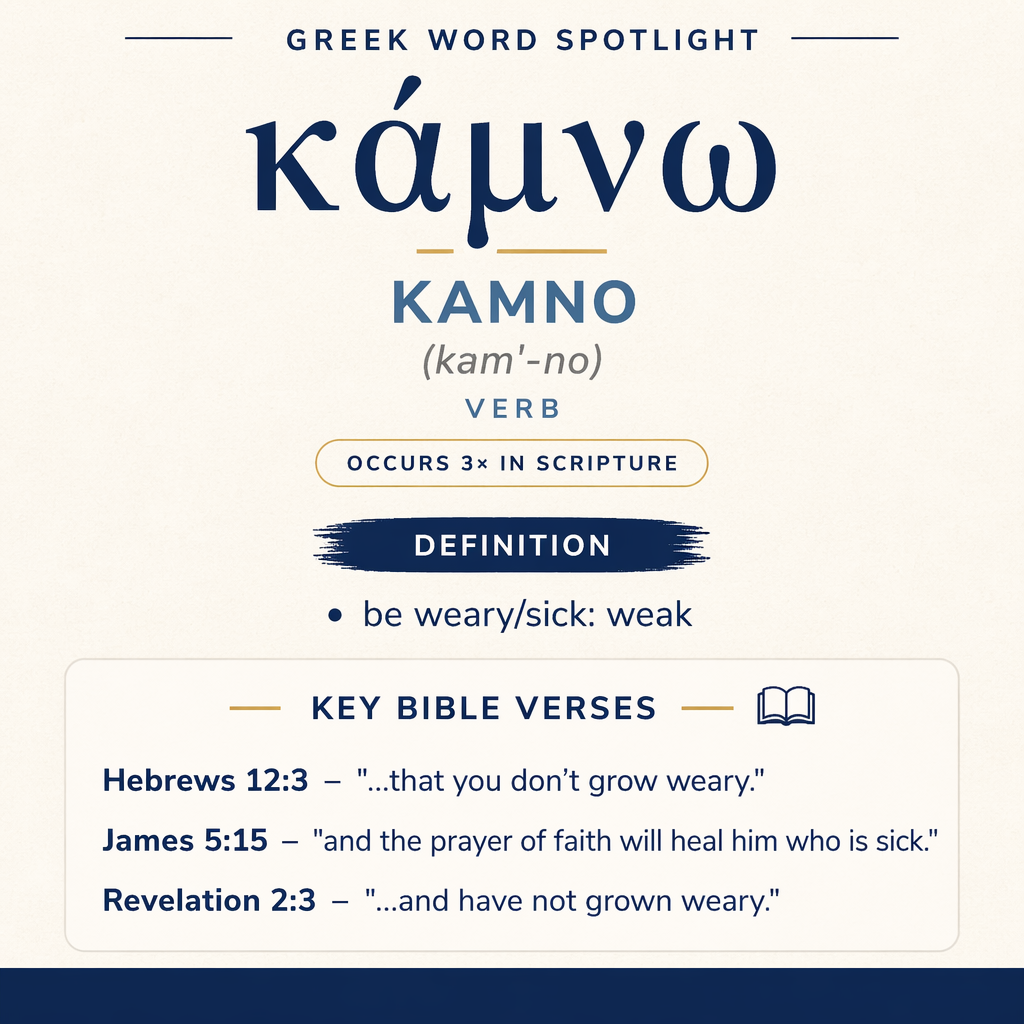
κάμνω means be weary/sick: weak and occurs three times in Hebrews 12:3, James 5:15, and Revelation 2:3.
Scripture Occurrences
κάμνω occurs 3 times in Scripture. The references are Hebrews 12:3, James 5:15, and Revelation 2:3.
Learn More →Verse Contexts
It appears with “grow weary” in Hebrews 12:3 and Revelation 2:3. It appears with “sick” in James 5:15.
Learn More →κάμνω expresses the state of being weary or sick—weak—and in the New Testament it appears in contexts of moral perseverance, inward exhaustion, and bodily illness. Its three occurrences span exhortation in Hebrews, pastoral care in James, and a commendation in Revelation.
Occurrences
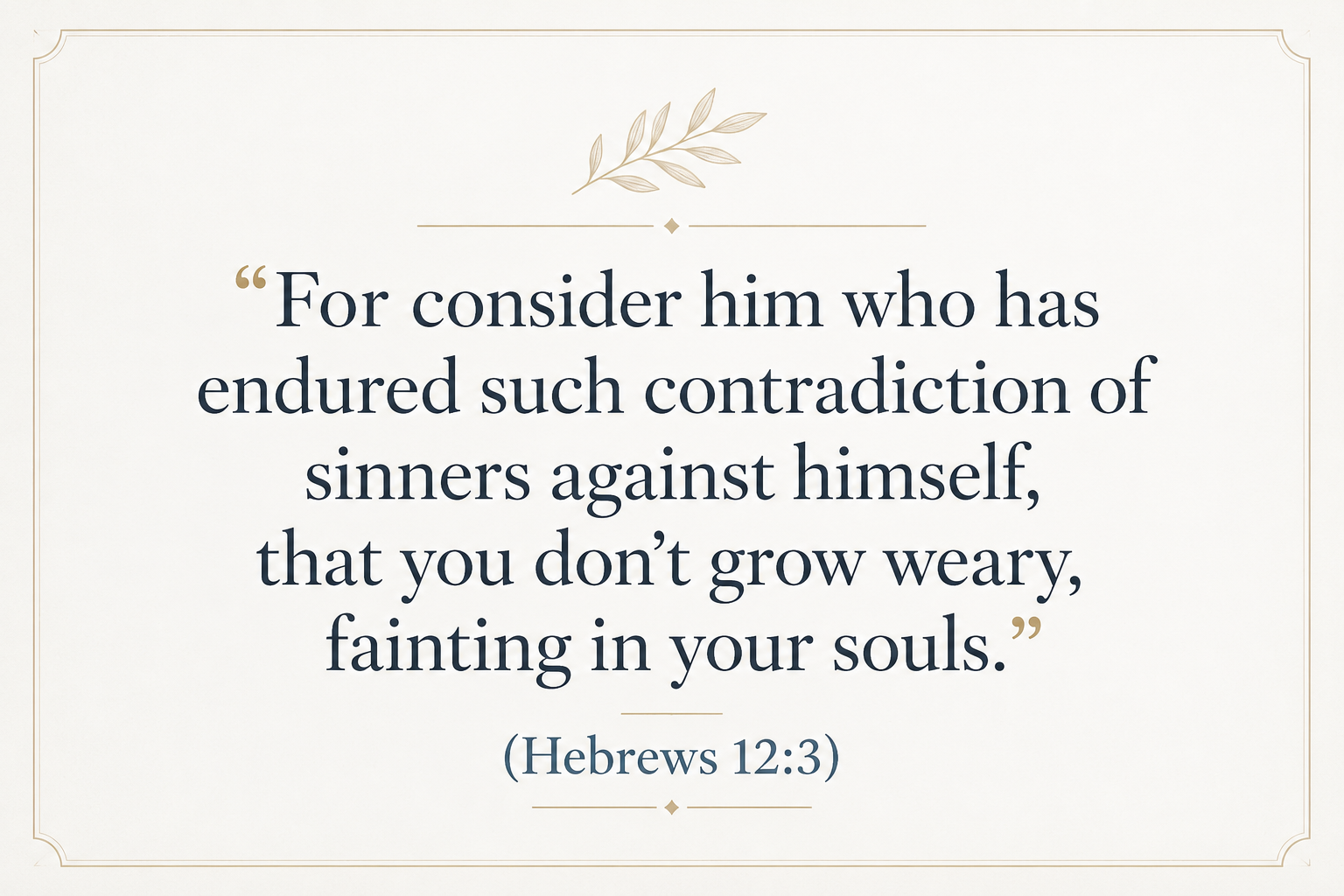
“For consider him who has endured such contradiction of sinners against himself, that you don’t grow weary, fainting in your souls.” (Hebrews 12:3)
Here κάμνω belongs to an exhortation shaped by comparison: “consider him who has endured” so that the readers “don’t grow weary.” The weariness in view is not presented as a mere moment of tiredness but as a weakening that can reach into the inner life—“fainting in your souls.” The verse frames weariness as an outcome that may follow sustained opposition (“contradiction of sinners against himself”), and it answers that danger with deliberate reflection on endurance. κάμνω thus marks the threshold where prolonged strain begins to sap strength, threatening collapse at the level of the self (“your souls”) rather than only the body.
“and the prayer of faith will heal him who is sick, and the Lord will raise him up. If he has committed sins, he will be forgiven.” (James 5:15)
In James the word stands in a setting of intercession and restoration: “the prayer of faith will heal him who is sick.” κάμνω here clearly carries the sense of sickness described as weakness, because it is answered by healing and by the Lord’s action of raising the person up. The verse holds together several outcomes: bodily recovery (“heal”), renewed strength or recovery from a low state (“raise him up”), and, if sins have been committed, forgiveness. Within this sentence κάμνω functions as the condition that prompts communal prayer and divine intervention; the sickness is not isolated as a purely physical problem but is situated within a relational and moral horizon where restoration may include forgiveness. The term’s contribution is to name the person as presently brought low—sick, weak—so that the promised effects of prayer and the Lord’s raising can be meaningfully contrasted with that weakened condition.
“You have perseverance and have endured for my name’s sake, and have not grown weary.” (Revelation 2:3)
In Revelation κάμνω appears as a commendation: “have perseverance,” “have endured,” and “have not grown weary.” The word is paired with perseverance and endurance, so that weariness is the opposite of continued steadfastness under pressure. The phrasing “for my name’s sake” sets the endurance within a motive and a public allegiance; κάμνω would name the weakening that could compromise that endurance. The statement does not deny that there has been strain—endurance implies it—but it praises the community for not allowing that strain to produce the weakening described by κάμνω. In this context the word functions as a measure of moral stamina: they have borne weight without yielding to the inward depletion that would end perseverance.

Sense and Usage
Across these passages κάμνω consistently denotes a condition of weakness expressed either as weariness or as sickness. The contexts show that this weakness can be located in different spheres while retaining a common core: a person or community is brought low, with strength diminished and the risk of collapse or incapacity present.
Two of the occurrences (Hebrews 12:3; Revelation 2:3) are shaped by endurance language. In both, κάμνω is not the struggle itself but what can result from struggling over time. Hebrews presents weariness as a danger that reaches inwardly (“fainting in your souls”), indicating that the weakening can become existential—an internal slackening that threatens continued faithfulness. Revelation, by contrast, uses κάμνω to highlight a victory over that danger: the community has endured and “have not grown weary.” Taken together, these two uses place κάμνω on the line between perseverance and collapse: endurance is the active stance, while κάμνω is the weakening that would undermine it.
James 5:15 brings the same weakness into the register of sickness. The word’s placement with “heal” and “raise him up” presents κάμνω as a state that can be reversed by divine action in response to prayer. This usage also shows that κάμνω can be personal and concrete rather than communal and moral; it names an individual’s lowered condition. Yet the verse’s structure—healing, raising, forgiveness—keeps the sense from becoming narrowly clinical. The weakness of κάμνω is the sort of condition that calls for care, prayer, and restoration, and in the event of sin it stands alongside forgiveness as part of the person’s being set right.
When these uses are read together, κάμνω does not split into unrelated meanings but moves within a coherent field: weakness that can be experienced as wearying pressure over time or as sickness requiring recovery. In Hebrews and Revelation, the weakening is implicitly opposed by endurance and perseverance; in James, it is opposed by healing and being raised up. The word therefore helps the reader perceive strain not only as an external circumstance but as something that can penetrate and diminish strength, whether of the inner life (“your souls”) or of the body (“sick”).
The three scenes also show κάμνω functioning in different verbal environments. Hebrews uses it as an outcome to be avoided (“don’t grow weary”), and attaches to it the accompanying description “fainting in your souls,” portraying weariness as a draining that can progress to collapse. Revelation likewise uses it as an outcome, but negated (“have not grown weary”), giving κάμνω a diagnostic role: it marks what has been resisted despite the need to endure. James uses it as the condition to be treated (“him who is sick”), giving κάμνω a pastoral role that elicits prayer and anticipates restoration.
Imagery and Reflection
These verses paint κάμνω with images of pressure and recovery. Hebrews depicts the inner person near the point of fainting, as though strength is ebbing under prolonged contradiction; Revelation depicts a community still standing after endurance “for my name’s sake,” without the weakening that would signal defeat; James depicts a sick person who is raised up, shifting the picture from depletion to renewal. In each case, κάμνω names the moment when weakness becomes visible—either as weariness that threatens perseverance or as sickness that requires healing and lifting up.
Sources: Lexical data from Strong’s Exhaustive Concordance and the Translators Brief Lexicon of Extended Strongs for Greek (STEPBible, CC BY). Occurrence data from the Translators Amalgamated Greek New Testament (STEPBible, CC BY). Scripture quotations from the World English Bible (public domain).