
Exploring the Meaning of Kakosis in Greek
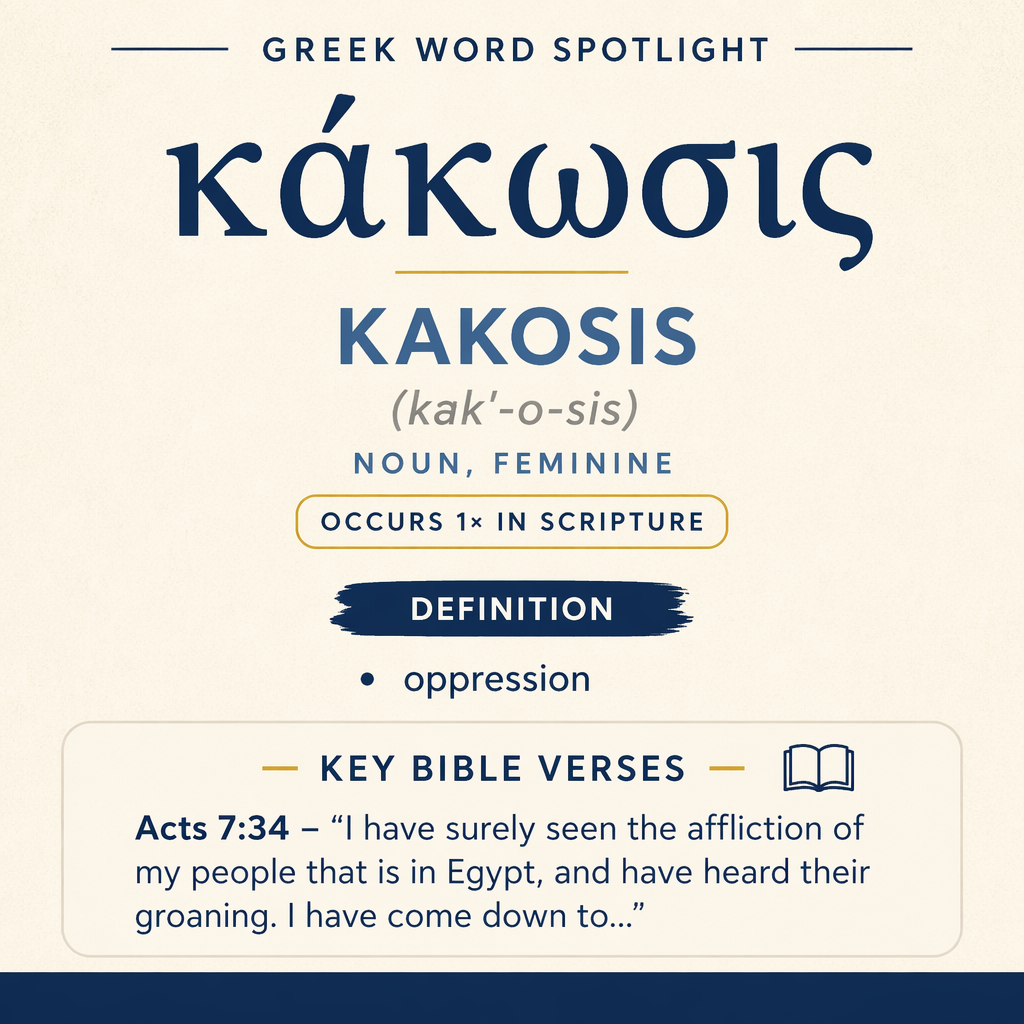
κάκωσις means oppression and appears once in Scripture, in Acts 7:34.
Biblical Occurrence
This word occurs 1 time in Scripture. Its single occurrence is in Acts 7:34.
Learn More →Context Snapshot
In Acts 7:34 it is rendered as “affliction” in the line, “I have surely seen the affliction of my people… in Egypt.”
Learn More →κάκωσις means “oppression” and appears in the Greek New Testament in Acts 7:34. In that passage it belongs to a remembered scene of suffering, groaning, and divine deliverance.
Root and Related Words
κάκωσις is connected with the verb kakoo (κακόω), “to harm” (Strong’s G2559). The noun-form places the idea in a named condition or experience rather than an action narrated moment by moment.

Occurrences
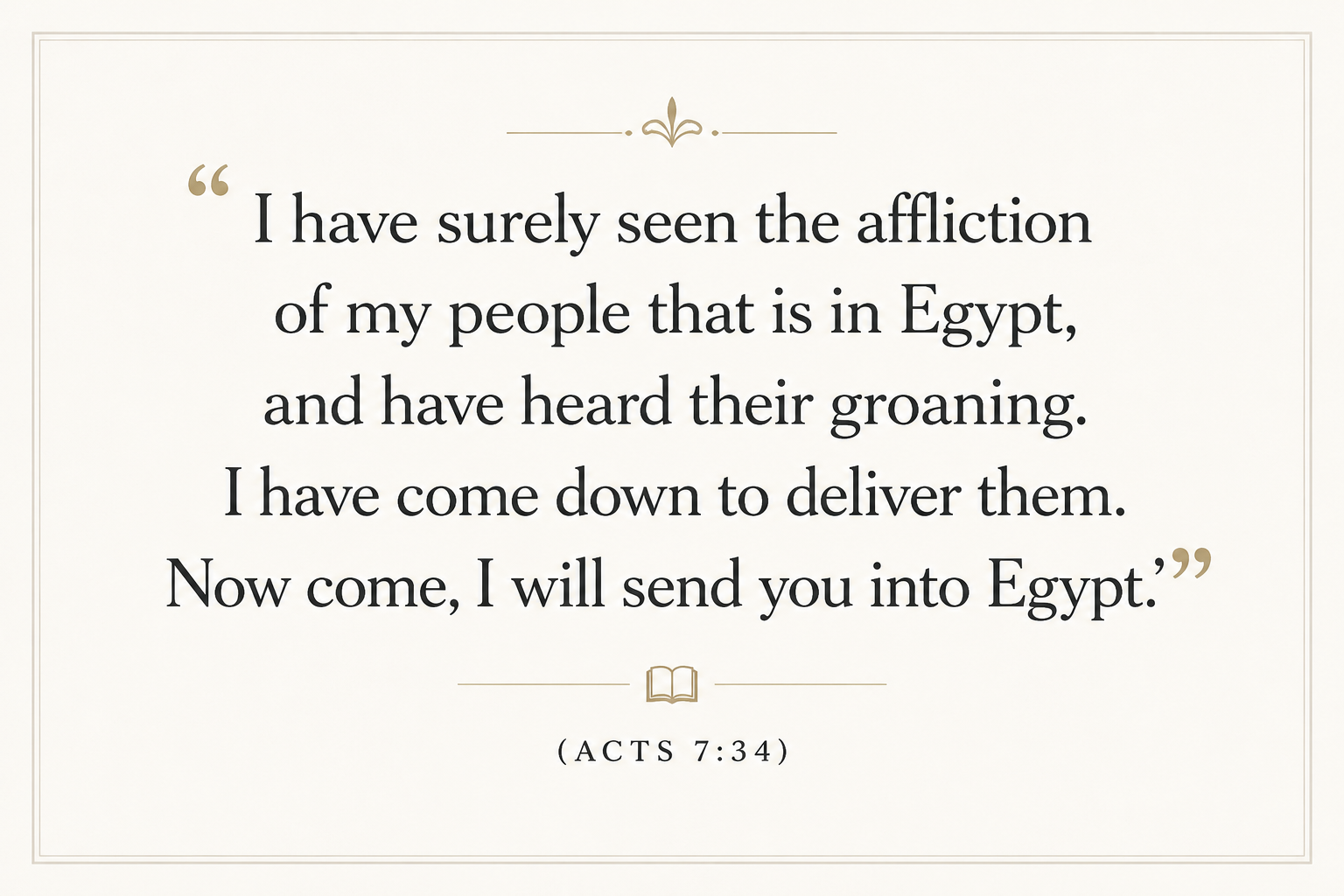
“I have surely seen the affliction of my people that is in Egypt, and have heard their groaning. I have come down to deliver them. Now come, I will send you into Egypt.’” (Acts 7:34)
Here κάκωσις is heard within a speech that recalls God’s awareness of his people’s suffering. The verse holds together three linked elements: what is happening to the people (“the affliction of my people that is in Egypt”), what rises from them in response (“their groaning”), and what God does in response (“I have come down to deliver them”). In this setting, κάκωσις names the oppressive situation as a reality located “in Egypt,” something that can be “seen” by God in the sense that it is fully observed and recognized. It is not described as a private trouble of isolated individuals but as the shared plight of “my people,” a condition encompassing a community.
The wording also frames the oppression as a decisive reason for deliverance. The sequence in the quotation moves from perception (“seen”), to attention to sound (“heard”), to intervention (“come down to deliver”), and then to commission (“I will send you”). κάκωσις thus functions as the circumstance that prompts action: the oppression is not a backdrop but the stated problem that calls for rescue and for the sending of an agent back “into Egypt.” The oppression is paired closely with “groaning,” suggesting a lived weight that produces audible distress, and the verse places that distress within God’s hearing. The term therefore contributes a concrete social reality to the scene, the sort of hardship that can be recognized, lamented, and answered.
Sense and Usage
In Acts 7:34, “oppression” is not treated as a vague idea but as a condition with location, victims, and consequences. It is located (“in Egypt”), it falls upon a defined group (“my people”), and it expresses itself (“their groaning”). The verse’s structure also shows how κάκωσις can be spoken of as something that can be “seen” by God—not merely inferred, but regarded as an objective state of affairs. The oppression is presented as sustained enough to generate ongoing groaning, yet not so hidden or ambiguous that it escapes notice. In this use, κάκωσις belongs to the language of public suffering: it marks a situation that can be named aloud and brought into the open within a communal memory.
The immediate verbal environment gives κάκωσις a strong relational shape. The oppression is not first defined by the oppressor but by the one who claims the oppressed as his own: “my people.” That possessive framing turns κάκωσις into more than an unfortunate circumstance; it is an injury against a people who are under divine regard. In the same breath, the verse moves from oppression to deliverance without shifting subjects: the one who sees and hears is also the one who comes down. κάκωσις, as used here, therefore carries the implication of being answerable—something that invites or calls forth deliverance because it is witnessed and heard by God.
The inclusion of the commissioning line (“Now come, I will send you into Egypt.”) shows another feature of the word’s usage in this context: oppression is the reason for mission. The verse does not linger in description but uses the mention of oppression as a turning point that propels a person toward action. κάκωσις thus sits at the hinge between lament (“groaning”) and assignment (“I will send you”), indicating that oppression is not only endured and voiced; it is also addressed through concrete steps of rescue. Within this single attestation, the term is bound to the themes of recognition, response, and sending.
Imagery
The verse’s imagery places oppression within sensory language: it is “seen,” and it is accompanied by “groaning” that is “heard.” κάκωσις therefore evokes a scene in which suffering is both visible and audible—something that presses upon a people in a definable place and rises from them as a collective sound. Against that sensory weight stands the image of descent and deliverance: “I have come down to deliver them.” The oppression is real enough to be named, and the deliverance is portrayed as equally purposeful, answering what has been seen and heard.
Sources: Lexical data from Strong’s Exhaustive Concordance and the Translators Brief Lexicon of Extended Strongs for Greek (STEPBible, CC BY). Occurrence data from the Translators Amalgamated Greek New Testament (STEPBible, CC BY). Scripture quotations from the World English Bible (public domain).





