Exploring the Meaning of Kakia in Greek
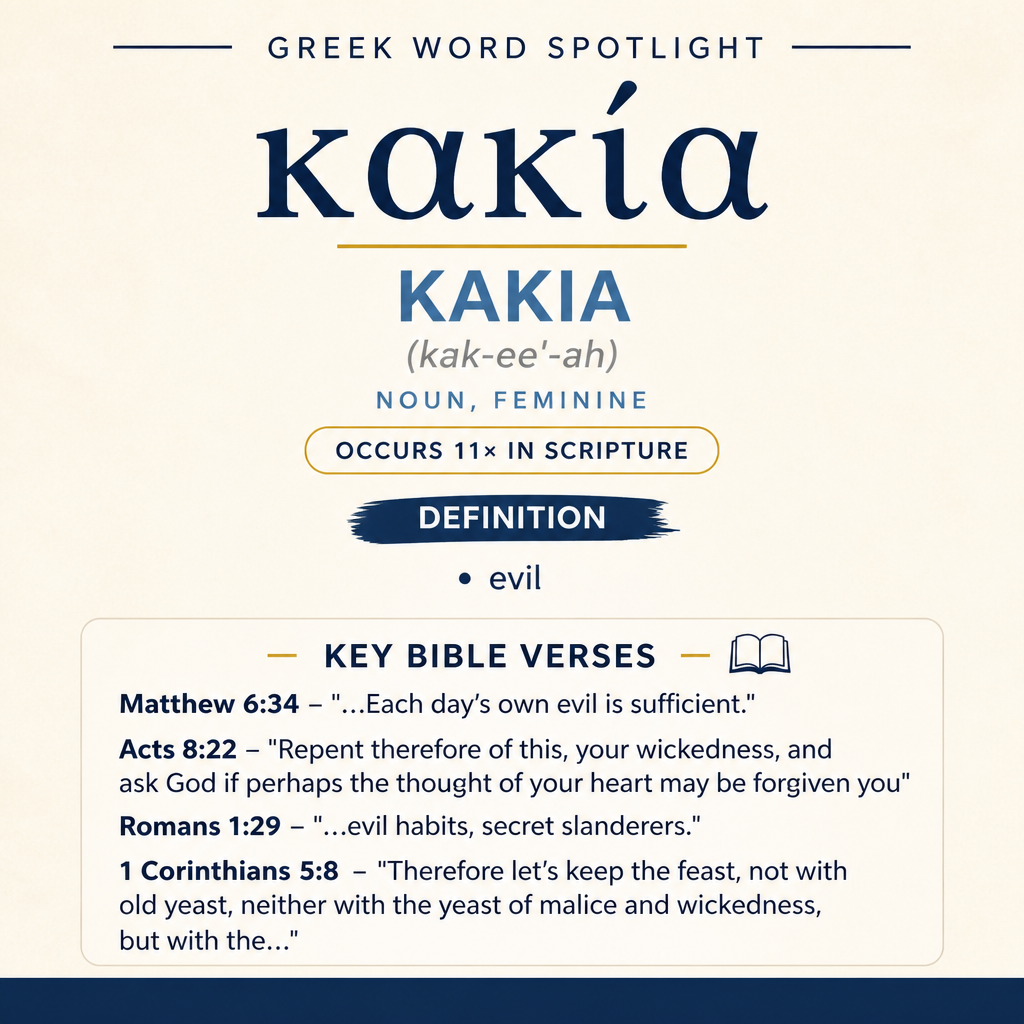
κακία means “evil” and appears 11 times in Scripture, including Matthew 6:34; Acts 8:22; Romans 1:29; and Ephesians 4:31.
Core Meaning
κακία is defined as “evil.” In several passages it is rendered “malice” or “wickedness.”
Learn More →Biblical Usage
It occurs in contexts listing sinful behaviors, such as Romans 1:29 and Titus 3:3. It is also paired with “malice” in 1 Corinthians 5:8.
Learn More →Moral Exhortation
Believers are told to put away κακία in Ephesians 4:31 and Colossians 3:8. In 1 Corinthians 14:20, it is contrasted with mature thinking.
Learn More →Kakia means “evil” and appears in a cluster of teachings that address daily pressures, inner motives, social conflict, and the moral habits that shape community life. Across the passages where it occurs, it is treated as something that can characterize a day, fill a life, corrupt a thought, and cling to speech—yet also as something to repent of and put away.
Occurrences
“Therefore don’t be anxious for tomorrow, for tomorrow will be anxious for itself. Each day’s own evil is sufficient.” (Matthew 6:34)
Here kakia names the “evil” that belongs to “each day.” The sentence frames it as a burden already present in the day’s experience, set alongside anxiety about the future. The term contributes a sober realism: even without borrowing trouble from tomorrow, today has its own share of evil that makes anxious forecasting unnecessary and unhelpful.

“Repent therefore of this, your wickedness, and ask God if perhaps the thought of your heart may be forgiven you.” (Acts 8:22)
In this confrontation, kakia is personalized—“this, your wickedness”—and linked directly to “the thought of your heart.” The word marks the moral quality of what is internal and intended, not merely what is visible. It also stands as the object of repentance and the reason for seeking forgiveness, showing kakia as something that can be owned, named, and renounced.
“being filled with all unrighteousness, sexual immorality, wickedness, covetousness, malice; full of envy, murder, strife, deceit, evil habits, secret slanderers,” (Romans 1:29)
Kakia appears in a crowded list describing what it looks like to be “filled” and “full” of corrupt traits. Within this catalog it functions as one item among many, but the phrasing “being filled” gives it a comprehensive feel: evil is not a momentary slip but something that can saturate a person’s life alongside behaviors and relational sins such as “envy,” “strife,” and “deceit.”
“Therefore let’s keep the feast, not with old yeast, neither with the yeast of malice and wickedness, but with the unleavened bread of sincerity and truth.” (1 Corinthians 5:8)
In this metaphor, kakia is paired with “malice” and pictured as “yeast.” The image presents evil as something that works through a batch—small in appearance but influential in effect. By contrasting “the yeast of malice and wickedness” with “the unleavened bread of sincerity and truth,” the verse sets kakia as a corrupting ingredient that must not be carried into what is meant to be kept clean.
“Brothers, don’t be children in thoughts, yet in malice be babies, but in thoughts be mature.” (1 Corinthians 14:20)
Here kakia is placed in a striking comparison: maturity is required “in thoughts,” but the community is urged to be infant-like “in malice.” The word therefore contributes a moral axis for growth: there is a kind of evil that should not develop sophistication. The verse treats kakia as something whose “growth” is undesirable, the opposite of the maturity expected in thinking.
“Let all bitterness, wrath, anger, outcry, and slander be put away from you, with all malice.” (Ephesians 4:31)
Kakia is grouped with a chain of disruptive attitudes and expressions—“bitterness,” “wrath,” “anger,” “outcry,” and “slander.” The command “be put away from you” casts evil as something that can be removed, not excused as inevitable temperament. Placed at the end (“with all malice”), kakia functions as a comprehensive term that gathers and deepens the list’s relational toxicity.
“but now you also put them all away: anger, wrath, malice, slander, and shameful speaking out of your mouth.” (Colossians 3:8)
The instruction “put them all away” again frames kakia as discardable, but the list highlights how evil moves into speech: “slander” and “shameful speaking out of your mouth.” Kakia sits among the inner heat of “anger” and “wrath” and the outward release of harmful talk, suggesting a continuum where evil can be both an attitude and a social force.
“For we were also once foolish, disobedient, deceived, serving various lusts and pleasures, living in malice and envy, hateful, and hating one another.” (Titus 3:3)
In this retrospective confession, kakia describes a former way of life: “living in malice and envy.” The word is not a single act but an environment—something one can “live in.” The verse also links that environment to broken relationships: “hateful, and hating one another,” portraying evil as a condition that breeds mutual hostility.
“Therefore, putting away all filthiness and overflowing of wickedness, receive with humility the implanted word, which is able to save your souls.” (James 1:21)
Kakia here is intensified by the phrase “overflowing of wickedness.” Evil is depicted as something that can spill over, exceeding bounds and contaminating. The remedy is twofold: removal (“putting away”) and reception (“receive with humility the implanted word”), so kakia functions as the opposing moral state to humble receptivity.
“Putting away therefore all wickedness, all deceit, hypocrisies, envies, and all evil speaking,” (1 Peter 2:1)
This verse uses kakia as the leading item in a list of communal sins. By placing “all wickedness” first and repeating “all” with several items, the command presses for thoroughness. The word thus contributes a broad starting point: evil as a general moral category under which “deceit,” “hypocrisies,” “envies,” and “evil speaking” are also to be stripped off.
“as free, and not using your freedom for a cloak of wickedness, but as bondservants of God.” (1 Peter 2:16)
Kakia is pictured as something that can be concealed—“a cloak of wickedness.” The contrast between being “free” and being “bondservants of God” shows that evil can exploit even good realities (freedom) as cover. The term’s contribution is to name the moral danger of disguising evil under respectable language or social privilege.

Sense and Usage
Across these passages, kakia functions as a morally charged descriptor for evil that can be experienced, harbored, practiced, and hidden. In Matthew 6:34 it is externalized as part of daily life—an objective trouble that accompanies a day and makes tomorrow-anxiety unnecessary. In Acts 8:22 it is internalized as a “thought of your heart,” showing evil as an inward moral reality that calls for repentance and forgiveness. Romans 1:29 broadens the lens: kakia sits inside a portrait of people “being filled” with corrupt dispositions and acts, so evil is treated as a pervasive condition rather than an isolated misstep.
Several occurrences emphasize evil’s contagious or spreading quality. The “yeast of malice and wickedness” (1 Corinthians 5:8) portrays kakia as something that permeates and alters what it touches, while “overflowing of wickedness” (James 1:21) presents it as excess that spills into life. Both images align with the repeated instruction to “put away” kakia (Ephesians 4:31; Colossians 3:8; 1 Peter 2:1): evil is not to be managed or accommodated but removed from the self and the community.
Other occurrences highlight kakia’s social and communicative expression. Ephesians 4:31 and Colossians 3:8 place it beside “slander” and, in Colossians, “shameful speaking out of your mouth,” indicating that evil is not only a private matter but something that can be voiced and spread through speech. Titus 3:3 describes “living in malice and envy” and then immediately speaks of being “hateful, and hating one another,” suggesting that kakia can become an atmosphere that sustains ongoing interpersonal hostility. 1 Peter 2:16 adds a further nuance: evil can be tactical—used as a “cloak,” a cover story—so kakia may involve concealment and exploitation of outward freedoms.
Finally, 1 Corinthians 14:20 frames kakia in terms of moral development. The community is called to maturity in thinking but infancy in malice, treating evil as something that should not be cultivated into cleverness or complexity. Taken together with the calls to sincerity, truth, humility, and service (1 Corinthians 5:8; James 1:21; 1 Peter 2:16), kakia stands as the opposite of a life ordered by clean motives and constructive speech.
Imagery
The passages attach concrete images to kakia that make its danger vivid: “yeast” that works through what is being prepared (1 Corinthians 5:8), an “overflowing” that suggests pollution by excess (James 1:21), and a “cloak” that hides what should be exposed (1 Peter 2:16). Alongside these, the steady verbs “repent,” “ask,” and “put away” (Acts 8:22; Ephesians 4:31; Colossians 3:8; 1 Peter 2:1) give kakia a practical profile: evil is something that can be confronted, removed, and replaced by patterns that fit sincerity, truth, humility, and service.
Sources: Lexical data from Strong’s Exhaustive Concordance and the Translators Brief Lexicon of Extended Strongs for Greek (STEPBible, CC BY). Occurrence data from the Translators Amalgamated Greek New Testament (STEPBible, CC BY). Scripture quotations from the World English Bible (public domain).