Exploring the Meaning of Kathexes in Greek
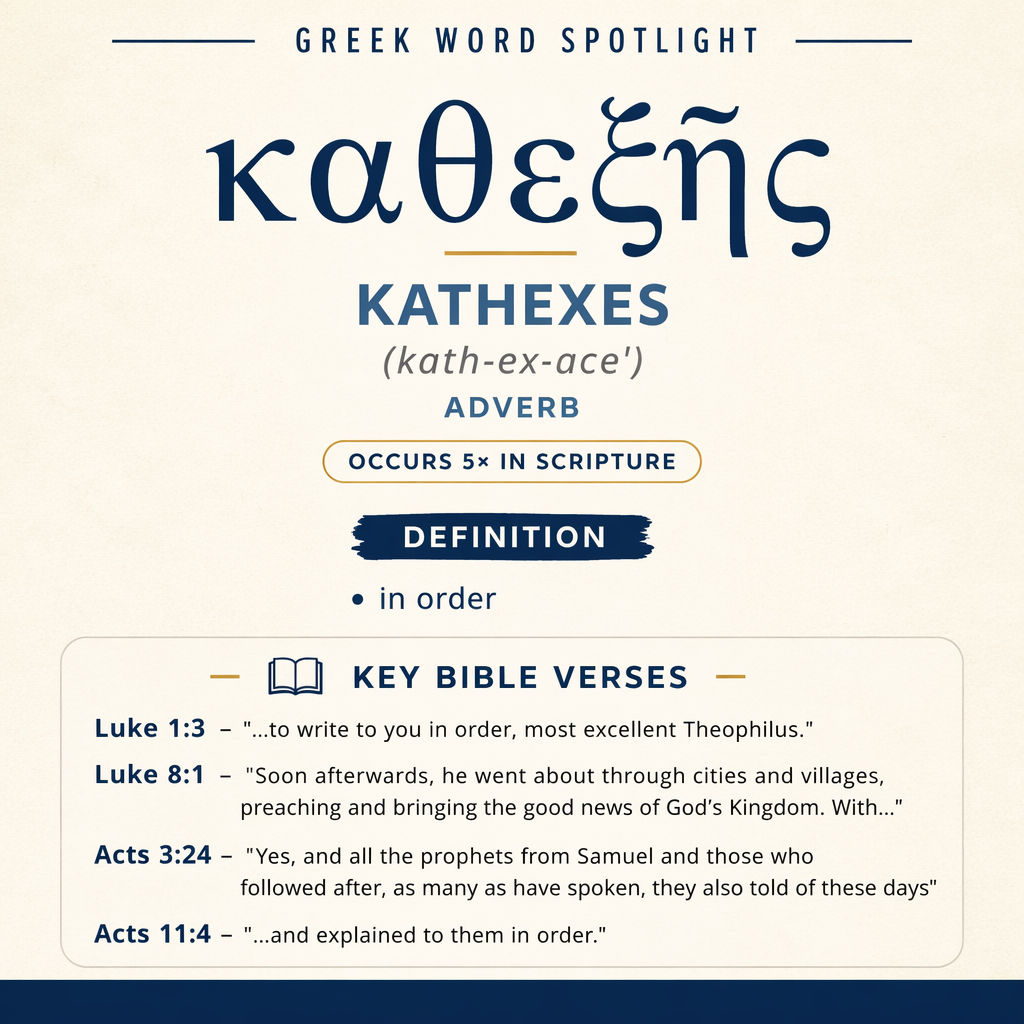
καθεξῆς means “in order” and appears five times in Scripture: Luke 1:3; Luke 8:1; Acts 3:24; Acts 11:4; Acts 18:23.
Core Meaning
καθεξῆς is defined as “in order.” It expresses ordered or sequential arrangement.
Learn More →Scripture Occurrences
The word occurs five times in Scripture. It appears in Luke 1:3; Luke 8:1; Acts 3:24; Acts 11:4; and Acts 18:23.
Learn More →Context Examples
In Luke 1:3, it describes writing “in order.” In Acts 11:4, Peter explains events “in order.”}],
Learn More →καθεξῆς expresses the idea of proceeding “in order,” marking actions or speech as arranged in a proper sequence. It appears in Luke’s prologue and in Acts, where it frames careful narration and orderly movement through places.
Root and Related Words
καθεξῆς (Kathexes) is connected with ἑξῆς (hexes), “next/afterward” (Strong’s G1836), and κατά (kata), “according to” (Strong’s G2596). Together these related elements support the adverb’s function of describing something that proceeds according to a sequence.

Occurrences
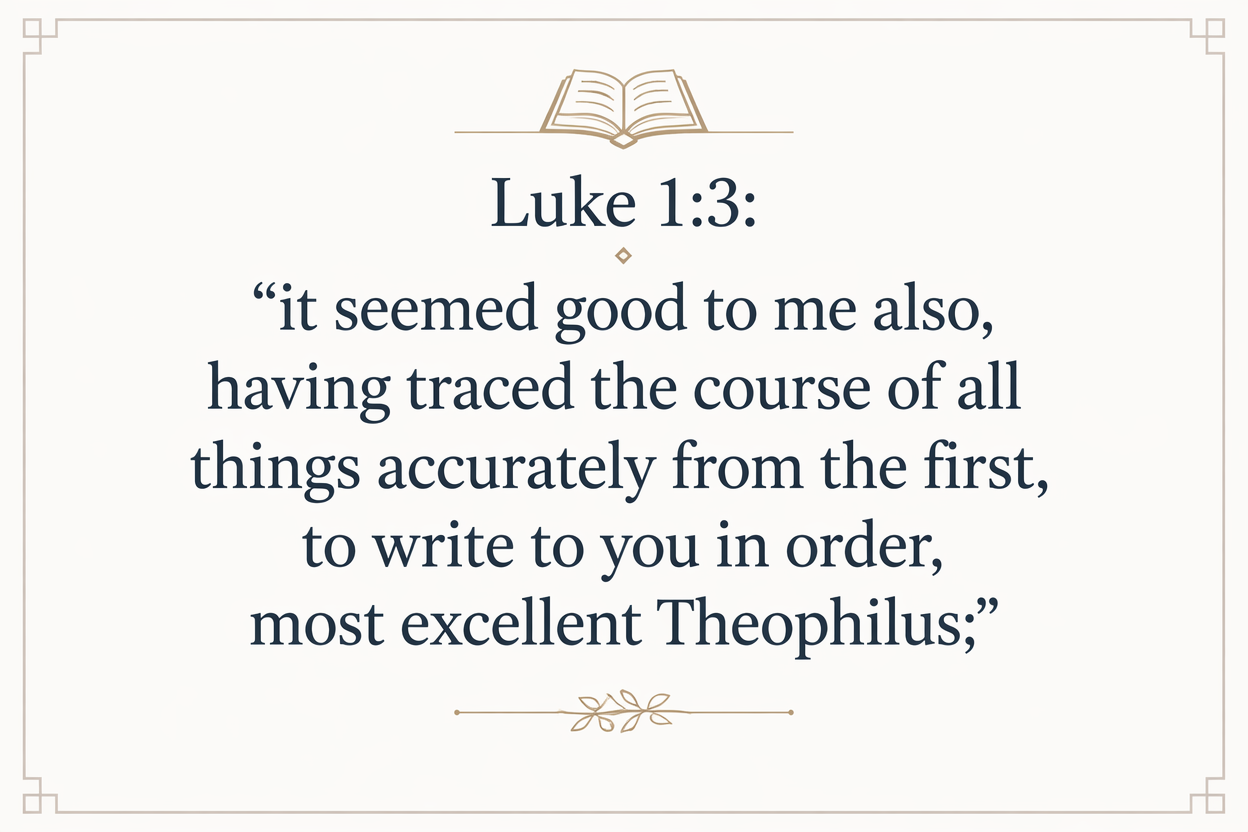
Luke 1:3: “it seemed good to me also, having traced the course of all things accurately from the first, to write to you in order, most excellent Theophilus;”
Here καθεξῆς qualifies the writing itself: the author presents his work as a composition arranged “in order.” The surrounding phrasing highlights careful preparation—“having traced the course of all things accurately from the first”—and καθεξῆς specifies that the resulting account is set out with a coherent sequence rather than as scattered notes. In this dedication to Theophilus, the adverb is part of a claim about method: the narrative aims to move from point to point in an ordered way.
Luke 8:1: “Soon afterwards, he went about through cities and villages, preaching and bringing the good news of God’s Kingdom. With him were the twelve,”
In this travel notice, καθεξῆς contributes to the sense of successive movement: Jesus goes “through cities and villages,” and the adverb supports the portrayal of events continuing step by step. The line reads like a transition that carries the story forward from what came before (“Soon afterwards”) into a continued itinerary. The word’s force is not about the content of the preaching but about the ordered progression of the ministry as it moves through multiple locations.
Acts 3:24: “Yes, and all the prophets from Samuel and those who followed after, as many as have spoken, they also told of these days.”
In Peter’s speech, καθεξῆς shapes the way the prophets are grouped: from “Samuel” to “those who followed after.” The adverb helps present the prophetic witness as a sequence—figures coming one after another—so that the hearers are invited to think of a continuous line rather than isolated voices. Within the sentence’s structure, the word contributes an ordered list-like movement through time, supporting the claim that many prophets, in succession, “told of these days.”
Acts 11:4: “But Peter began, and explained to them in order, saying,”
Here καθεξῆς marks Peter’s explanation as structured and sequential. The context is interpersonal and potentially contentious (“explained to them”), and the adverb indicates that Peter’s response is not a brief denial or a single assertion but an account given point by point. The narrative sets up what follows as a carefully arranged recounting, with καθεξῆς signaling that the explanation will proceed through events in an orderly sequence.
Acts 18:23: “Having spent some time there, he departed, and went through the region of Galatia, and Phrygia, in order, establishing all the disciples.”
In this summary of travel and strengthening work, καθεξῆς qualifies the way the journey through regions is carried out: “went through the region of Galatia, and Phrygia, in order.” The adverb portrays the movement as systematic, suggesting a sequence in visiting places. This ordered travel serves a pastoral purpose in the same sentence—“establishing all the disciples”—so καθεξῆς contributes to the picture of deliberate, organized progression through communities rather than a random route.
Sense and Usage
Across these passages, καθεξῆς consistently functions as a marker of sequence. In Luke 1:3 and Acts 11:4 it frames spoken or written explanation: an account is presented as arranged so that its parts follow one another coherently. In Luke 8:1 and Acts 18:23 it frames movement through locations: cities, villages, and regions are traversed in a successive pattern, giving the narrative a sense of continuity and ordered advance. In Acts 3:24 it frames a line of persons over time, presenting prophetic testimony as something that comes in succession.
Because καθεξῆς is used both for narration and for travel, it links “order” with the intelligibility of a storyline. When an author writes “in order,” the reader is prepared for a sequence that can be followed; when a speaker explains “in order,” listeners are prepared for an account whose steps can be tracked; when characters move through places “in order,” the story world is presented as unfolding through a connected chain of visits. In each setting the adverb does not add new content to the events themselves; it shapes how those events are arranged, recounted, or progressed.
The word also helps signal transitions. Luke 8:1 uses a brief forward-looking summary (“Soon afterwards…”) that advances the narrative into a new stretch of activity, and καθεξῆς supports that forward motion by implying the story continues in a sequenced way. Acts 18:23 uses a similarly compressed travel notice, and καθεξῆς lends that compression a sense of method: even when the narrative telescopes time and movement, the journey is still depicted as proceeding in a set order.
Imagery in Context
In these texts, καθεξῆς carries the imagery of a path that can be followed. Whether the “path” is a written account addressed to Theophilus, a spoken explanation delivered by Peter, a succession of prophets, or a route through cities and regions, the adverb presents events as laid out in a trackable sequence. The reader is invited to see the story as something that moves forward step by step—through time, through speech, and through geography.
Sources: Lexical data from Strong’s Exhaustive Concordance and the Translators Brief Lexicon of Extended Strongs for Greek (STEPBible, CC BY). Occurrence data from the Translators Amalgamated Greek New Testament (STEPBible, CC BY). Scripture quotations from the World English Bible (public domain).