Exploring the Meaning of Kathezomai in Greek
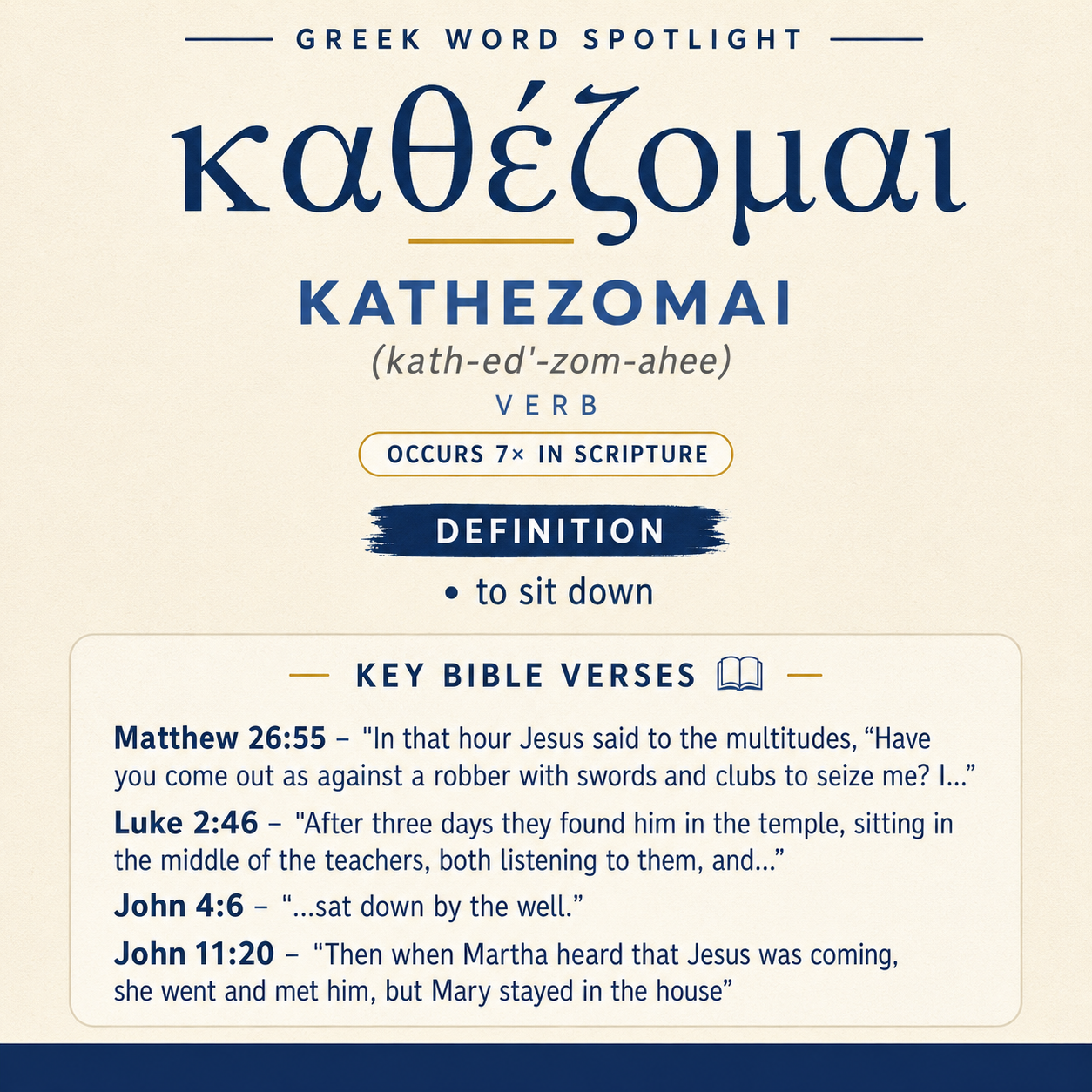
καθέζομαι means “to sit down” and occurs 7 times in Scripture, including Matthew 26:55; Luke 2:46; John 4:6; Acts 20:9.
Core Meaning
καθέζομαι is defined as “to sit down.” In its occurrences, it describes people sitting in various settings.
Learn More →Gospel Scenes
Luke 2:46 portrays Jesus sitting among the teachers in the temple. John 4:6 shows Jesus sitting by Jacob’s well, and John 20:12 depicts angels sitting.
Learn More →Acts Contexts
Acts 6:15 uses it for those sitting in the council. Acts 20:9 uses it for Eutychus sitting in the window.
Learn More →καθέζομαι names the action of sitting down, and in the New Testament it is used in scenes ranging from public teaching to fatigue, grief, and courtroom attention. The word appears in narrative moments where posture quietly signals presence, waiting, attentiveness, or vulnerability.
Occurrences
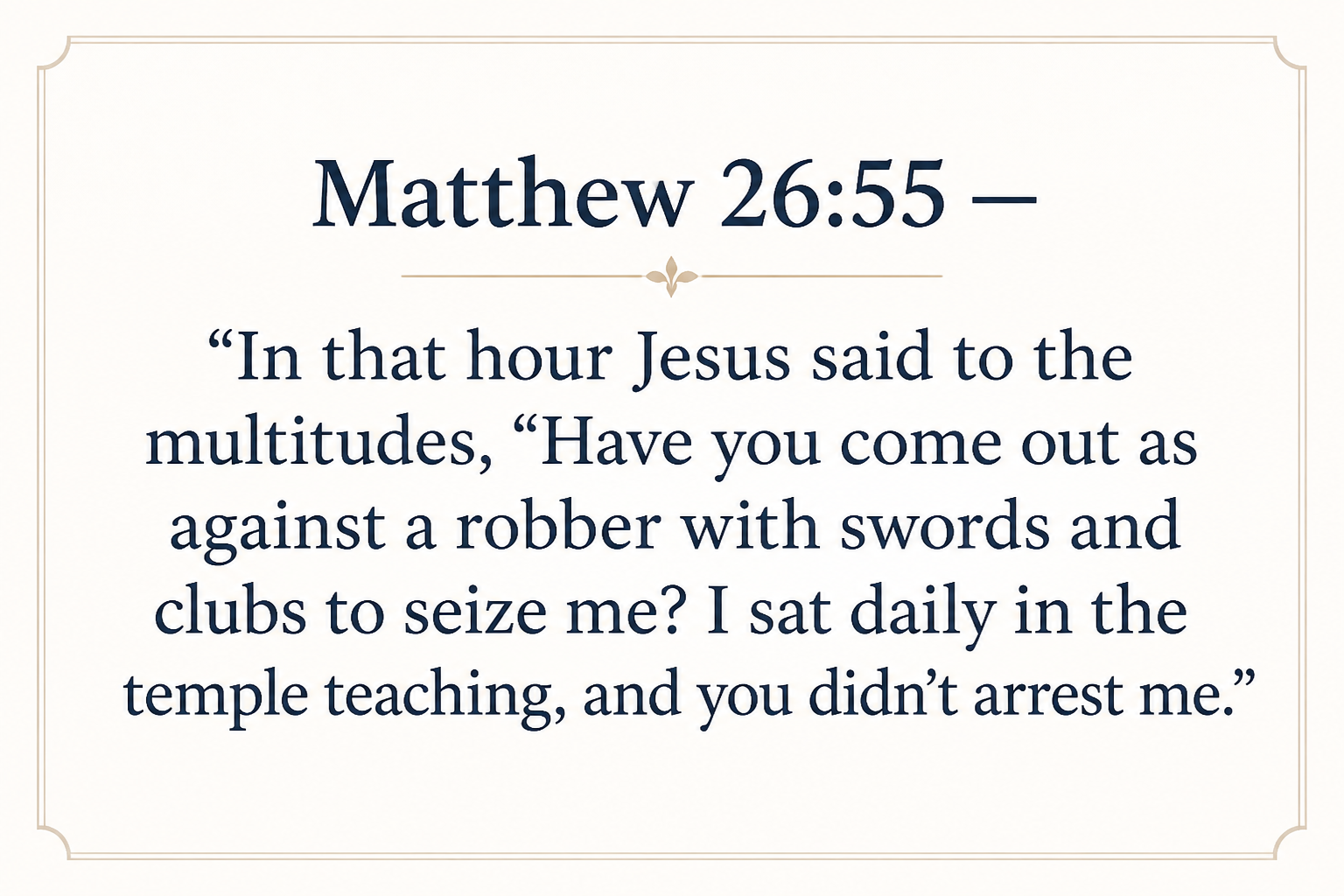
Matthew 26:55 — “In that hour Jesus said to the multitudes, “Have you come out as against a robber with swords and clubs to seize me? I sat daily in the temple teaching, and you didn’t arrest me.”
Here the verb marks Jesus’ settled, regular posture in a public religious space: “I sat daily in the temple teaching.” The sitting is not merely incidental furniture-use; it frames his teaching as open and observable, in contrast to the armed seizure implied by “swords and clubs.” The seated posture supports his argument that his activity has been conducted in the daylight of communal life (“daily… in the temple”), not in the manner of a hidden criminal.
Luke 2:46 — “After three days they found him in the temple, sitting in the middle of the teachers, both listening to them, and asking them questions.”
The action of sitting down places the boy Jesus within a circle of recognized instructors: he is “in the middle of the teachers.” The verse further defines what this sitting looks like in practice—“both listening… and asking… questions.” The posture fits the social setting of instruction: he is positioned to hear and engage, and his seated placement among the teachers underscores the focused, sustained nature of the exchange rather than a brief, passing encounter.
John 4:6 — “Jacob’s well was there. Jesus therefore, being tired from his journey, sat down by the well. It was about the sixth hour.”
In this travel scene, sitting down is explicitly motivated by physical weariness: “being tired from his journey.” The verb conveys a pause that is bodily and practical, locating Jesus “by the well,” a place associated with water and rest. The time marker (“about the sixth hour”) gives the sitting a concrete immediacy; it is a moment of stoppage within movement, preparing the narrative space for what follows at that location.
John 11:20 — “Then when Martha heard that Jesus was coming, she went and met him, but Mary stayed in the house.”
The verse contrasts Martha’s movement (“she went and met him”) with Mary’s remaining—rendered as staying in the house. In this context the verb’s force is still the simple action of sitting down, but it functions narratively as a posture of remaining rather than going out. Mary’s staying sets her apart from the immediate response of meeting Jesus on the way; the stillness implied by staying at home contributes to the scene’s emotional weight and delay, presenting her as not joining the outward motion at that moment.
John 20:12 — “and she saw two angels in white sitting, one at the head, and one at the feet, where the body of Jesus had lain.”
Sitting down here describes the fixed placement of the angels within the tomb: “one at the head, and one at the feet.” The posture communicates settled presence and ordered positioning rather than hurried activity. The seated arrangement also draws attention to the location “where the body of Jesus had lain,” so that the empty space is framed by two seated figures; their stillness heightens the focus on the absence of the body and the specificity of the place.
Acts 6:15 — “All who sat in the council, fastening their eyes on him, saw his face like it was the face of an angel.”
In the council setting, sitting down identifies those who comprise the assembled body: “All who sat in the council.” The verb helps depict a formal, deliberative scene—people in their places, watching. The seated posture supports the next action: they are “fastening their eyes on him,” an attentive, concentrated gaze. The verse’s description of what they see (“his face like it was the face of an angel”) is framed by this image of seated observers, collectively focused.
Acts 20:9 — “A certain young man named Eutychus sat in the window, weighed down with deep sleep. As Paul spoke still longer, being weighed down by his sleep, he fell down from the third floor and was taken up dead.”
The verb situates Eutychus in a precarious place: “sat in the window.” Sitting down here is a physical posture that becomes narratively dangerous. The verse connects his seated position with fatigue—he is “weighed down with deep sleep”—and the prolonged speaking (“As Paul spoke still longer”) intensifies the situation until sitting becomes the setup for falling: “he fell down from the third floor.” The seated posture thus functions as the quiet beginning of a chain of events, moving from stillness to sudden collapse.
Sense and Usage
Across these passages, καθέζομαι consistently anchors a scene by describing a person’s posture in space—sometimes calm and ordinary, sometimes charged with meaning because of what surrounds it. In Matthew 26:55, sitting down is linked with public teaching (“daily in the temple”), giving the action a steady, habitual quality; it presents a pattern of life that can be witnessed and verified. Luke 2:46 also ties sitting to learning and dialogue; the posture supports sustained listening and questioning in a shared setting, where being seated “in the middle” marks involvement rather than distance.
John 4:6 uses sitting down as the bodily expression of fatigue: the narrative explicitly supplies the cause (“being tired from his journey”) and the place (“by the well”). In this usage, the verb does not decorate the story; it is the natural gesture of travel-weariness that slows the pace and locates the next interaction. John 11:20, though phrased as staying in the house, likewise employs the action of sitting down to depict remaining rather than moving. The contrast between going out to meet and staying inside uses posture to delineate responses: one person steps into the path of the arriving Jesus; the other remains, creating narrative tension and emotional restraint through stillness.
John 20:12 shows sitting down in a scene of ordered stillness. The angels are not described as arriving or departing but as already seated, placed at two points (“head… feet”) around a specific location. The verb contributes to the tableau-like quality of the moment: attention is drawn to arrangement, presence, and the highlighted space where the body “had lain.” In Acts 6:15, sitting down belongs to civic-religious procedure: those seated constitute the council as an assembled audience, and their fixed posture supports their intent observation—“fastening their eyes.” Here sitting is part of the setting’s formality and collective focus.
Acts 20:9 demonstrates how the same simple action can carry narrative risk when paired with an unstable location and human weakness. Sitting down “in the window” is initially a neutral description of where Eutychus is, but when sleep presses on him and the speech extends, the posture becomes the hinge between hearing and falling. The verb thus serves as a spatial marker that makes the subsequent fall intelligible: the reader knows exactly where he was when drowsiness overcame him.
In these texts, then, sitting down functions as more than a static detail. It marks regularity (daily teaching), participation (among teachers), necessity (rest from travel), reserve (remaining in the house), ordered presence (angels positioned), formal assembly (a council seated), and exposure (a young man perched in a window). The verb’s plain physical sense allows it to bear these different narrative weights without changing its basic meaning; the surrounding actions and settings supply the particular emphasis each time.
Imagery
The imagery of sitting down in these passages repeatedly turns posture into a kind of narrative punctuation—pauses that define a place and clarify a relationship to others. A seated teacher in the temple stands against the threat of armed arrest (Matthew 26:55); a seated listener among teachers portrays attentive engagement (Luke 2:46). A weary traveler sitting by a well fixes the scene at a specific hour (John 4:6), while a woman staying seated in a house contrasts with another who goes out to meet (John 11:20). In the tomb, two seated angels frame an absence (John 20:12); in the council, seated observers intensify scrutiny (Acts 6:15); and in an upper room gathering, a sleeper seated in a window shows how quickly stillness can turn to calamity (Acts 20:9).
Sources: Lexical data from Strong’s Exhaustive Concordance and the Translators Brief Lexicon of Extended Strongs for Greek (STEPBible, CC BY). Occurrence data from the Translators Amalgamated Greek New Testament (STEPBible, CC BY). Scripture quotations from the World English Bible (public domain).