
Exploring the Meaning of Hippikon in Greek
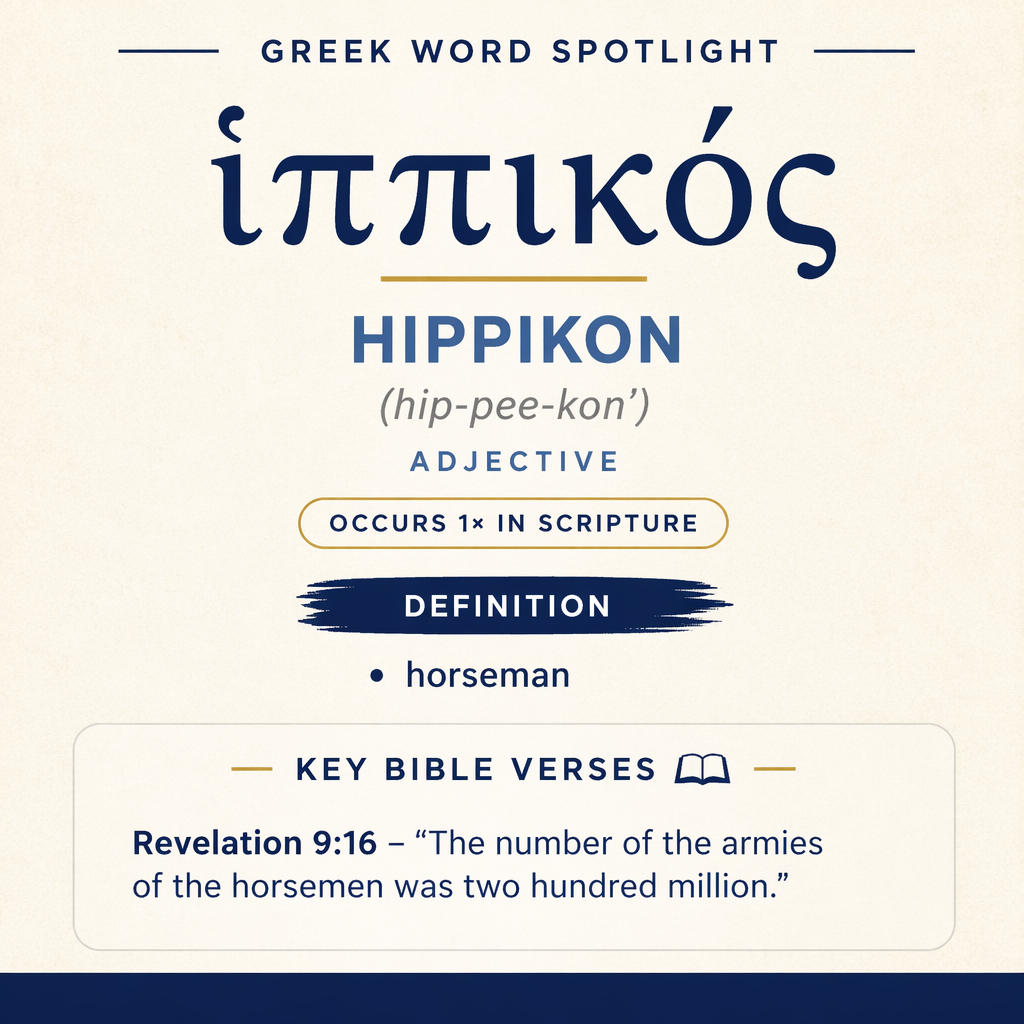
ἱππικός means “horseman” and appears once in Scripture in Revelation 9:16.
Scripture Occurrence
This word occurs 1 time in Scripture. It appears in Revelation 9:16.
Learn More →Verse Context
In Revelation 9:16, it refers to the armies of the horsemen numbered at two hundred million.
Learn More →ἱππικός means “horseman” and appears in a single New Testament passage describing a vast mounted force. In its lone setting it helps frame the scale and character of the army being counted and heard.
Root and Related Words
ἱππικός derives from hippos (ἵππος), “horse” (Strong’s G2462). The adjective’s connection to the animal is reflected in its association with mounted troops in context.
Occurrences
“The number of the armies of the horsemen was two hundred million. I heard the number of them.” (Revelation 9:16)
Here ἱππικός contributes the identifying feature of the armies being enumerated: they are armies characterized by horsemen. The verse is structured as a report of an exact tally (“two hundred million”) reinforced by auditory confirmation (“I heard the number of them”), and the presence of “horsemen” specifies the kind of forces that make up these “armies.” The term therefore functions to sharpen the picture from a generic military host to a mounted one, anchoring the count in a particular type of military presence. In the immediate wording, the horsemen are not incidental; they are the defining designation by which the armies are described and counted.
Sense and Usage
With the sense “horseman,” ἱππικός works as a descriptive label for troops distinguished by their association with horses. In Revelation 9:16 the word’s value lies in how it lets the reader envision an army in a specific configuration—an army of horsemen—while the verse simultaneously stresses enormity through the stated number and the speaker’s insistence that the number was heard. The term thus supports the passage’s emphasis on scale: an immense force is not merely listed but given a concrete military profile, one that implies mobility and mounted organization by the very identification of its members as horsemen.
Because the passage pairs “armies” with “horsemen,” ἱππικός also helps bind the collective and the individual: the “armies” are made up of “horsemen,” and the count pertains to the whole force as it is constituted by that defining kind of soldier. The verse presents the horsemen as the key unit of description—what is numbered is not an abstract fighting capacity but an army understood through its horsemen.
Imagery
The imagery carried by ἱππικός in Revelation 9:16 is the imagery of massed mounted forces: armies whose identity is tied to horsemen, presented with a number so large it is both declared and audibly affirmed. The single verse gives the term a stark, martial concreteness, joining the idea of horsemen to the overwhelming magnitude of the host being reported.
Sources: Lexical data from Strong’s Exhaustive Concordance and the Translators Brief Lexicon of Extended Strongs for Greek (STEPBible, CC BY). Occurrence data from the Translators Amalgamated Greek New Testament (STEPBible, CC BY). Scripture quotations from the World English Bible (public domain).





