
Exploring the Meaning of Ioudaikos in Greek
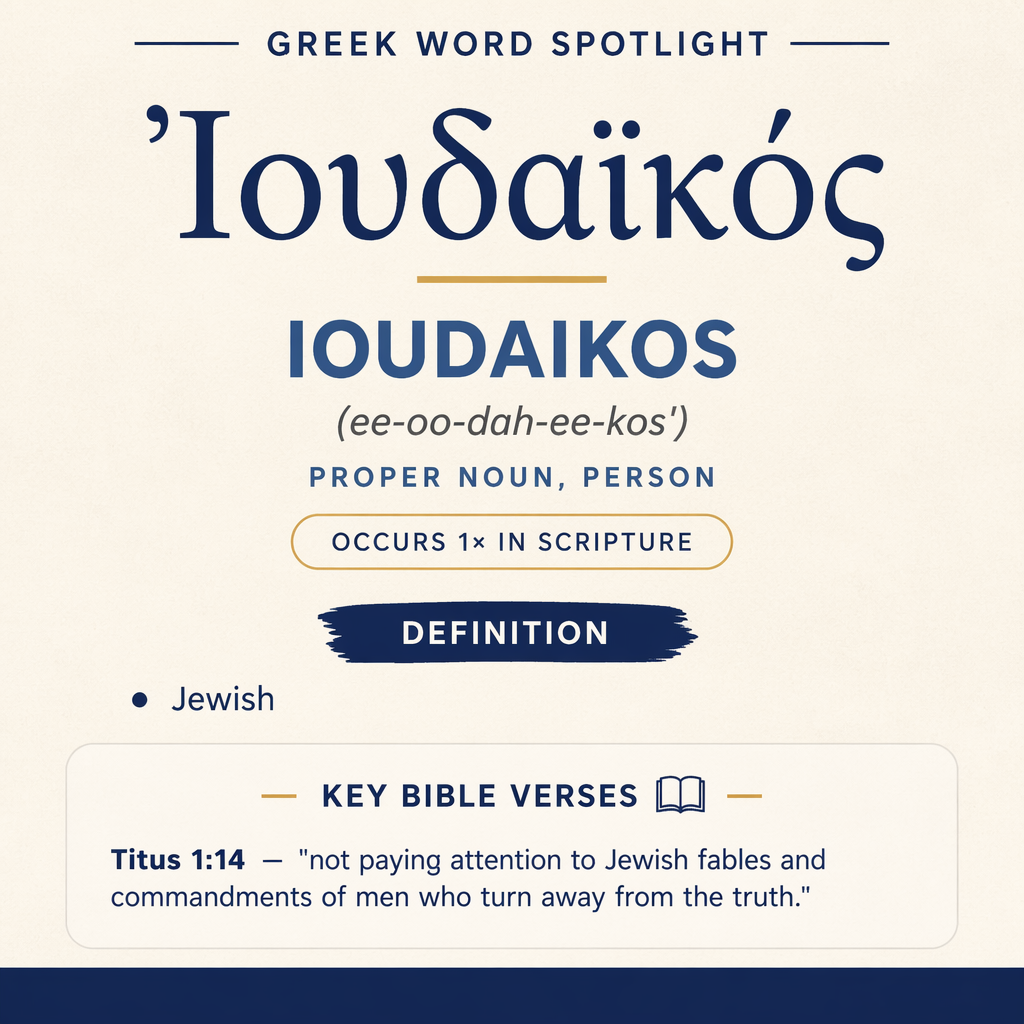
Ἰουδαϊκός means “Jewish” and appears once in Scripture, in Titus 1:14.
Verse Context
Titus 1:14 warns against paying attention to Jewish fables and commandments of men who turn away from the truth.
Learn More →Ἰουδαϊκός means “Jewish” and appears once in the New Testament, in Paul’s instruction to Titus about what to resist and what to hold fast. In its lone occurrence it functions as an identifying descriptor within a warning about teaching that distracts from truth.
Root and Related Words
Ἰουδαϊκός (Ioudaikos) is related to Ioudaios (Ἰουδαῖος), meaning “Jew” (Strong’s G2453). The relationship is reflected in the way the adjective marks something as belonging to, or characterized by, what is identified as “Jewish” in the verse where it occurs.

Occurrences
Titus 1:14: “not paying attention to Jewish fables and commandments of men who turn away from the truth.”
Here “Jewish” narrows the kind of “fables” in view. Paul is not speaking in general terms about any and every tale; he specifies a subset—fables marked as “Jewish.” In the same breath he places these “Jewish fables” alongside “commandments of men,” and he describes the people promoting such commandments as those “who turn away from the truth.” Within this single line, the adjective serves a framing role: it labels one stream of story or tradition (“fables”) as “Jewish,” then immediately sets that stream within a larger contrast between attention given to such materials and faithfulness to “the truth.” The result is that the “Jewish” label is not merely ethnic description; it is part of an evaluative warning about which voices and themes should not receive a teacher’s or congregation’s attention.
Sense and Usage
The force of “Jewish” in Titus 1:14 is classificatory: it identifies the cultural or communal character of certain “fables.” Because the line also mentions “commandments of men,” the adjective participates in a contrast between what is associated with “the truth” and what diverts from it. The verse does not define the fables themselves, but it does tell the reader how they function in the situation Titus faces: they are items that some people press upon others, demanding attention, and this emphasis accompanies a turning “away from the truth.”
Placed before “fables,” “Jewish” gives the warning specificity. The concern is not simply that stories exist, but that particular stories—marked by their “Jewish” character—are being used in a way that competes with truth. In the same sentence, “commandments of men” adds a second category, and together the two categories create a paired description of problematic teaching: a story-shaped element (“fables”) and a rule-shaped element (“commandments”). “Jewish” modifies only the first element in the wording quoted, but it helps establish the concrete profile of the teaching being resisted: it comes with recognizable labels and origins, and it is promoted by people who are described in moral and epistemic terms (“turn away from the truth”).
In this occurrence, then, “Jewish” operates less as a neutral marker and more as a tag within a pastoral boundary. It tells Titus what kind of material is being circulated and treated as worthy of attention, and it supports the instruction that such attention should be refused. The emphasis falls on discernment: refusing to be drawn into a teaching environment where “fables” and “commandments of men” gain focus at the expense of “the truth.”
Imagery
The imagery in Titus 1:14 is auditory and instructional: voices competing for attention. “Jewish” marks one kind of voice—“Jewish fables”—set alongside “commandments of men,” both portrayed as influences that pull listeners away from “the truth.”
Sources: Lexical data from Strong’s Exhaustive Concordance and the Translators Brief Lexicon of Extended Strongs for Greek (STEPBible, CC BY). Occurrence data from the Translators Amalgamated Greek New Testament (STEPBible, CC BY). Scripture quotations from the World English Bible (public domain).





