
Exploring the Meaning of Hikmas in Greek
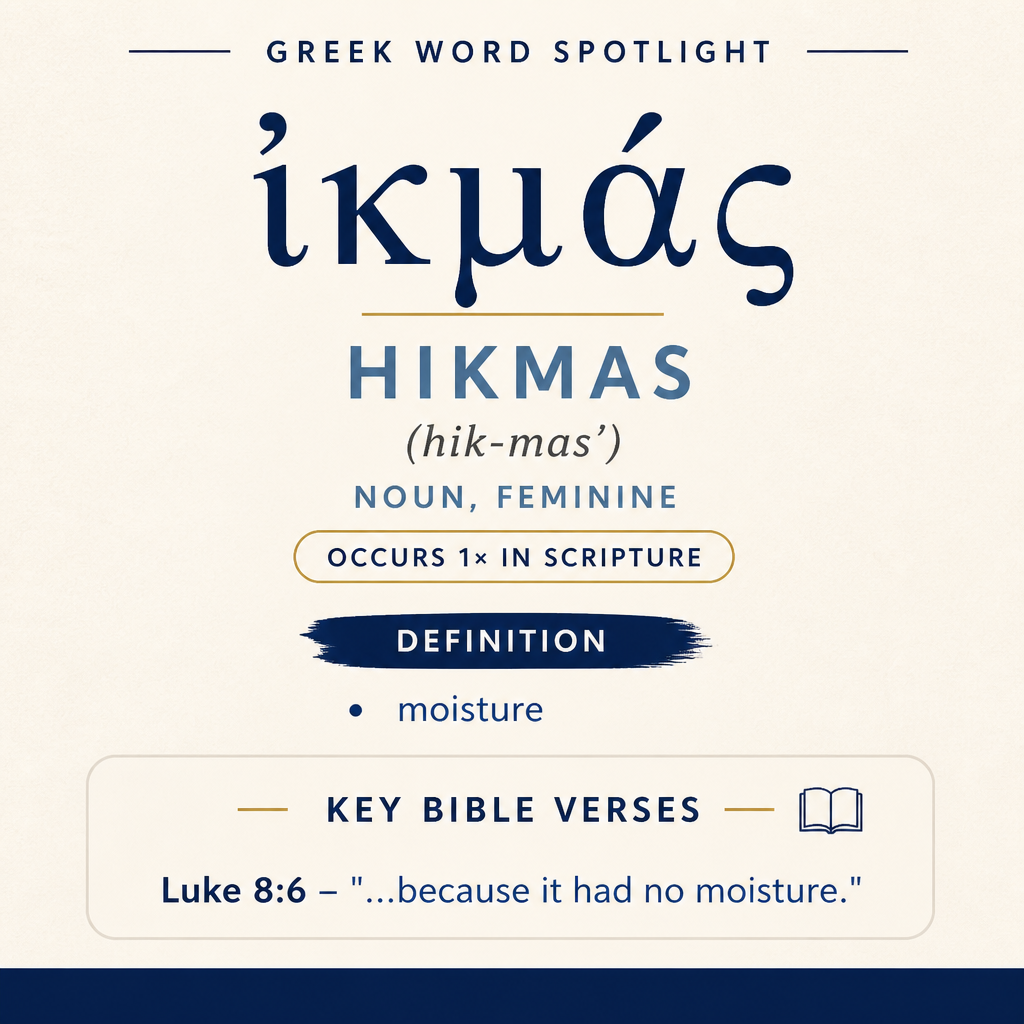
ἰκμάς means “moisture” and appears once in Scripture, in Luke 8:6.
ἰκμάς refers to moisture. It appears in Jesus’ parable of the sower to explain why one kind of seedling fails to endure.
Occurrences
“Other seed fell on the rock, and as soon as it grew, it withered away, because it had no moisture.” (Luke 8:6)
In this line of the parable, ἰκμάς names the concrete condition that makes the difference between a plant that can keep living and one that cannot. The seed “fell on the rock,” a setting that allows a quick start—“as soon as it grew”—yet leads swiftly to collapse: it “withered away.” The explanation is not left vague or purely descriptive; it is stated as the reason: “because it had no moisture.” Here ἰκμάς functions as the missing element that connects the rocky location with the visible outcome of withering. The word therefore carries explanatory force: the growth is real enough to be noticed, but it is unsustainable when the environment cannot supply what the young plant needs to remain fresh and viable.
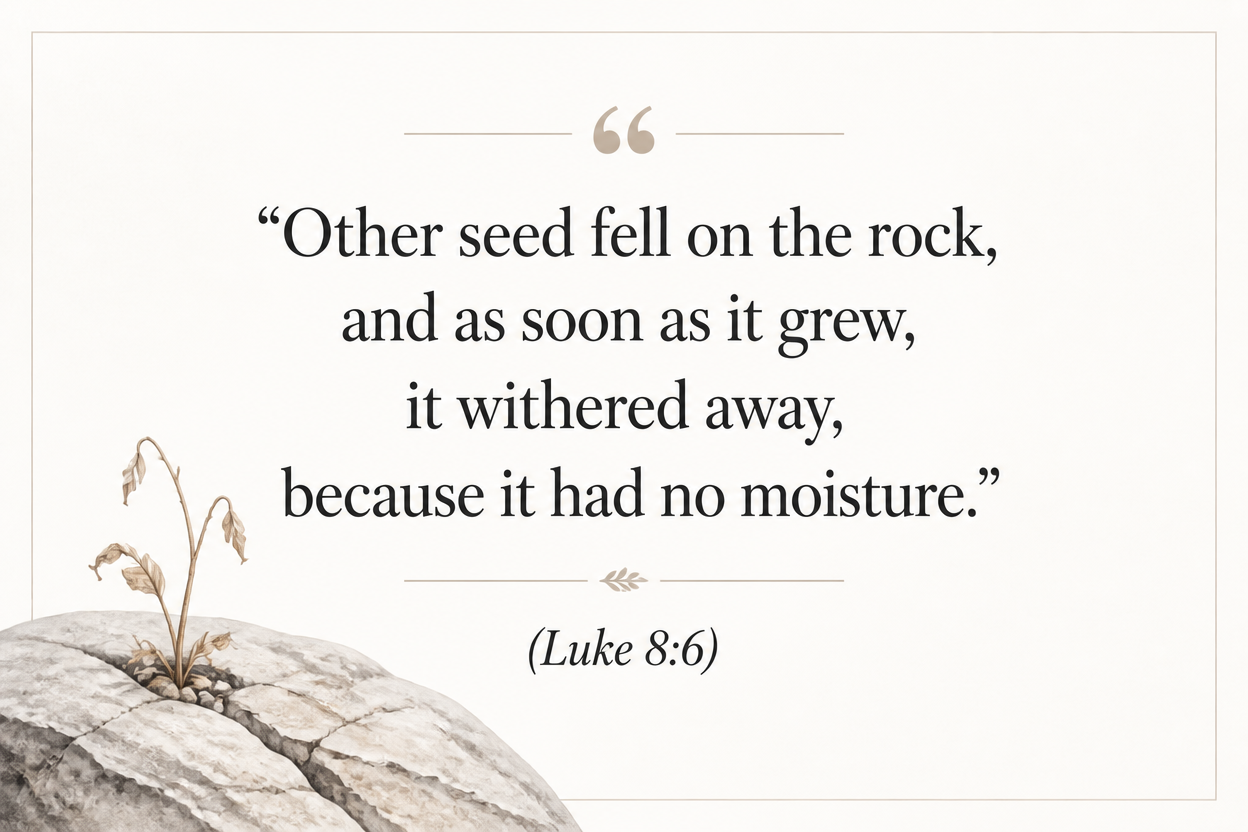
The verse also places ἰκμάς in a tight causal chain. The narrative sequence moves from place (“on the rock”) to early development (“as soon as it grew”) to failure (“it withered away”), and then anchors the failure in a specific lack (“no moisture”). Because the parable’s imagery is agricultural, the word belongs to ordinary, observable life: a seedling’s fate is determined not only by the fact that it sprouts but by whether the setting can provide what is necessary for continued life. In this way ἰκμάς is not an ornament in the sentence; it is the key explanation that makes the withering intelligible rather than merely unfortunate.

Sense and Usage
The use of ἰκμάς in Luke 8:6 shows moisture as a life-sustaining condition rather than a passing detail. The seed’s problem is not described as slow growth, stunted development, or external damage; the issue is a deficit in the environment that leads to a predictable result. Moisture, as expressed by ἰκμάς, stands for what the plant cannot produce for itself and what the rocky surface does not supply. The word is therefore aligned with dependence: the seedling’s continued vitality depends on a provision from outside itself.
Within the verse’s wording, moisture is framed negatively—“no moisture”—and the negation sharpens the sense. Luke does not present two competing causes (for example, heat and dryness) but singles out one missing factor. That focus makes ἰκμάς a diagnostic term in the parable: it identifies the decisive absence that explains why initial growth does not guarantee endurance. The sentence assumes a straightforward, almost proverbial natural logic: without moisture, withering follows. The word therefore emphasizes the fragility of early growth when it is not matched by sustaining conditions.
The placement of ἰκμάς at the end of the verse also gives it rhetorical weight. The line culminates with the reason clause, so the listener arrives at the explanation last: the withering is traced back to a lack of moisture. In a parable that contrasts different soils and outcomes, this use treats moisture as one of the concrete variables by which a setting is assessed. The “rock” is not merely a hard place; in the logic of the image it is a place where moisture is unavailable to the sprouting seed. ἰκμάς thus helps the parable’s picture stay grounded in the simple realities of planting: the visible promise of a sprout can be undone by invisible deficiency beneath or around it.
Even in its single occurrence, the term is precise enough to shape the scene. The growth “as soon as it grew” suggests speed and immediacy, while “withered away” suggests rapid decline. Between those two, ἰκμάς marks the difference between a momentary appearance of life and the capacity to remain alive. The word’s contribution, then, is to underline the necessity of sustained provision for sustained life, expressed in the most tangible and ordinary way: a plant needs moisture.
Imagery
Luke 8:6 uses ἰκμάς to paint a small, vivid contrast: a seedling that briefly rises and then collapses, not because it never grew, but because something essential is missing. The image invites the reader to imagine the thin, exposed setting of “the rock” and the quick fading of green life when there is “no moisture.” The parable’s power in this line lies in how ordinary the scene is—growth that looks promising at first, followed by withering that becomes inevitable when moisture is absent.
Sources: Lexical data from Strong’s Exhaustive Concordance and the Translators Brief Lexicon of Extended Strongs for Greek (STEPBible, CC BY). Occurrence data from the Translators Amalgamated Greek New Testament (STEPBible, CC BY). Scripture quotations from the World English Bible (public domain).





