
Exploring the Meaning of Hikanos in Greek
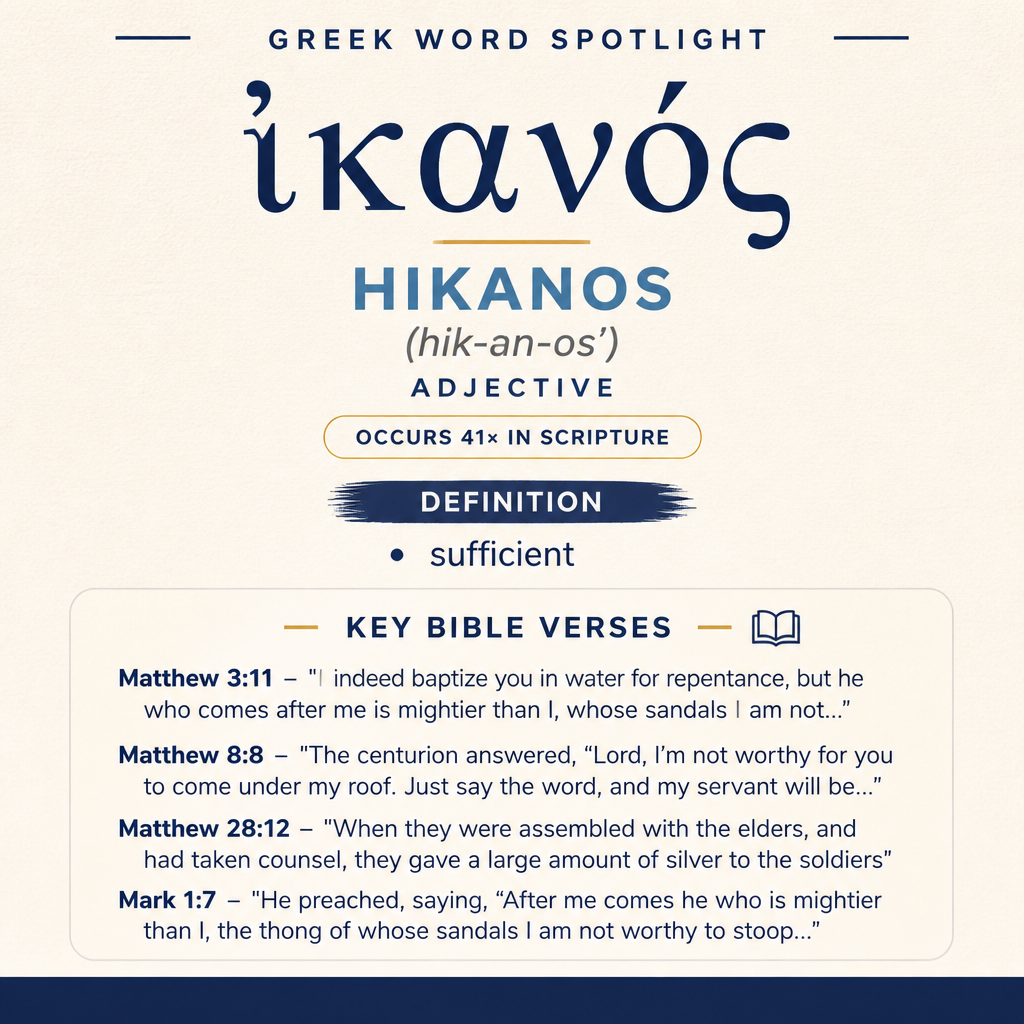
ἱκανός (Hikanos) means “sufficient” and occurs 41 times in Scripture, including Matthew 3:11; Matthew 8:8; Mark 1:7; and Luke 7:6.
Scripture Footprint
It occurs 41 times in Scripture. Listed occurrences include Matthew, Mark, and Luke.
Learn More →Sample Contexts
It appears in statements of unworthiness: “not worth” (Matthew 3:11) and “not worthy” (Matthew 8:8; Mark 1:7; Luke 7:6).
Learn More →ἱκανός expresses the idea of what is sufficient. In these Gospel scenes it appears in language of worthiness, adequacy, and scale, helping narrators and speakers measure themselves, crowds, and resources in relation to what is happening.
Occurrences
“I indeed baptize you in water for repentance, but he who comes after me is mightier than I, whose sandals I am not worthy to carry. He will baptize you in the Holy Spirit.” (Matthew 3:11)
Here ἱκανός contributes to John’s comparison between his own role and the coming one’s greater might. The statement “I am not worthy to carry” frames John as insufficient for even a lowly service, while the verse immediately places that insufficiency alongside the coming baptism “in the Holy Spirit,” heightening the gap between what John can do and what the mightier one will do.
“The centurion answered, “Lord, I’m not worthy for you to come under my roof. Just say the word, and my servant will be healed.” (Matthew 8:8)
The centurion uses ἱκανός to describe himself as insufficient to host Jesus: “I’m not worthy for you to come under my roof.” In the same breath he expresses confidence that Jesus’ spoken command is sufficient for healing—“Just say the word”—so the adjective helps hold together humility about personal standing and assurance about effective authority.
“When they were assembled with the elders, and had taken counsel, they gave a large amount of silver to the soldiers,” (Matthew 28:12)
The scene turns on quantity: a “large amount of silver” supplied to soldiers after deliberation. ἱκανός fits the verse’s emphasis on an amount adequate to accomplish the intended result of the leaders’ counsel, presenting the payment as more than token and sufficient for persuasion.
“He preached, saying, “After me comes he who is mightier than I, the thong of whose sandals I am not worthy to stoop down and loosen.” (Mark 1:7)
As in Matthew’s parallel, ἱκανός intensifies John’s self-lowering in relation to the mightier one. The particular action—stooping down to loosen a sandal thong—sharpens the point: John portrays himself as insufficient even for this menial act, and the adjective presses the contrast between John’s preaching role and the superior status of the one who follows.
“They came to Jericho. As he went out from Jericho, with his disciples and a great multitude, the son of Timaeus, Bartimaeus, a blind beggar, was sitting by the road.” (Mark 10:46)
In this travel notice, ἱκανός belongs to the phrase “a great multitude,” characterizing the crowd by size. The adjective sets the scene as publicly charged and well-attended, so that what follows (introduced by the presence of “a blind beggar” by the road) takes place within the pressure and visibility of a sufficiently large gathering.
“Pilate, wishing to please the multitude, released Barabbas to them, and handed over Jesus, when he had flogged him, to be crucified.” (Mark 15:15)
The “multitude” in this verse is not described by number, but ἱκανός contributes to its force as a mass capable of being “pleased” and therefore influencing Pilate’s actions. The word helps portray the crowd as sufficiently weighty—whether by size or presence—to function as a factor Pilate considers, shaping the grim sequence: release, flogging, and handing over.
“John answered them all, “I indeed baptize you with water, but he comes who is mightier than I, the strap of whose sandals I am not worthy to loosen. He will baptize you in the Holy Spirit and fire,” (Luke 3:16)
Luke’s version again uses ἱκανός to express personal inadequacy in a concrete task: “not worthy to loosen” a sandal strap. Within the same sentence the contrast is expanded by the coming baptism “in the Holy Spirit and fire,” so the adjective supports Luke’s depiction of a difference not only in rank but in the sufficiency of what each baptism accomplishes.
“Jesus went with them. When he was now not far from the house, the centurion sent friends to him, saying to him, “Lord, don’t trouble yourself, for I am not worthy for you to come under my roof.” (Luke 7:6)
Here ἱκανός appears in a message carried by intermediaries (“sent friends”), which itself echoes the centurion’s sense of insufficiency. The request “don’t trouble yourself” flows from “I am not worthy,” so the adjective functions socially: it marks the centurion’s assessment that his household setting is not sufficient for the presence of the one approaching, even as the narrative shows Jesus already moving toward the house.
“Soon afterwards, he went to a city called Nain. Many of his disciples, along with a great multitude, went with him.” (Luke 7:11)
ἱκανός helps frame the movement toward Nain with a sense of scale: “Many of his disciples” and “a great multitude” accompany Jesus. The adjective makes the following events a public procession rather than a private visit, indicating that the travel itself has drawn a sufficiently large company to be described as a multitude.
“Now when he came near to the gate of the city, behold, one who was dead was carried out, the only son of his mother, and she was a widow. Many people of the city were with her.” (Luke 7:12)
This verse pairs two groups: those going with Jesus (from the prior verse) and “Many people of the city” with the widow. ἱκανός contributes to the description of the city’s attendance at the funeral procession, presenting the widow’s loss as witnessed and shared by a sufficiently large community presence as the scene converges at the city gate.
“When Jesus stepped ashore, a certain man out of the city who had demons for a long time met him. He wore no clothes, and didn’t live in a house, but in the tombs.” (Luke 8:27)
In this encounter, ἱκανός belongs to the time phrase “for a long time,” marking duration as sufficient to be noteworthy. The adjective supports the portrayal of an entrenched condition: the man’s long-standing bondage is matched by a life-pattern described in stark negatives (no clothes, not in a house) and a location (the tombs) that underscores how thoroughly his situation has taken hold.
“Now there was there a herd of many pigs feeding on the mountain, and they begged him that he would allow them to enter into those. Then he allowed them.” (Luke 8:32)
Here ἱκανός characterizes “a herd of many pigs,” again focusing on size. The adjective supplies the sense of a sufficiently large herd to serve as a notable feature of the setting and as a meaningful object of request—“they begged him that he would allow them to enter into those”—before the decisive action: “Then he allowed them.”

Sense and Usage
Across these passages, ἱκανός marks sufficiency in two main ways: adequacy of a person in relation to a higher figure, and adequacy of quantity or extent in the scene.
In the statements about sandals and roofs (Matthew 3:11; Mark 1:7; Luke 3:16; Matthew 8:8; Luke 7:6), the word functions as a measure of personal adequacy. The speakers place themselves below what the moment requires: John presents himself as insufficient even for a servant-like task connected to the “mightier” one, and the centurion presents himself as insufficient to receive Jesus “under my roof.” In both contexts, this self-assessment is not an end in itself; it frames the sufficiency located elsewhere—John points forward to the coming one’s baptismal work, and the centurion points to the sufficiency of Jesus’ word to heal.
In crowd and amount descriptions (Matthew 28:12; Mark 10:46; Mark 15:15; Luke 7:11–12; Luke 8:32), ἱκανός turns the reader’s attention to scale as an explanatory element. A “large amount of silver” is sufficient to serve the purpose that follows counsel. “A great multitude” with Jesus, or a “multitude” that Pilate wishes to please, supplies social weight: events happen in the presence of enough people to create visibility and pressure. “Many people of the city” with the widow makes the grief a communal procession. The “many pigs” constitute a sufficiently large herd to matter in the action of the episode.
Finally, the time expression in Luke 8:27 shows that sufficiency can be measured not only by rank or number but by duration. “For a long time” is long enough to define the man’s condition and to make the meeting with Jesus a confrontation with a problem that has been sufficient in length to shape his entire way of life.
Imagery
The word’s imagery often attaches to tangible measures: sandals handled (or not handled), a roof one is fit (or not fit) to host under, silver counted out in an amount large enough to be called “large,” and crowds large enough to be called “a great multitude.” Even when the measure is time—“for a long time”—ἱκανός still works the same way, giving the narrative a sense of what is sufficient to define a situation.
Sources: Lexical data from Strong’s Exhaustive Concordance and the Translators Brief Lexicon of Extended Strongs for Greek (STEPBible, CC BY). Occurrence data from the Translators Amalgamated Greek New Testament (STEPBible, CC BY). Scripture quotations from the World English Bible (public domain).





