Exploring the Meaning of Idoumaia in Greek
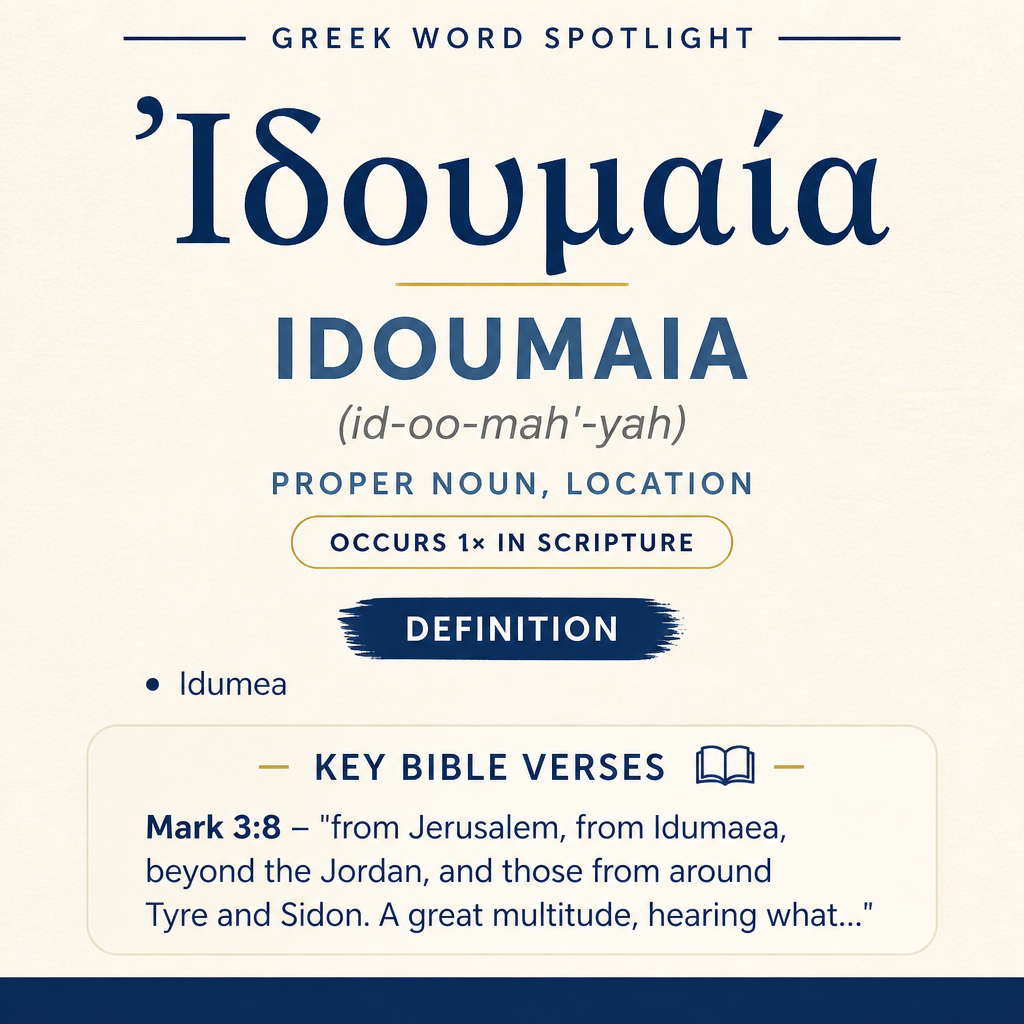
Ἰδουμαία means Idumea and appears once in Scripture in Mark 3:8.
Ἰδουμαία means “Idumea” and appears in the New Testament as a place-name. In its lone occurrence, it helps map the reach of the crowds gathering around Jesus’ activity.
Occurrences
“from Jerusalem, from Idumaea, beyond the Jordan, and those from around Tyre and Sidon. A great multitude, hearing what great things he did, came to him.” (Mark 3:8)
In Mark 3:8, Ἰδουμαία functions as one coordinate in a rapidly expanding list of origins. The verse arranges locations in a sequence (“from Jerusalem, from Idumaea, beyond the Jordan, and those from around Tyre and Sidon”), and within that sequence “Idumaea” marks a distinct region represented in the “great multitude.” The word’s contribution is therefore geographical and rhetorical at once: geographically, it identifies a specific place from which people arrive; rhetorically, it intensifies the impression of breadth by adding another named region alongside other well-known points of reference.

The syntax of the line sets “from Idumaea” parallel to “from Jerusalem,” placing it inside a pattern of repeated “from” phrases. That repetition presents the crowd not as a local cluster but as a convergence of many starting points. “Idumaea” is not treated as a destination but as an origin—one more source feeding into the movement toward Jesus. Within the same sentence, the reason for the travel is also supplied: the people are “hearing what great things he did.” The place-name thus becomes a witness to the spread of that report. In the scene as stated, Idumea is not described in itself; it is named to show that the news has traveled far enough that people from there join the influx.
The verse also places “Idumaea” among locations that vary in how they are expressed: some are named directly (“Jerusalem,” “Idumaea”), one is expressed relationally (“beyond the Jordan”), and others are expressed as surrounding areas (“around Tyre and Sidon”). “Idumaea,” by contrast, stands as a straightforward toponym in the list, adding a clear, fixed label that complements the more relational phrases. This mix of naming styles helps Mark portray the crowd as both widespread and diverse, and “Idumaea” participates by contributing a concrete, named source region to the whole.

Sense and Usage
As a proper noun meaning “Idumea,” Ἰδουμαία serves to anchor the narrative in real geography, not by explaining the region but by using its name as a marker of distance and inclusion. In Mark 3:8 the name is not an incidental detail; it functions as evidence for scale. When a single sentence piles up multiple origins before arriving at “A great multitude,” the reader is guided to infer that the gathering is larger than the immediate locale and that Jesus’ impact is not confined to one neighborhood.
Because the verse ties the people’s movement to what they “hearing what great things he did,” the place-name also supports a picture of information spreading outward and then drawing people inward. “Idumaea” plays its part by representing one of the outward points from which the inward movement occurs. The sense of the word remains stable and concrete: it names a place. Yet its narrative effect is dynamic, because it is part of a list that depicts motion, report, and response—people coming because they have heard.
The particular placement of “Idumaea” within the sequence affects how it is heard. It comes immediately after “Jerusalem” and before “beyond the Jordan.” In that position, “Idumaea” helps prevent the list from being read as a simple pairing of a central city with nearby districts. Instead, it broadens the span: a major city is named, then another region is named, then a trans-Jordan designation follows, then coastal areas are mentioned. The reader experiences the list as widening circles of origin points. The meaning “Idumea” is therefore not expanded into additional senses, but it is set to work as a geographic indicator that reinforces Mark’s emphasis on the extensive reach of the crowds.
In a narrative moment where the emphasis falls on quantity (“A great multitude”) and cause (“hearing what great things he did”), the inclusion of “Idumaea” communicates that the response is not isolated. The word helps depict the scene as a convergence: multiple areas, one gathering. That convergence, presented in the simple naming of origins, makes the crowd’s size and variety feel credible within the story’s own terms.
Imagery
Although Ἰδουμαία is a place-name, Mark 3:8 gives it an implied visual role: it belongs to a mental map made from the list of origins. The imagery is not of the region itself but of streams of travelers arriving from many directions—“from Jerusalem, from Idumaea, beyond the Jordan, and those from around Tyre and Sidon”—until the scene resolves into “A great multitude … came to him.” In that single line, “Idumaea” becomes one of the named horizons from which the crowd flows toward the center of action.
Sources: Lexical data from Strong’s Exhaustive Concordance and the Translators Brief Lexicon of Extended Strongs for Greek (STEPBible, CC BY). Occurrence data from the Translators Amalgamated Greek New Testament (STEPBible, CC BY). Scripture quotations from the World English Bible (public domain).