Exploring the Meaning of Idea in Greek
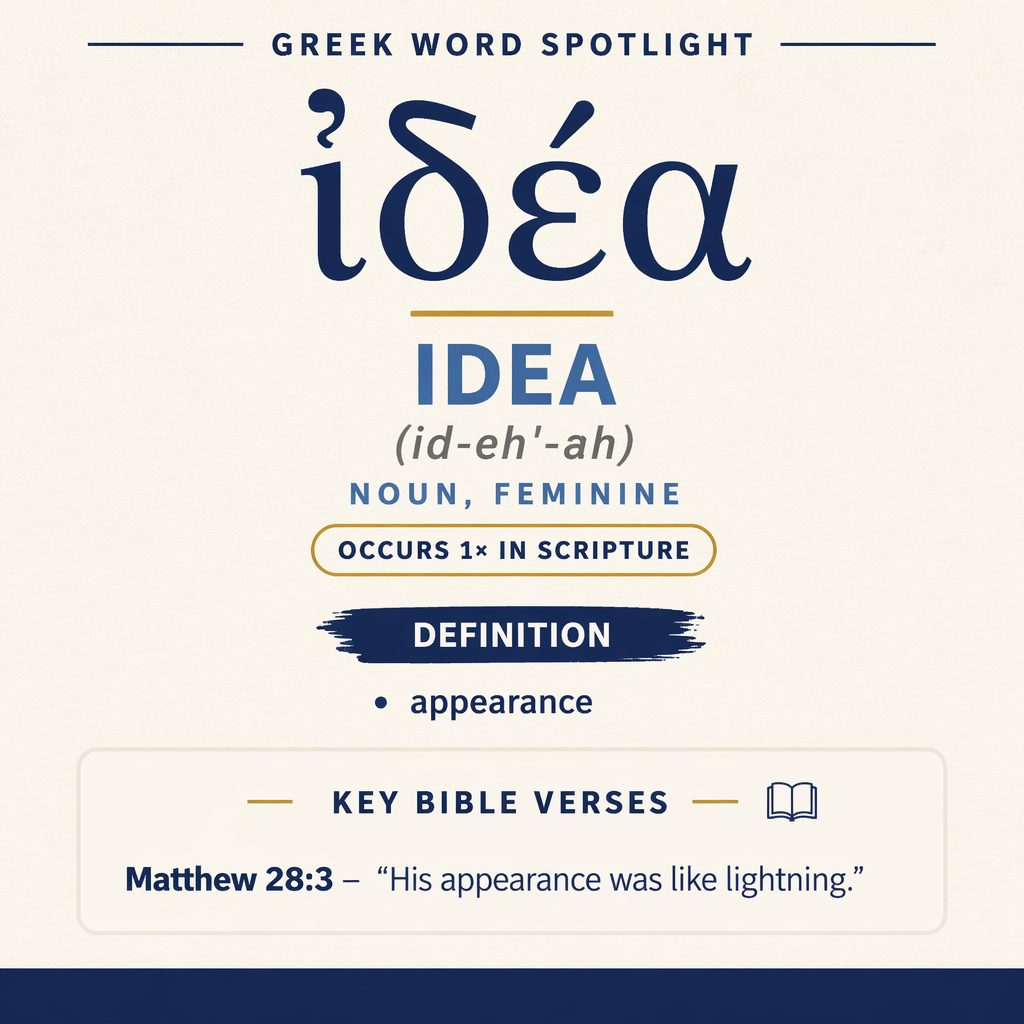
ἰδέα means “appearance” and occurs once in Scripture, in Matthew 28:3.
Scripture Occurrence
ἰδέα occurs 1 time in Scripture. Its sole occurrence is in Matthew 28:3.
Learn More →Matthew 28:3
In Matthew 28:3, it describes “His appearance” as “like lightning.” The verse also notes clothing “white as snow.”
Learn More →ἰδέα means “appearance” and is used once in the New Testament, in Matthew 28:3. In that scene it describes what is seen of a heavenly figure at the tomb.
Root and Related Words
ἰδέα (Idea) is related to εἴδω (eido), “to perceive: understand” (Strong’s G1492). The conceptual link is between perception and what is perceived—what comes into view for an observer.

Occurrences
“His appearance was like lightning, and his clothing white as snow.” (Matthew 28:3)
In Matthew 28:3, ἰδέα focuses attention on the visible impression made by the figure being described: “His appearance was like lightning.” The comparison does not merely supply a decorative image; it communicates how the figure presents to sight—striking, vivid, and immediate. The verse pairs that description with another visible detail: “his clothing white as snow.” Together, the two clauses form a coordinated portrayal of how the figure looks. In this single use, ἰδέα serves as a concise label for outward manifestation: the way the figure is encountered visually in that moment.
The phrase “was like lightning” anchors the description in a phenomenon known for its sudden visibility and intense brilliance. Because ἰδέα names “appearance,” the simile naturally belongs to the realm of what is seen rather than what is heard or felt. The language directs the reader to envision a look that is unmistakable and overpowering in its visual effect. The additional note about clothing—“white as snow”—extends the same focus on visible qualities: color, brightness, and contrast. ἰδέα thus frames the first clause as an assessment of the figure’s overall look, while the second clause supplies a specific, concrete feature that reinforces that look.
Sense and Usage
The single New Testament use of ἰδέα shows “appearance” functioning as an outward, visible aspect—what can be described in terms of brightness and color. In Matthew 28:3, “appearance” is not treated as a private impression detached from observation; it is presented as something that can be compared (“like lightning”) and elaborated (“clothing white as snow”). The word therefore naturally fits in narrative description where a scene is being set and a figure’s presence is being made vivid through visual detail.
Because ἰδέα is tied here to luminous imagery, it highlights how appearance can carry communicative weight within a story: what is seen conveys significance without the verse needing to explain it in abstract terms. The description operates by sensory clarity—lightning for radiance, snow for whiteness—so that “appearance” becomes the heading under which those sensory markers are gathered. In this usage, ἰδέα functions as the bridge between the observer’s perception (what is registered by sight) and the narrative’s depiction (what is expressed in words).
The relationship to εἴδω (eido), “to perceive: understand,” further suits the context: the scene invites perception, and ἰδέα names the perceivable aspect. Even within a brief clause, the term signals that the account is concerned with how the figure is apprehended visually. The result is a compact but potent description in which “appearance” is the locus for portraying a presence that dominates the scene through visible brilliance and purity of color.
Imagery
Matthew 28:3 attaches ἰδέα to imagery of intense light and striking whiteness: lightning and snow. These comparisons keep the reader’s attention on what can be seen, as though the scene is illuminated by its own brightness. “Appearance” becomes the narrative doorway through which the reader enters that visual moment.
Sources: Lexical data from Strong’s Exhaustive Concordance and the Translators Brief Lexicon of Extended Strongs for Greek (STEPBible, CC BY). Occurrence data from the Translators Amalgamated Greek New Testament (STEPBible, CC BY). Scripture quotations from the World English Bible (public domain).