Exploring the Meaning of Thremma in Greek
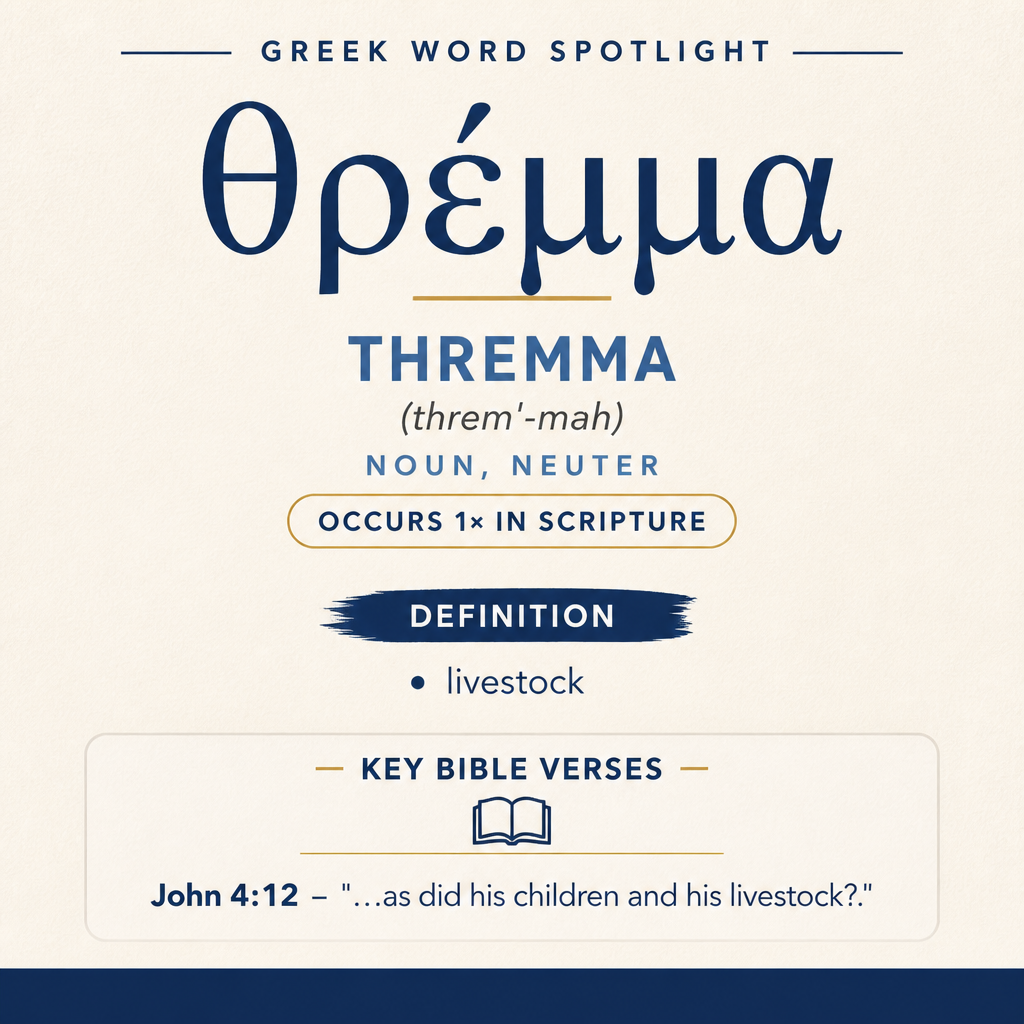
θρέμμα means “livestock” and appears once in Scripture, in John 4:12.
Verse Context
In John 4:12, it appears in a question about Jacob, his children, and his livestock.
Learn More →θρέμμα means “livestock” and appears in the Samaritan woman’s question to Jesus beside Jacob’s well. In that single setting, it helps frame the well’s significance by linking it to the everyday needs of a household and its animals.
Root and Related Words
θρέμμα derives from the verb trepho (τρέφω), “to feed” (Strong’s G5142). The connection between the two words places θρέμμα in the orbit of what is sustained and kept alive through feeding, which suits its use for animals kept by a family.

Occurrences
“Are you greater than our father, Jacob, who gave us the well and drank from it himself, as did his children and his livestock?” (John 4:12)
Here θρέμμα closes a small list: Jacob “drank from it himself,” and the well also served “his children and his livestock.” The Samaritan woman’s question leans on this list to underline how deeply the well is woven into the story she invokes. By naming livestock alongside Jacob and his children, θρέμμα pushes the scene beyond a private sip of water; it evokes a site that met the needs of an entire household economy, including the animals that would have required regular watering.
The placement is also rhetorically pointed. She is not merely recalling that Jacob once used the well; she describes a well worthy of ancestral memory because it sustained life broadly—family members and their animals. In this way, θρέμμα contributes to the implied scale of the well’s usefulness. If the well’s water reached even to the livestock, then the well is presented as a practical, enduring provision, not a minor convenience.
Within the question “Are you greater than our father, Jacob,” θρέμμα serves the comparison by amplifying what is at stake in “greater.” The well is framed as a gift with proven, multi-generational benefit: enough to support Jacob personally, his descendants (“his children”), and the animals bound up with their daily work and survival (“his livestock”). The word therefore anchors the memory of Jacob’s well in concrete, ordinary life at the very moment she challenges Jesus’ implied claims.
Sense and Usage
In John 4:12, “livestock” is not an abstract category but part of a carefully chosen trio that measures the worth of a water source. θρέμμα works as a reality-check term: wells are judged not only by the prestige of their origin but by the breadth of their service. The mention of livestock brings the scene down to the level of chores, thirst, and repeated trips for water—needs that persist regardless of social debate or religious dispute.
Because θρέμμα sits beside “children,” it also hints at the household as a single unit of dependency on water: the human members and the animals under their care. Livestock are dependent beings in the narrative logic of the verse; they do not find or draw water on their own. The term therefore suggests a pattern of provision: someone draws from the well for those who rely on them, including the animals. That implication fits the surrounding question’s appeal to Jacob as “our father,” a figure associated here with giving and sustaining through the well.
θρέμμα’s association with trepho (τρέφω), “to feed,” reinforces the sense that these animals belong to a sphere of ongoing care. In this verse, the animals are not wild creatures encountered incidentally; they are livestock—animals kept, sustained, and integrated into family life. The well’s water reaches into that sustained life, supplying what is needed for both people and the animals they maintain.
The word also sharpens the contrast between a remembered source of water and the challenge posed to Jesus. The Samaritan woman’s reasoning is: Jacob gave this well; Jacob used it; Jacob’s household used it; even the livestock benefited from it. By invoking livestock, she stresses proven adequacy. A well that meets animal needs has demonstrated capacity, because livestock require substantial and repeated watering. Thus θρέμμα quietly expands the weight of her question: surpassing Jacob would mean surpassing a provision that has served broadly and tangibly.
Imagery
The imagery tied to θρέμμα in John 4:12 is plain and earthy: a well that supplies water not only for drinking but for sustaining the animals bound to family life. The word brings the scene to the edge of daily labor—leading animals to water, drawing enough for them, and measuring the goodness of a well by how many dependents it can satisfy.
Sources: Lexical data from Strong’s Exhaustive Concordance and the Translators Brief Lexicon of Extended Strongs for Greek (STEPBible, CC BY). Occurrence data from the Translators Amalgamated Greek New Testament (STEPBible, CC BY). Scripture quotations from the World English Bible (public domain).