
Exploring the Meaning of Thera in Greek
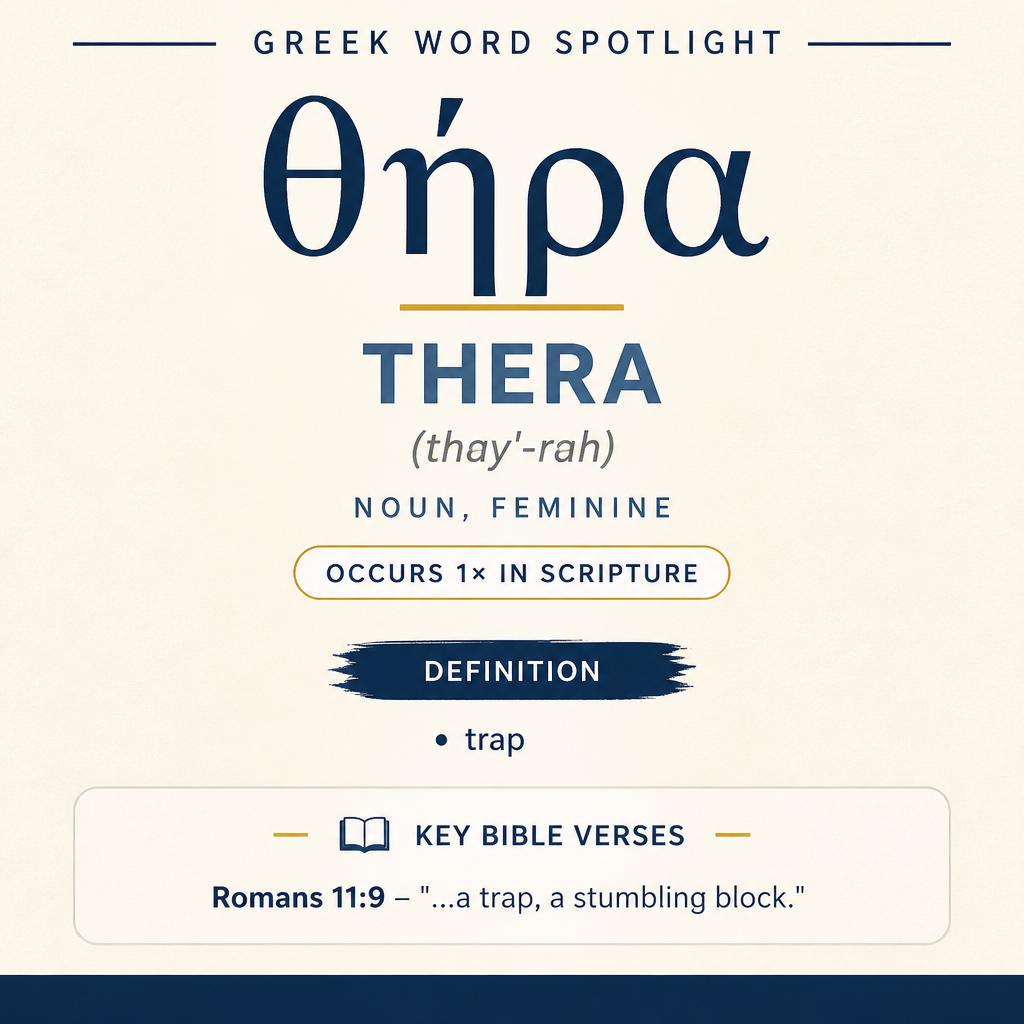
θήρα (Thera) means “trap” and appears once in Scripture, in Romans 11:9.
Scripture Occurrence
It occurs 1 time in Scripture. The occurrence is in Romans 11:9.
Learn More →Romans 11:9 Context
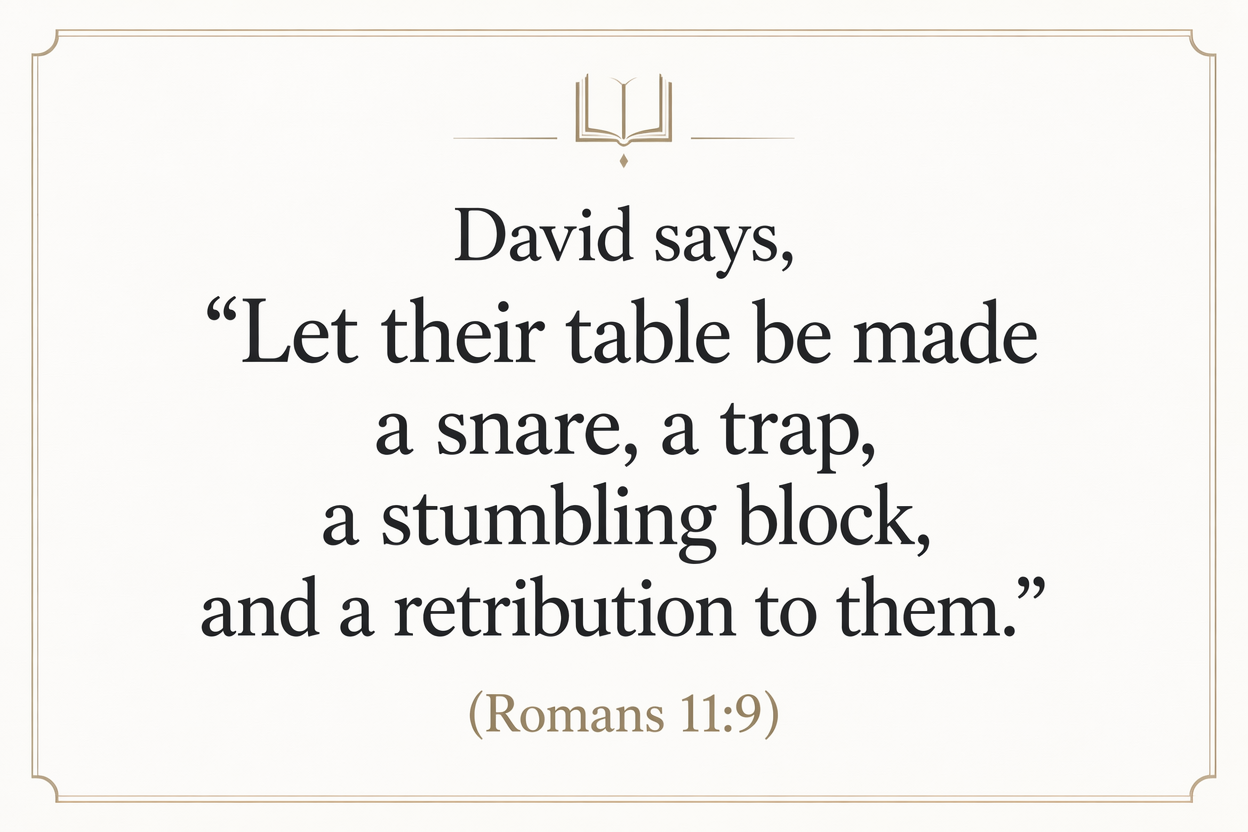
In Romans 11:9, David says, “Let their table be made a snare, a trap, a stumbling block, and a retribution to them.”
Learn More →θήρα refers to a “trap” and appears in the New Testament in a single citation from Paul’s argument in Romans, where David’s words are invoked to describe a sudden and fitting reversal. In that setting, the term belongs to a cluster of images that portray harm arising from what would normally be a place of safety and provision.
Occurrences
David says, “Let their table be made a snare, a trap, a stumbling block, and a retribution to them.” (Romans 11:9)
In Romans 11:9, θήρα stands in the middle of a series of four nouns: “a snare, a trap, a stumbling block, and a retribution.” The immediate picture begins with something familiar and ordinary—“their table”—and then asks that it be “made” into something dangerous. Within that chain of terms, “trap” contributes the idea of danger that is set, not merely encountered: a harmful outcome that lies ready to catch its victim. The verse does not isolate θήρα as a standalone metaphor; it places it alongside near images (“snare”) and alongside effects (“stumbling block”) and outcome (“retribution”). In that tightly packed list, “trap” intensifies the sense that what appears as a place of normal enjoyment can become a site of capture and harm.
The grammatical framing also matters for the force of the word: “Let their table be made…” is a petition-like formulation, and the nouns that follow (“snare…trap…stumbling block…retribution”) are the results desired. θήρα, therefore, is not describing a neutral tool or an abstract possibility. In this sentence it is one of the concrete shapes that judgment takes within the imagery: the table is transformed into something that catches and holds. The word’s presence reinforces the notion of an outcome that is not accidental; it is an arranged danger, fitting the closing phrase “to them,” which anchors the imagery in personal consequence.

Sense and Usage
As used in Romans 11:9, θήρα (“trap”) functions as a metaphor of capture and peril, but it remains grounded in an everyday object-world: tables, snares, stumbling, and repayment. The word carries its weight by suggesting an enclosed harm—something that takes hold of a person once they have stepped into its reach. The verse’s structure reinforces that sense: θήρα is not presented as the first warning sign (that role is already served by “snare”), and it is not the final consequence (that is “retribution”). Instead, “trap” sits between entanglement and downfall, depicting the moment when danger closes in and turns the ordinary course of life into a constraining disaster.
Because θήρα is paired with “snare,” its imagery works by accumulation rather than by fine distinction: the sentence stacks related terms so that the reader feels the comprehensiveness of the peril. A “snare” suggests being caught; a “trap” reinforces that capture with the sense of a set hazard that does its work decisively. That layered description is then broadened by “stumbling block,” which adds the picture of collapse and injury, and by “retribution,” which adds the idea of payback. In that progression, θήρα helps move the metaphor from merely being hindered to being overtaken—caught in a danger that holds fast.
The placement of θήρα after “their table” also shapes the way the term is felt. A table normally implies food, fellowship, and security; the request that such a setting become a trap presents judgment as reversal. The trap is not out in the wilderness or on a path one expects to be hazardous; it is at a place associated with ordinary life and benefit. Thus θήρα, in this usage, conveys not only danger but the shock of danger arising from the familiar. The image is potent precisely because it does not require an unusual scenario: the setting is the daily and the known, and the “trap” is the unexpected turn that transforms it.
Finally, θήρα contributes to the moral and rhetorical force of the line by portraying judgment in terms of fitting consequence. The final phrase, “and a retribution to them,” frames the whole series as a deserved outcome. In that framing, “trap” is not random misfortune; it is part of an ordered sequence of consequences. The table becomes a trap “to them”—the ones in view—so the word supports the verse’s emphasis that what ensnares and captures is aimed, personal, and effectual.
Imagery
Romans 11:9 binds θήρα to a vivid reversal: a table becomes a place of capture. The word, set among “snare” and “stumbling block,” paints judgment as a danger that closes around a person and turns support into hazard. The resulting picture is concrete and unsettling: the ordinary surface of life becomes the mechanism of being caught, and the trap is one link in a chain that ends in “retribution.”
Sources: Lexical data from Strong’s Exhaustive Concordance and the Translators Brief Lexicon of Extended Strongs for Greek (STEPBible, CC BY). Occurrence data from the Translators Amalgamated Greek New Testament (STEPBible, CC BY). Scripture quotations from the World English Bible (public domain).





