Exploring the Meaning of Therizo in Greek
θερίζω means “to reap” and occurs 21 times in Scripture, including Matthew 6:26; Matthew 25:24–26; Luke 12:24; Luke 19:21–22; John 4:36–37.
Core Meaning
θερίζω is defined as “to reap.” In the cited passages, it appears alongside sowing and gathering.
Learn More →Gospel Occurrences
It appears in Matthew 6:26 and Luke 12:24 in statements about birds that “don’t sow” and “don’t reap.” It also appears in Matthew 25:24–26 and Luke 19:21–22 in a servant’s words about “reaping where you didn’t sow.”
Learn More →John 4 Context
In John 4:36–37, “he who reaps” receives wages and gathers fruit to eternal life. The saying is stated: “One sows, and another reaps.”
Learn More →θερίζω expresses the act of reaping and appears in sayings and parables that draw on sowing-and-harvest imagery. In these passages it can describe literal farm work, a figure for receiving material return, and a picture of outcomes tied to prior actions.
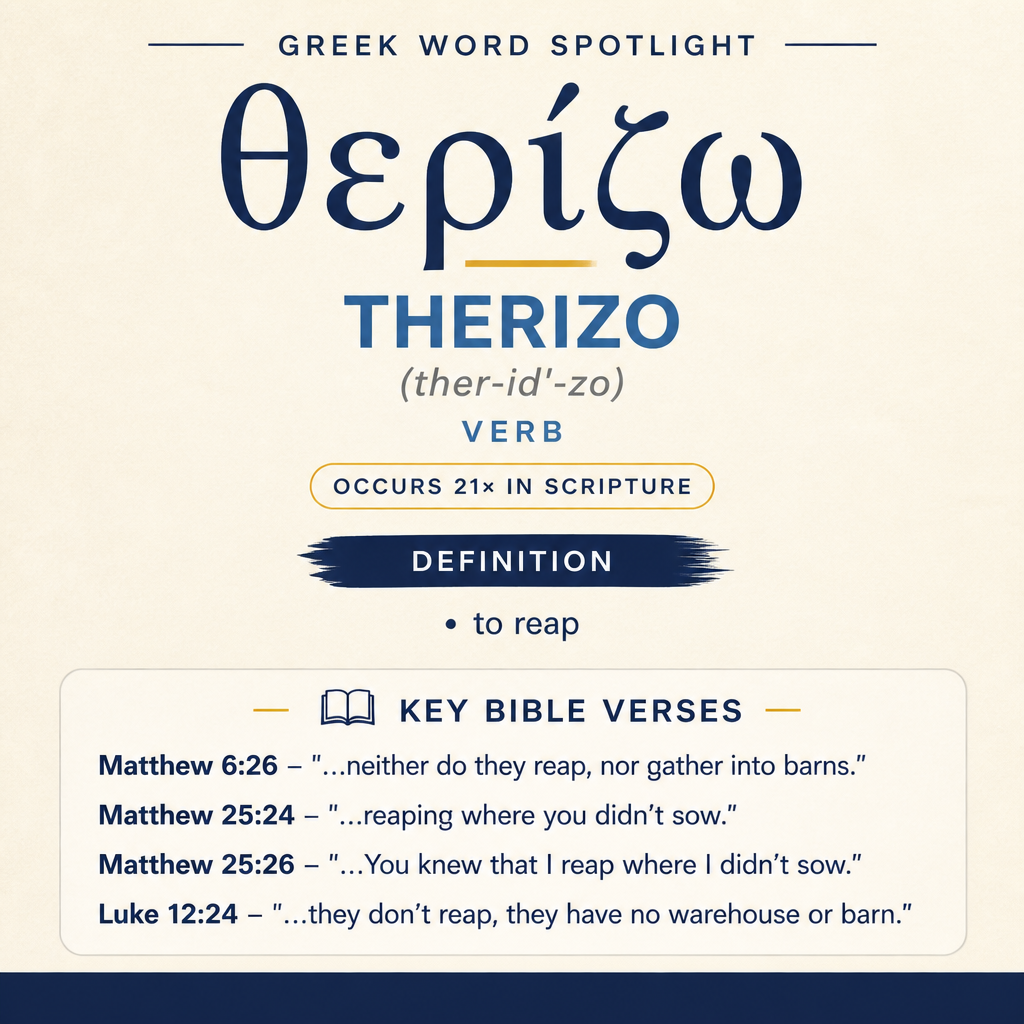
Occurrences
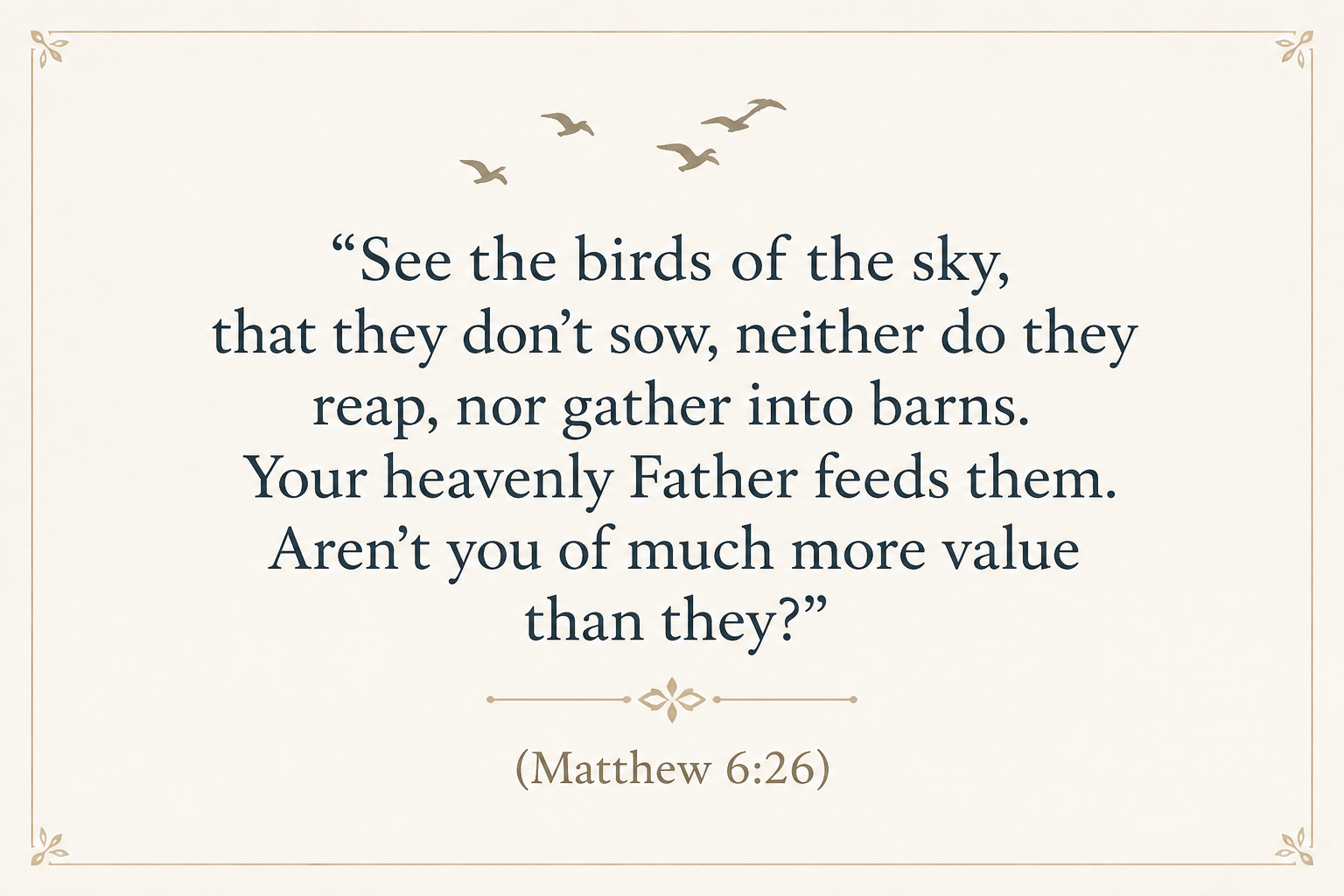
“See the birds of the sky, that they don’t sow, neither do they reap, nor gather into barns. Your heavenly Father feeds them. Aren’t you of much more value than they?” (Matthew 6:26)
Here “reap” is placed alongside “sow” and “gather into barns,” framing reaping as part of an ordinary agricultural cycle. The point depends on what reaping normally implies: a planned process of provision, storage, and food security. Birds are described as doing none of these, yet being fed, so reaping represents a kind of self-provisioning that humans often assume is necessary.
“He also who had received the one talent came and said, ‘Lord, I knew you that you are a hard man, reaping where you didn’t sow, and gathering where you didn’t scatter.” (Matthew 25:24)
“Reaping where you didn’t sow” uses reaping to depict receiving benefit from fields one did not plant. In the servant’s speech, the verb contributes to his characterization of the master as “a hard man,” pairing reaping with “gathering” to emphasize taking in gain without the preceding labor that sowing and scattering would represent.
“But his lord answered him, ‘You wicked and slothful servant. You knew that I reap where I didn’t sow, and gather where I didn’t scatter.” (Matthew 25:26)
The master repeats the servant’s description, again linking reaping to sowing and gathering to scattering. Within the rebuke, “I reap where I didn’t sow” functions as a premise the servant claimed to believe; reaping, as the harvest outcome, becomes part of the servant’s stated rationale for his fear and inaction.
“Consider the ravens: they don’t sow, they don’t reap, they have no warehouse or barn, and God feeds them. How much more valuable are you than birds!” (Luke 12:24)
This is closely parallel to Matthew’s birds illustration, but with “ravens” and with “warehouse or barn.” “Reap” is again coordinated with “sow,” and set beside the absence of storage infrastructure. The verb helps paint reaping as one of the normal means by which creatures might secure food; the saying contrasts that expectation with divine feeding.
“for I feared you, because you are an exacting man. You take up that which you didn’t lay down, and reap that which you didn’t sow.’” (Luke 19:21)
Reaping is used as an analogy for taking profit without prior investment: “reap that which you didn’t sow.” It is paired with “take up that which you didn’t lay down,” so the action of reaping is presented as a kind of collecting or claiming of results not personally initiated.
“He said to him, ‘Out of your own mouth I will judge you, you wicked servant! You knew that I am an exacting man, taking up that which I didn’t lay down, and reaping that which I didn’t sow.” (Luke 19:22)
The lord’s response repeats the servant’s wording. “Reaping” remains the harvest-side action contrasted with “sow,” and its rhetorical force lies in the mismatch: results are gathered where no planting occurred. In the judgment formula “Out of your own mouth I will judge you,” the verb stands inside the servant’s professed understanding of the master’s behavior.
“He who reaps receives wages and gathers fruit to eternal life; that both he who sows and he who reaps may rejoice together.” (John 4:36)
Reaping is explicitly connected to receiving “wages” and to “gathers fruit to eternal life.” The verse does not detach reaping from its agricultural frame (it still has “sows” and “fruit”), but it extends the scene so that the reaper’s work yields a reward and a harvest characterized as “fruit to eternal life.” The closing purpose clause sets sower and reaper side by side as distinct roles that can share a single joy.
“For in this the saying is true, ‘One sows, and another reaps.’” (John 4:37)
“Reaps” appears as the counterpart to “sows” in a compact proverb-like line. The verb contributes the idea that the harvest role may be performed by someone other than the one who did the planting, keeping the focus on division of labor rather than on the mechanics of farming.
“I sent you to reap that for which you haven’t labored. Others have labored, and you have entered into their labor.” (John 4:38)
Reaping is directly associated with enjoying the outcome of other people’s work: “to reap that for which you haven’t labored.” The verb, paired with “haven’t labored” and contrasted with “Others have labored,” frames reaping as the receiving end of a process whose difficult earlier stages may belong to others. “Entered into their labor” reinforces that reaping here is participation in an already-ongoing work rather than initiating it.
If we sowed to you spiritual things, is it a great thing if we reap your fleshly things? (1 Corinthians 9:11)
Reaping functions as the expected counterpart to sowing, with “spiritual things” cast as what has been sown and “fleshly things” as what might be reaped. The verb contributes the notion of a return that corresponds to prior giving; the rhetorical question depends on the normal logic that sowing precedes and warrants reaping, even when the categories are “spiritual” and “fleshly.”
Remember this: he who sows sparingly will also reap sparingly. He who sows bountifully will also reap bountifully. (2 Corinthians 9:6)
The verse uses reaping to express proportional outcome: the manner of sowing (“sparingly” or “bountifully”) is mirrored in the manner of reaping. θερίζω carries the harvest-side consequence, and its pairing with adverbs creates a simple scale: the size of what is gathered corresponds to the size of what was planted.
Don’t be deceived. God is not mocked, for whatever a man sows, that he will also reap. (Galatians 6:7)
Reaping is the inevitable counterpart to sowing: “whatever a man sows, that he will also reap.” The verb contributes the certainty of outcome, reinforced by the surrounding warnings (“Don’t be deceived. God is not mocked”). Reaping here is not described in quantity, as in 2 Corinthians, but in kind: what is gathered matches what was sown.

Sense and Usage
Across these passages θερίζω is consistently set in a field of closely associated actions—especially sowing, and often gathering and storing. The repeated collocation with “sow” (Matthew 6:26; Luke 12:24; John 4:36–37; 2 Corinthians 9:6; Galatians 6:7) anchors the verb in a sequence: sowing as the initiating act and reaping as the subsequent collecting of results.
In the sayings about birds and ravens, reaping belongs to the ordinary human strategy for securing food: sow, reap, gather, store. By denying these actions to the birds (“they don’t sow, neither do they reap, nor gather into barns,” Matthew 6:26; similarly Luke 12:24), the verb helps define what is being contrasted with God’s feeding. Reaping stands for a recognizable form of provision that implies planning and control over resources.
In the parabolic speeches (Matthew 25:24, 26; Luke 19:21, 22), reaping becomes a charged metaphor for taking in profit where one did not perform the initiating labor. The repeated phrase “reaping that/where you didn’t sow” keeps the act of reaping intact while shifting attention to its moral and relational implications inside the story: who is entitled to the harvest, and what kind of master is implied by harvesting without sowing. Because these lines also pair reaping with “gathering” and “taking up,” the verb participates in a cluster of verbs describing acquisition.
In John 4, reaping is still harvest work, yet it is framed in terms of reward (“receives wages”), purpose (“gathers fruit to eternal life”), and shared joy between distinct workers (“both he who sows and he who reaps may rejoice together,” John 4:36). The proverb “One sows, and another reaps” (John 4:37) and the mission statement “I sent you to reap that for which you haven’t labored” (John 4:38) emphasize that reaping can be undertaken by someone who stands downstream from earlier labor. The verb thus readily bears the idea of receiving the fruit of another’s work without changing its basic action.
In Paul’s agricultural analogies, θερίζω expresses return corresponding to investment. In 1 Corinthians 9:11, reaping “your fleshly things” is presented as a fitting counterpart to having “sowed to you spiritual things,” letting the harvest image speak about reciprocity between different kinds of benefit. In 2 Corinthians 9:6, reaping is scaled to the manner of sowing, making the harvest image a vehicle for proportionality. In Galatians 6:7, reaping is presented as the matching outcome to sowing—what is sown determines what is reaped—set within a warning that underscores the reliability of this connection.
Imagery
The passages consistently use the field-and-harvest cycle to make outcomes visible: some reap without sowing (as a disputed portrait of an “exacting” or “hard” man), some reap because others labored before them, and some reap in direct proportion to how they sowed. Even where barns, warehouses, wages, and fruit enter the picture, reaping remains the concrete act that marks the moment when earlier work—one’s own or another’s—becomes gathered result.
Sources: Lexical data from Strong’s Exhaustive Concordance and the Translators Brief Lexicon of Extended Strongs for Greek (STEPBible, CC BY). Occurrence data from the Translators Amalgamated Greek New Testament (STEPBible, CC BY). Scripture quotations from the World English Bible (public domain).