Exploring the Meaning of Therapeia in Greek
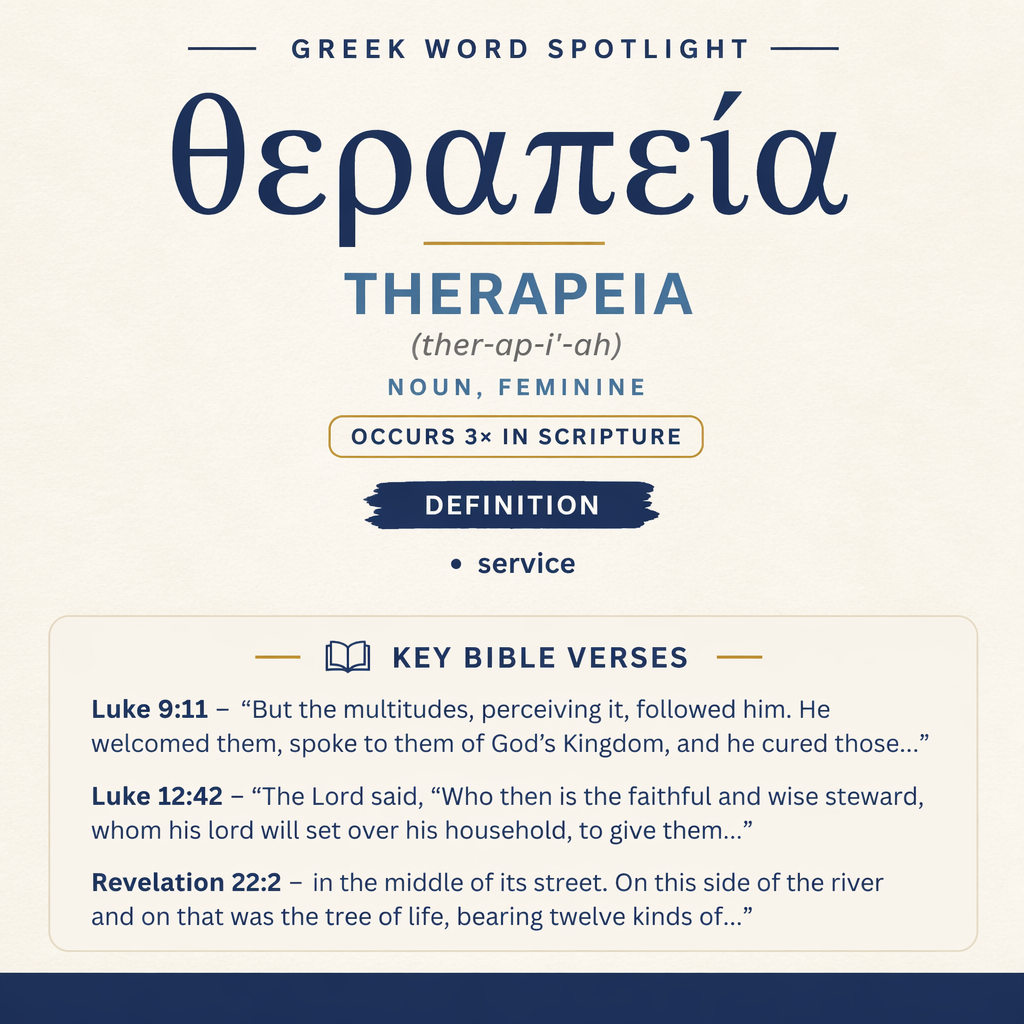
θεραπεία (Therapeia) means “service” and appears three times in Scripture: Luke 9:11; Luke 12:42; Revelation 22:2.
Scripture Occurrences
This word occurs 3 times in Scripture: Luke 9:11; Luke 12:42; Revelation 22:2.
Learn More →Context Snapshots
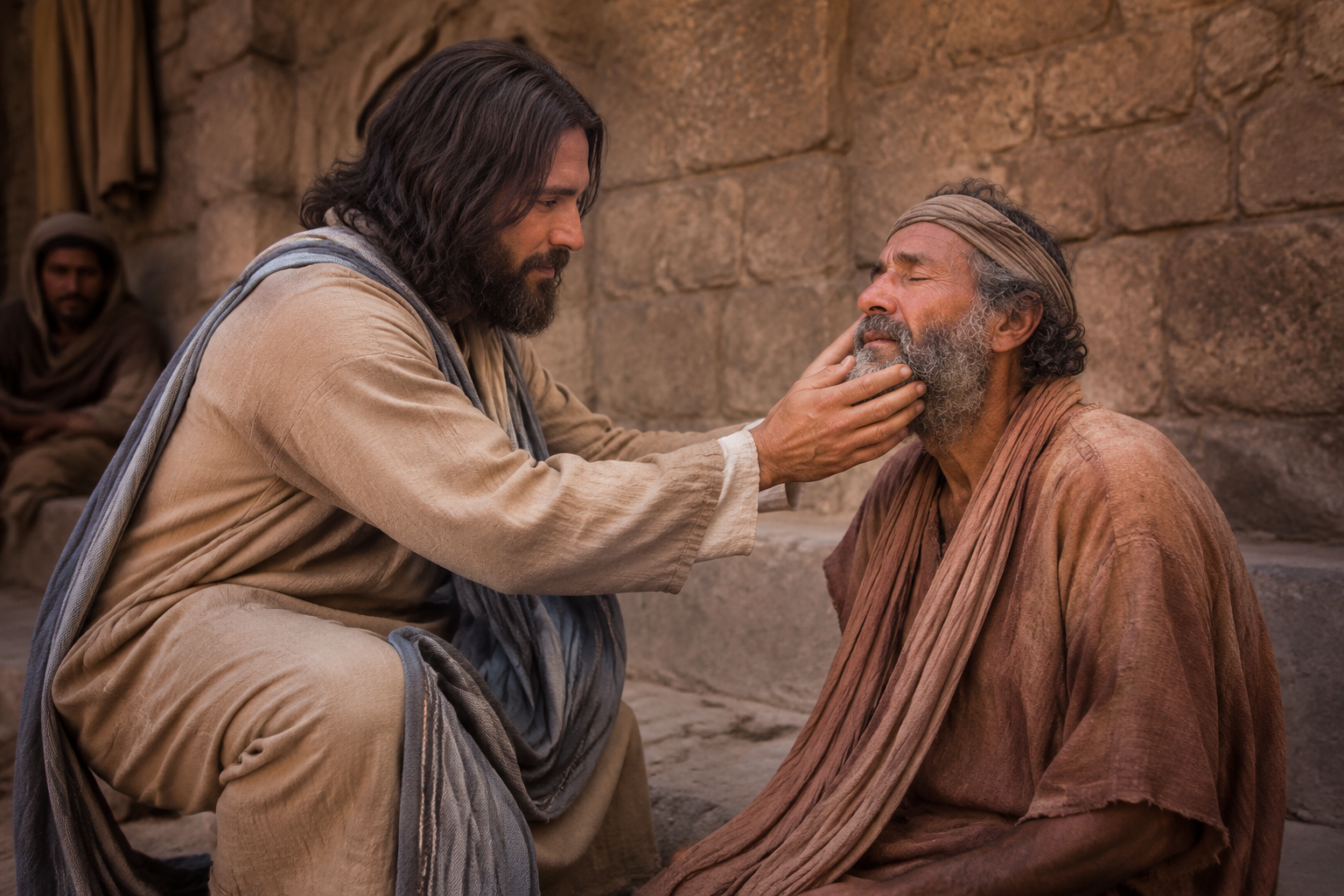
In Luke 9:11, it appears in a scene where Jesus welcomes the crowds, speaks of God’s Kingdom, and cures the needy. It also appears in Luke 12:42 and Revelation 22:2.
Learn More →θεραπεία denotes “service” and appears in scenes of Jesus’ ministry, a household steward’s appointed task, and the river-and-tree imagery of the New Jerusalem. In these three passages the term is carried by narrative action and by vivid end-time description, giving “service” a wide canvas of concrete expression.
Root and Related Words
Therapeia is related to the verb therapeuō (θεραπεύω), “to serve/heal” (Strong’s G2323). This relationship links the noun to contexts where serving is enacted in practical care, whether in personal attention to need or in ordered responsibility within a household.
Occurrences
“But the multitudes, perceiving it, followed him. He welcomed them, spoke to them of God’s Kingdom, and he cured those who needed healing.” (Luke 9:11)
In this scene the crowd presses in on Jesus: they “followed him,” and he responds with a threefold pattern—welcome, teaching, and restorative action. Therapeia contributes the idea of “service” as something rendered to people in need, set alongside speech about “God’s Kingdom.” The verse frames Jesus’ response as attentive and active: he “welcomed them” (personal reception), “spoke to them” (instruction), and “cured those who needed healing” (direct care for those whose condition called for it). Within that sequence, the term belongs to the concrete end of his ministry: service that meets an immediate human necessity. The wording “those who needed” also places the action within discernment of need rather than display; the service is directed to a specific class within the multitude, namely the ones requiring help.
The verse also positions this service within a public setting (“the multitudes”), so the noun’s force is not private or hidden. It belongs to the open, communal aspect of Jesus’ work: people perceive, follow, receive welcome, and some receive the practical benefit that answers their need. In Luke’s tightly packed sentence, therapeia stands as one feature of the Kingdom message in action—service that accompanies proclamation.
“The Lord said, “Who then is the faithful and wise steward, whom his lord will set over his household, to give them their portion of food at the right times?” (Luke 12:42)
Here therapeia sits within a question about delegated responsibility. The Lord’s focus is not on crowds coming for help but on a “steward” appointed “over his household.” Service is expressed as entrusted administration: the steward’s task is “to give them their portion of food at the right times.” The verse highlights character (“faithful and wise”) and the concrete form that such character takes: steady provision, correctly timed. Therapeia thus fits the realm of ordered, ongoing obligation rather than a single act of assistance. The steward serves by managing resources, meeting needs, and doing so with regularity and appropriateness (“at the right times”).
The language of placement—“whom his lord will set over his household”—shows that this service is authorized and assigned. It is not self-chosen leadership but a role under a “lord,” with a defined sphere (“his household”) and defined beneficiaries (“them”). In this verse, therapeia colors service as something accountable and structured: a pattern of provision carried out within a chain of authority.
“in the middle of its street. On this side of the river and on that was the tree of life, bearing twelve kinds of fruits, yielding its fruit every month. The leaves of the tree were for the healing of the nations.” (Revelation 22:2)
In Revelation’s closing vision, therapeia appears within an environment of abundance and regularity. The description places the tree of life by a river and emphasizes fruitfulness: it bears “twelve kinds of fruits,” and it yields “its fruit every month.” Within that setting, “The leaves of the tree were for the healing of the nations.” Therapeia, understood as “service,” is carried by the leaves’ function toward “the nations.” The verse does not describe a personal attendant or a steward distributing food; instead, service is embedded in the created provision of the city itself. The leaves serve the nations by being “for” their benefit. The image presents service as a sustained, accessible resource—like the monthly yield of fruit, the leaves are part of the environment’s continual giving.
The phrase “in the middle of its street” and the river’s placement (“On this side of the river and on that”) creates a sense of public availability. The service rendered by the leaves is not tucked away; it belongs to the city’s central thoroughfare. In this passage, therapeia resonates with the idea of communal good extending beyond one household to “the nations,” widening the scope of service to an international horizon in a renewed setting.
Sense and Usage
Across these passages, therapeia as “service” expresses itself through different kinds of giving. In Luke 9:11, service is personal attention to those who “needed” help, paired with welcome and instruction. The verse’s triad shows service operating alongside speech: it is one mode of response within a larger ministry, tangible and directed toward specific need within a large group. The narrative makes service visible as action done for others rather than merely an attitude.
In Luke 12:42, the term’s sphere shifts from public ministry to household management. Service is not only responsive; it is scheduled and sustained—food portions given “at the right times.” The steward’s work embodies service through responsible distribution. This is service as duty under appointment, measured by faithfulness and practical wisdom. The verse frames service as provision that must be dependable, because it supports the household’s life rhythms.
In Revelation 22:2, service is portrayed as the beneficent function of what is supplied in the city’s life: leaves “for the healing of the nations.” Without changing the basic sense, the passage relocates service from an agent’s acts (Jesus curing; a steward giving food) to a created medium that carries benefit outward. The nations are the recipients, and the leaves are the means by which the service is rendered. The steady cadence of “yielding its fruit every month” reinforces that this service is not sporadic; it is continuous and reliable.
Taken together, these three contexts give therapeia a consistent direction: it is service rendered to others. Yet the recipients broaden—from individuals within the multitude, to members of a household, to the nations—and the forms of service range from immediate care, to regulated provision, to abundant communal benefit. The word’s usage in these verses keeps “service” concrete: welcome expressed in action, food given in due season, and leaves provided for the nations’ good.
Imagery
The imagery tied to therapeia moves from touchable human need to enduring civic abundance. Luke presents service in the press of a crowd and in the daily structure of a household meal, scenes where need and timing shape what is done. Revelation presents service as part of a city’s landscape: a street, a river, and a tree whose leaves exist “for the healing of the nations.” In each passage, therapeia is associated with giving that meets need—whether by curing, by feeding, or by providing what benefits peoples on a wide scale.
Sources: Lexical data from Strong’s Exhaustive Concordance and the Translators Brief Lexicon of Extended Strongs for Greek (STEPBible, CC BY). Occurrence data from the Translators Amalgamated Greek New Testament (STEPBible, CC BY). Scripture quotations from the World English Bible (public domain).